
Introduction to BMW Group governance for AI agents
BMW Group governance for AI agents puts oversight into the architecture, deployment pipeline and individual workflow steps. Teams retain room to choose frameworks and build capabilities, while shared controls govern permissions, quality and production approval. The central idea is that autonomy should depend on the risk of each action and the evidence supporting it.
The scale explains the emphasis. According to the AWS account of BMW Group’s approach, BMW Group’s research and development organization has more than 12,500 developers working on approximately 500 million lines of vehicle software code. Its BMW Connected Vehicle backend comprises more than 1,300 microservices providing digital services for 24 million vehicles. The article describes hundreds of agents and globally distributed teams, making coordination an enterprise concern.
Those figures establish the setting; they do not demonstrate the effectiveness of the governance model. The supplied account describes practices and architectural patterns drawn from experience operating agentic systems since 2023. It does not provide comparative measurements showing how much these controls improve development speed, reduce incidents or lower costs. Its value is the specificity of the operating model, with results remaining a separate question.
At the technical center is the agent harness: a runtime layer around a large language model that supplies the execution loop, tool dispatch, memory management and observability hooks. BMW’s stated premise is to make agents cooperate from the outset without requiring every team to adopt a single framework or toolchain. Shared governance therefore needs enforcement points that sit beyond an individual agent’s implementation.
Read as an organizational design, the model connects three decisions: what a team can build, what an agent may do and what must be demonstrated before deployment. Its significance lies in connecting those decisions through reusable infrastructure. Governance becomes something teams encounter while defining, testing and registering an agent, with continuing evaluation supplying evidence for later changes.
The need for governance in AI development

The AWS account identifies a tension between locally driven experimentation and enterprise requirements for safety, security, composability and cost efficiency. Independent teams need freedom to solve their own problems, but the source warns that uncoordinated development can produce isolated capabilities and duplicate work. Governance is meant to give that distributed activity a shared structure.
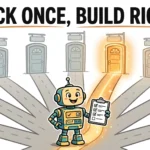
BMW’s described approach starts before orchestration code is written. Teams should establish five artifacts: a clear scope, an interaction model, precise tool definitions, a ground-truth evaluation dataset and explicit evaluation criteria. Together, these describe the agent’s intended responsibilities, how it will be invoked, which capabilities it can use and how its outputs will be judged.
That sequence matters analytically because it makes approval assessable. A scope statement provides a reference for identifying an agent operating beyond its purpose. Tool definitions provide a basis for reviewing whether a capability is being used as intended. Evaluation criteria make quality requirements explicit before implementation choices become entrenched. These are connections implied by the described controls, rather than measured outcomes supplied by the source.
The account also distinguishes successful execution from a faithful, policy-compliant result. A service response alone cannot establish the latter. BMW’s proposed observability approach captures execution trajectories, including tool invocations and context retrievals, using OpenTelemetry spans to connect a user request to the final output. The evaluation dataset covers common queries and edge cases, and instrumentation is required before evaluation runs.
Verification and evaluation then serve different purposes. Automated regression tests first check components and their interactions. Only a passing build proceeds to evaluation of non-deterministic outputs against the reference dataset and quality thresholds. Prompt edits, tool additions and model changes trigger this pipeline. Where agents route between models, the account recommends recording the routing decision and its justification, with poor outcomes becoming new evaluation cases.
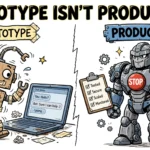
The resulting governance requirement extends beyond initial approval. An agent’s instructions, tools and model can change, and the source describes production usage diverging from design assumptions. Continuous evidence is therefore part of the model’s logic: initial validation establishes a starting point, while subsequent changes and observed failures must feed back into testing and evaluation.
Balancing innovation with compliance

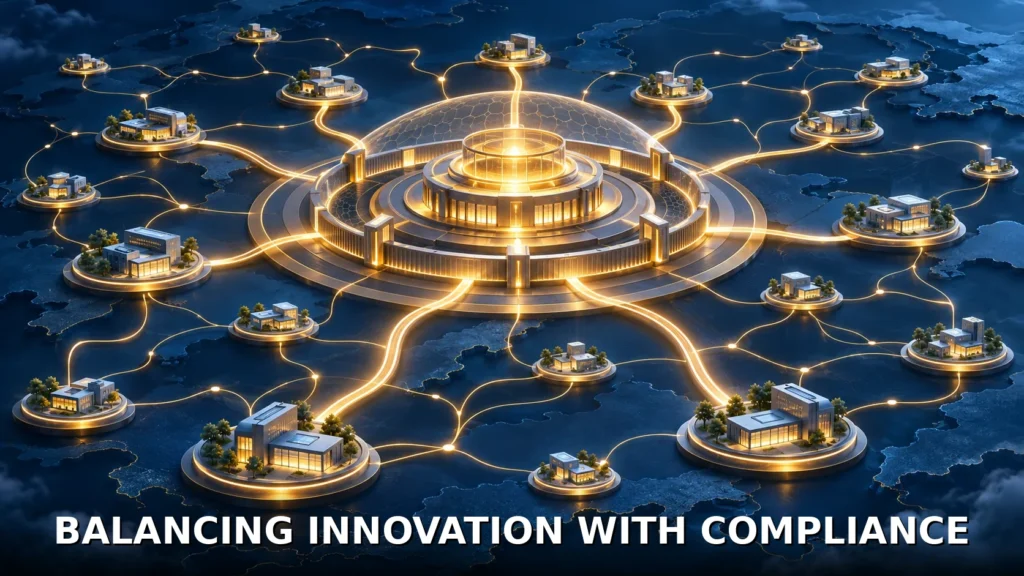
BMW’s described balance combines development by individual teams with centrally curated controls. Teams build skills and Model Context Protocol, or MCP, tools for immediate needs and share those assets through a registry. A central team supplies automated governance checks and reusable governance-as-code modules. The intended benefit is to make common standards repeatable while allowing teams to contribute their own implementations.
A key architectural choice is to externalize governance. Authentication, authorization, rate limiting and content filtering are enforced at integration points, including an MCP gateway, the central registry and an orchestration boundary. The source argues that placing these rules outside individual codebases lets them persist through framework migrations, model changes and team reorganizations. That is a design rationale, not evidence that every migration preserves controls automatically.
Enforcement is also separated from the agent’s reasoning. Permission checks, policy-as-code rules and compliance validations operate as deterministic code, mainly in the continuous integration and delivery pipeline. The account describes these as deployment gates that neither the agent nor its prompts can override. Egress controls, including recipient allowlisting and outbound secret scanning, address the risk of confidential information leaving through an otherwise legitimate call.
The deployment pipeline illustrates how these principles become operational requirements. Its first described phase checks approved supply chain registries, component and interaction tests, evaluation library references and observability instrumentation. The next phase combines static analysis with security testing in an isolated staging environment. It also validates egress controls, least-privilege permissions, policy compliance and whether declared autonomy matches actual permissions.
A governance agent can assist audits by identifying possible scope creep, excessive instruction complexity, tool misuse and performance deterioration. The account says its findings go to human review. This preserves a distinction between automated assistance with inspection and the deterministic controls that gate deployment: the governance agent’s judgment is not presented as a substitute for those controls.
Infrastructure as code supplies the repeatability behind the model. The source names Terraform and AWS CloudFormation for provisioning infrastructure, alongside policy mechanisms such as AWS Config and Open Policy Agent. It describes fine-grained roles, validated deployments and policy checks as gates before registration. The architectural implication is that shared compliance requirements can travel with reusable deployment patterns. The package provides no quantified evidence of the maintenance effort those patterns require or the development time they save.
Graduated trust model for AI agents
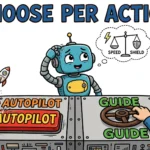
BMW’s graduated trust model assigns autonomy to individual workflow steps. An agent does not receive one blanket trust designation covering everything it might do. The account distinguishes drafting documentation, changing customer records and writing to production databases as activities that warrant different oversight, then defines three levels.
| Level | Human involvement and enforcement | Stated use |
|---|---|---|
| Level 0: Human-in-the-loop | Every action requires explicit human approval. | Starting point for new agents and high-risk operations. |
| Level 1: Human-on-the-loop | The agent executes autonomously and surfaces decisions for asynchronous human review. | Medium-risk tasks with defined inputs, outputs and rollback options. |
| Level 2: Autonomous within guardrails | The agent operates independently inside strictly defined policy boundaries enforced deterministically. | Low-risk, well-understood operations with verified track records. |
A single workflow can include steps at all three levels. This permits a narrower decision about autonomy: a team can assess whether a particular action is ready for greater independence without extending that permission to every action in the workflow. The source says increases in autonomy should rest on measurable evaluation data as confidence builds.
The differences between the levels are operationally consequential. At Level 0, approval precedes each action. At Level 1, execution can proceed before a person reviews the decision, making defined inputs, outputs and rollback options part of the stated suitability conditions. At Level 2, independence remains bounded by explicit policies. Prompt instructions alone do not constitute the described guardrails.
The pipeline check comparing declared autonomy with actual permissions connects this classification to implementation. A label communicates intended oversight, while permissions determine available actions. Reviewing both is therefore necessary to assess whether the deployed configuration corresponds to the declared level. Least-privilege roles scoped to agents or tools provide another control over that configuration.
There are limits to what can be concluded from the published model. The supplied material does not specify numerical thresholds for moving a step between levels, how long a verified track record must be or a universal formula for assigning risk. It consequently supports an explanation of the decision structure, rather than a ready-made approval standard for every organization. The substantive principle is to grant autonomy at the level of the action, with evaluation evidence and enforceable permissions supporting the decision.
Centralized registry for agent management
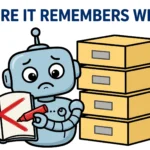
The centralized registry gives distributed development a common inventory of agents, tools and skills. In the AWS account, it has four roles: discovery, governance approval, security review and duplicate detection. Build-time metadata makes capabilities discoverable, while production approval and an audit trail establish a record of their governance status.
Security checks occur before approval, including checks for prompt injection and similar issues. Duplicate detection also runs automatically at registration, flagging equivalent capabilities already maintained by other teams. The source describes these as checkpoints and safeguards; it does not report detection accuracy, false-positive rates or measured reductions in duplicate development. The defensible claim is that these checks are built into the described process.
The registry matters because BMW’s architecture favors specialized, composable capabilities. Its three-tier hierarchy begins with MCP tools, each wrapping a single capability such as an API call or database query without embedding workflow assumptions. Skills combine tools into domain-specific capabilities. Flows orchestrate skills into complete business processes. The source’s examples include a code review skill and an end-to-end review pipeline; they illustrate the hierarchy rather than establish particular production deployments.
Each tier is validated independently, with component tests for tools and skills and interaction tests for their composition into flows. The account identifies MCP and Agent Skills for tool integration, A2A for communication between agents and OpenTelemetry for observability. Discovery and common interfaces address related but distinct needs: teams must locate an existing capability before they can assess how to compose it into a workflow.
Specialization supplies another reason for a shared registry. When usage patterns change or an agent becomes too complex, the account recommends separating responsibilities into more focused agents and skills. It argues that narrower roles can support independent updates and scaling, smaller model choices and least-privilege access. These remain architectural benefits advanced by the source, without quantified savings or reliability results in the supplied evidence.
Central curation thus complements local ownership. Teams can build capabilities close to their problems, while the registry gives the enterprise a place to inspect, approve, discover and reuse them. Its role extends beyond cataloging: it connects the composable architecture to the governance process. The unresolved test is how effectively that arrangement works in operation. The supplied account makes the controls and responsibilities concrete, but leaves their measured impact on quality, speed and cost unestablished.