


Output format is unaligned.
When Anthropic began trading on the Nasdaq on Thursday 19 November 2026, the numbers arrived all at once: the largest initial public offering on record, a valuation above $1.5 trillion, and seven founders suddenly worth billions each on paper. The questions about the anthropic founders net worth that followed were harder than the headlines made them look, because the answer changed with the share price. At the $83 offering price each founder’s stake was worth about $20 billion. At the opening price it was worth considerably more, and at the close it was worth something in between. This article sets out who the seven founders are, how the offering created that wealth, how much cash they actually took out, and what they have promised to give away.
A record IPO made seven founders multibillionaires
Anthropic priced its offering on Wednesday 18 November 2026 at $83 per share and sold 980 million Class A shares under the ticker ANT. The offering raised $81.3 billion, which multiple reports described as the largest IPO ever, surpassing the record set by SpaceX’s listing in June 2026. At the offering price, Anthropic carried a fully diluted valuation of about $1.5 trillion.
Trading told a more volatile story. Shares opened on Thursday at $111.50, more than 30 percent above the offering price, briefly pushing the company’s fully diluted valuation past $2 trillion. They reached an intraday high of $115.10 and fell as low as $92.72 before closing at $97.17, up 17 percent on the offering price. At the close, Anthropic’s fully diluted valuation was about $1.75 trillion, with some reports putting it at $1.77 trillion. That spread is a reminder that there is no single valuation for the day: the figure depends on the price and the share-count basis used, and the price moved during the session.
The same applies to the founders’ wealth. The $20 billion figure widely reported on the day of pricing, the $23 billion to $24 billion figure reported at the close, and the $24.5 billion figure from the Bloomberg Billionaires Index at a midday price on 20 November 2026 are not contradictory. They are the same stakes measured at different prices. Any account that gives one number without its price and date is incomplete.
Who the seven founders are
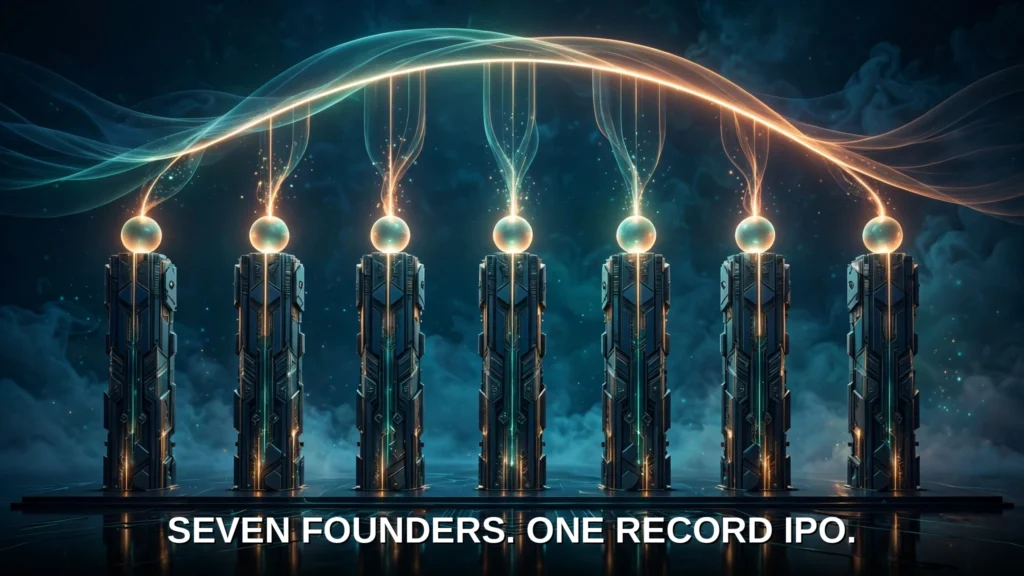
Anthropic’s seven co-founders are Dario Amodei, Daniela Amodei, Tom Brown, Jack Clark, Jared Kaplan, Sam McCandlish and Christopher Olah. All seven still hold senior roles at the company, and all seven were former OpenAI staff. Their ownership is unusually even: each holds roughly 240 million Class A shares, about 1.3 to 1.4 percent of the company on a fully diluted basis, with filing summaries differing slightly on the exact percentage and on whether the figure is an economic stake or a share of the vote. The even split is part of why the wealth figures are so similar for all seven, with only small differences between individuals at any given price.
Dario Amodei, 43, is Anthropic’s chief executive. He led development of GPT-2 and GPT-3 at OpenAI. Daniela Amodei is Anthropic’s president and chair of its board.
Tom Brown is Chief Compute Officer. Jack Clark is Head of Public Benefit and leads the Anthropic Institute.
Jared Kaplan is Chief Science Officer. Sam McCandlish is Chief Architect. Christopher Olah leads research into interpretability: understanding what happens inside AI models as they process information and generate responses.
The anthropic founders net worth at three share prices

The mechanism behind the wealth is simple: a roughly equal stake multiplied by a fast-moving share price. At the $83 offering price, Reuters estimates reported in coverage put each founder’s stake at between about $19.76 billion for Daniela Amodei and about $20.07 billion for Dario Amodei, with the other five founders in between, for a combined total of about $139 billion to $140 billion. Those are paper values. They describe what the stakes were worth at that price, not money the founders had received.
At the opening price of $111.50, the same stakes were worth roughly a third more. At the closing price of $97.17, reporting put each founder’s holding at roughly $23 billion to $24 billion. The Bloomberg Billionaires Index later estimated about $24.5 billion each at a midday price on 20 November 2026, or about $171 billion combined; the reporting used for this article does not give the exact share price behind that estimate. The article’s advice to readers is to treat every wealth figure as a pair: a dollar amount and the share price and date it was measured at. Without the second half, the first half cannot be compared with any other figure.
It is also worth stating what the stake values are not. They are not cash in hand, they are not the founders’ total wealth from all sources, and they do not account for taxes, fees, or any restrictions on selling shares. A founder whose stake is valued at $20 billion at one price and $24 billion at another has not necessarily gained $4 billion in any sense that can be spent. The value will keep moving with Anthropic’s share price, in both directions.
What the founders actually cashed out
The cash the founders actually realised in the offering was far smaller than the paper wealth, and it was fixed before trading began. Each of the seven sold about 3.4 million shares in the IPO, for about $280 million each before underwriting fees and taxes, or about $1.95 billion in total. One filing summary puts the precise figure at 3.38 million shares each. Because the shares were sold at the $83 offering price, the founders did not benefit from the opening-day rise on the shares they sold: the same shares were worth more within hours of trading, at the market’s valuation rather than the offering price.
Dario and Daniela Amodei had also taken part in earlier tender offers, according to the IPO filings. The bulk of each founder’s stake remains unsold and therefore remains exposed to the share price and to whatever selling restrictions apply, which the sources used for this article do not fully settle.
The distinction matters for how the story is read. The IPO made the founders multibillionaires in the sense that their remaining stakes carry very large paper values. Each of them received roughly $280 million in gross cash proceeds before fees and taxes from the shares sold in the offering. Both statements are true. Only the second describes money received.
The 80% philanthropy pledge
Alongside the offering, Anthropic disclosed that each founder has pledged to dedicate 80 percent of personal Anthropic equity to philanthropy. The New York Times reported the pledge as a commitment to give away 80 percent of their stakes during their lives. The precise scope of the pledge, and what counts as philanthropy under it, is a matter for the filings and for any later disclosure by the founders, and this article does not go beyond what the filings and reporting state.
What the filings do state, as quoted by TechCrunch, is the legal character of the commitment:
“voluntary, revocable expressions of each co-founder’s philanthropic intent and do not constitute legally binding obligations.”
In other words, the pledge is a stated intention, not a contract. TechCrunch also reported that the founders can scale back their charitable commitments if they struggle to live on the remaining share of their wealth. Readers should therefore treat the 80 percent figure as a promise about future giving, revocable by the person who made it, rather than as money already given away or held in trust. Whether and how the pledges are acted on is an open question that only future filings and disclosures can answer.
From an OpenAI exit to a $1.5 trillion company
Anthropic was founded in January 2021 by the seven former OpenAI employees. The reported reason for the departure was disagreement over how AI should be built, with concerns about AI safety at the centre.
The company behind the Claude chatbot grew from that start to a public company valued at about $1.5 trillion at its offering price in about five years. The scale of the business behind the valuation is also the scale of its costs. TechCrunch, reporting the filings, put Anthropic’s compute and infrastructure spending commitments at $451.6 billion due before the end of 2030, and $1.05 trillion to $1.08 trillion in total infrastructure commitments. A $1.5 trillion valuation and a trillion dollars of future commitments belong in the same picture: this is a company whose value rests on very large, continuing spending.
The offering itself also reshaped Anthropic’s ownership beyond the founders. In addition to the Class A shares sold in the IPO, Anthropic sold $26 billion of a special non-voting Class N stock to large technology companies: Nvidia bought $10 billion, Google bought $10 billion, and AMD, Broadcom, Micron, Microsoft and TSMC divided the rest. TechCrunch reported that Anthropic raised $104.8 billion for its own coffers in total, with a possible $117 billion if bankers take up their full allotment of shares. Google ended up owning 13.4 percent of the company and Amazon 14.6 percent, or 28 percent combined, through earlier investments and conversions connected to the IPO. Those stakes carry economics without the voting control the founders retain, as the next section explains.
What the wealth does not mean yet
The founders’ wealth comes with an unusual governance structure that separates economic ownership from control. A single Class F share, held by an entity called Founder LLC, carries a fixed 50.1 percent of the company’s general voting power and no economic rights. The Founder LLC arrangement survives as long as the seven founders together retain at least 2 percent of the shares they held at listing, according to filing summaries.
That structure means the founders’ control does not depend on holding a majority of the company’s economics. Each founder holds only about 1.3 to 1.4 percent of the economics, yet together, through one share, they hold a voting majority. Public shareholders, including the large technology companies that bought Class N stock with no voting rights, cannot outvote that bloc on matters put to shareholders generally.
Three limits should stay with the reader. First, the wealth is paper wealth until shares are sold, and it will rise and fall with a share price that moved from $111.50 to $97.17 in a single session. Second, the philanthropy pledge is voluntary and revocable, so the $20 billion-plus figures are not figures for charitable giving already made. Third, several details that would complete the picture — the exact stake percentage on a single consistent basis, the selling restrictions on the remaining stakes, and the final total raised once any underwriters’ option is settled — vary between filing summaries and later reports, and this article has given ranges where the sources differ rather than choosing one figure and presenting it as settled. The founders are multibillionaires on any of the measures used here. How much that is worth, in cash, and what it is used for, are questions the next filings will have to answer.