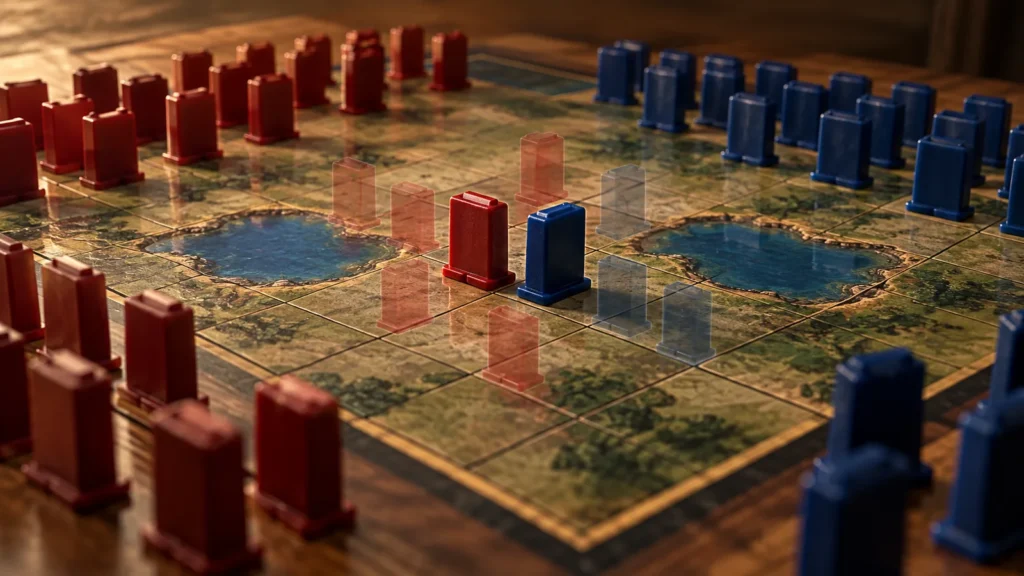



Ataraxos, an AI developed by researchers at MIT, Carnegie Mellon University, New York University and Stanford University, defeated Stratego champion Pim Niemeijer in a 20-game series with 15 wins, one loss and four draws. The researchers report that the system cost a few thousand dollars to train. Their study, published in Nature on September 30, 2026, presents a method for combining learned strategies with planning when crucial information remains hidden.
The technical contribution extends beyond the match result. Ataraxos brings together self-play reinforcement learning, a network that models hidden information, and search performed when a decision is needed. The same techniques produced superhuman results in Barrage Stratego and state-of-the-art results in Hanabi and dou dizhu, spanning adversarial, cooperative and team games. Nature study
Why hidden pieces change the planning problem
Classic Stratego gives each player 40 pieces whose identities are concealed from the opponent until encounters reveal them. Players must choose moves while reasoning about both the visible position and what the opposing pieces could be. An apparently promising move can have different consequences depending on information the other player possesses.
That creates a problem for search: the visible board does not specify one complete game state. It is compatible with many underlying arrangements. Evaluating future moves therefore requires a way to reason about those alternatives, rather than treating one guessed arrangement as certain. MIT News reports that possible piece configurations exceed 10 to the 66th power, illustrating the scale of the uncertainty. MIT News
For developers, the useful distinction is between choosing an action from known facts and choosing an action under beliefs about missing facts. Ataraxos explicitly incorporates the latter into its architecture. Its belief model supplies estimates of hidden information, while its decision procedure evaluates choices with that uncertainty in view.
Three components connect training to decisions
The paper describes a design pattern with three components. A policy–value network learns through self-play to propose decisions and predict game outcomes. A belief network, trained on self-play data, models hidden information. A search procedure then refines the policy at test time. Nature study
These components serve different purposes. The policy provides a learned starting strategy, and the value predictions help assess prospects. The belief network represents the uncertainty that the policy must operate under. Search adds computation at the point of action, allowing the system to reconsider its choices for the position it actually faces.
MIT’s account describes the belief component as a generative model that estimates the likely identities of opposing pieces using probabilities. The system then evaluates future choices before selecting its next move. That connection is central: estimating hidden pieces is useful because those estimates inform decisions, rather than merely producing a separate prediction about the board. MIT News
The architecture also gives a concrete meaning to test-time computation. Training produces a strategy and models that support decision-making; additional search refines the strategy during play. Understanding the reported performance therefore requires considering the combination of training and search, rather than reading the match record as a result from the policy network alone.
Self-play learns both the arrangement and the moves
Stratego requires decisions before the first move: how to arrange the pieces. Ataraxos handles this with two interdependent self-play processes. A set-up network learns arrangements for the 40 pieces, while a move network learns how to play those positions. This division lets the learning process address both the starting configuration and the subsequent game. Nature study

The training schedule also changes over time. The researchers use stronger regularization and more aggressive policy updates early in self-play, then weaker regularization and smaller updates later. The important implementation point supported by the paper is that the strength of regularization and the size of updates are coordinated across training, rather than fixed throughout.
The reported efficiency comparison is substantial, but needs precise attribution. Gabriele Farina told MIT News that Ataraxos reached higher playing strength than DeepMind’s DeepNash while using less than one hundredth as many training examples and less than one thirtieth as many self-play games. Those are the researchers’ comparative claims. MIT News
Training examples, self-play games and dollar cost describe different aspects of efficiency. The ratios should not be treated as interchangeable, or assumed to describe the cost of every decision during a match. The paper’s few-thousand-dollar training figure establishes a reported training expense; it does not by itself establish the full cost of developing or operating the system.
What the evaluations establish
The clearest human comparison is the 20-game series against Niemeijer. Winning 15 games while losing one provides direct evidence of strength against an elite opponent. It also gives the superhuman claim an identifiable evaluation, rather than leaving it as an unspecified ranking or promotional label. Nature study
The paper reports another evaluation during a demonstration at the Stratego World Championship on August 1–3, 2025. Across 40 games against attendees, Ataraxos recorded 38 wins and two losses. This was a demonstration against people at the event, rather than a result from entering and winning the human tournament. The journal publication in September 2026 should likewise be distinguished from the earlier demonstration.
Barrage Stratego provides a separate human test. The variant uses eight pieces per player. Researchers evaluated their AI against three of the four top-ranked players in four 50-game series, including two series against the number-one-ranked player. Ataraxos won all four series. Nature study
The card-game results support a broader methodological claim, with different comparisons. In Hanabi, the researchers report statistically significant new state-of-the-art results for variants with two through five players. For the two-player variant, they report using two orders of magnitude less compute than the previous state of the art. In dou dizhu, Ataraxos defeated PerfectDou and DouZero with statistical significance.
Those findings show that the techniques can be applied across different information and cooperation structures. They do not mean that a single trained Stratego model played every game unchanged. The study describes building AIs for the different games using the same techniques, and the benchmark results should be read at that level of generality.
The next challenge is making decisions auditable
For AI application developers, Ataraxos offers an experimentally tested architecture for connecting learned behavior, uncertainty modeling and planning. Its results make that combination worth examining when other participants hold information an agent cannot directly observe.
Extending it beyond games remains a separate research problem. The supplied reporting describes potential uses in settings such as negotiations and cybersecurity, but does not demonstrate deployments there. Farina also identifies interpretability as a requirement for consequential applications: people need to be able to audit recommendations and retain the final decision. MIT News reporting, as discussed by Superpower Daily
A strong game score measures whether a strategy succeeds within that game’s evaluation. An auditable recommendation must also let a person assess the assumptions behind a proposed action. Ataraxos establishes a strong result for learning and planning with hidden information; explaining those decisions remains part of the work needed to turn the research into practical decision support.
Sources
- Scalable decision-making for games of imperfect information – Nature
- AI defeated a four-time Stratego world champion 15 to 1 using far less training – Research Today
- This game-playing AI is the new champ at Stratego | MIT News | Massachusetts Institute of Technology
Explore more AI Industry coverage.