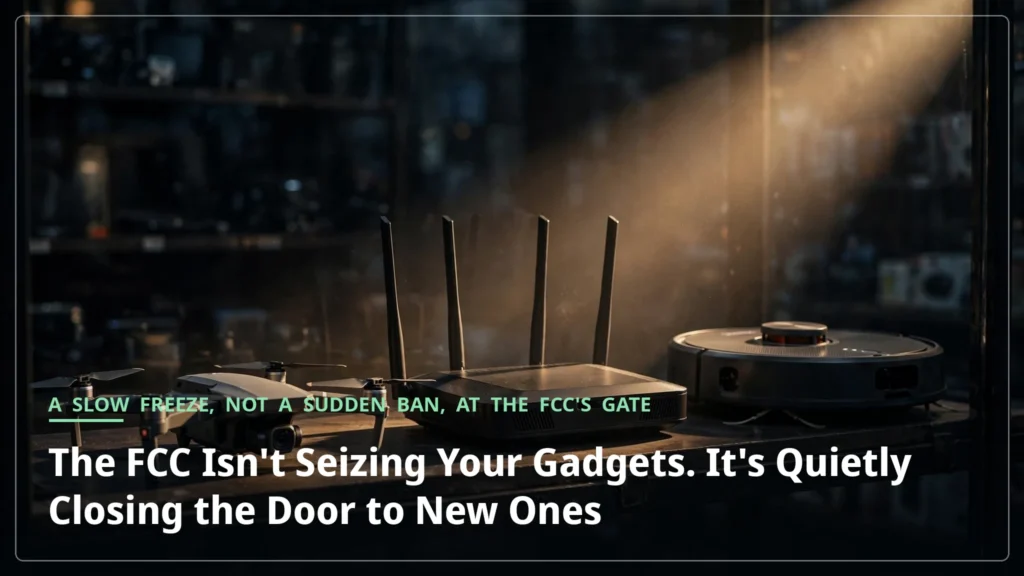



The FCC foreign gadget ban has not seized gadgets from the shelves, and for models authorized before July 28, 2026, that is by design: the July 28, 2026 action did not revoke prior authorizations. What the agency has done is quieter, and in the long run more consequential: it has narrowed the pipeline behind the shelves, one category at a time.
That is the shape of the FCC’s foreign-gadget clampdown. It works less as a sudden import ban than as a slow freeze. The mechanism is the agency’s Covered List, and the mechanism matters, because it explains both why so little has visibly changed and why so much may change next.
The gate nobody sees
Most electronic devices need an FCC equipment authorization before they can be imported, marketed or sold in the United States. Equipment placed on the Covered List cannot receive a new authorization. The result is not, for models authorized before July 28, 2026, that those models vanish under that action. It is that new foreign-produced models cannot get through the gate unless they find another way in.
The standard for listing, as quoted in a Kirkland & Ellis alert, is equipment that poses “an unacceptable risk to the national security of the United States or the security and safety of United States persons.” A national security determination, by its nature, may rest on classified material the government has not published, so the absence of public evidence does not by itself prove the absence of a threat.
Three listings, one pattern
The pattern arrived in stages. On December 22, 2025, the FCC added all foreign-produced drones and drone critical components to the Covered List, acting on a national security determination. In March 2026, it placed all foreign-produced consumer-grade internet routers on the list. On July 28, 2026, it added foreign-produced advanced robotic devices and certain foreign-produced power inverters.
Each step widened the same gate. Drones first, then the boxes that carry a home’s internet, then the robots and inverters that are moving from novelty to infrastructure. Taken together, the listings cover a surprising share of the connected home — not by taking products away, but by stopping their successors at the door.
What stays, and for how long
The July 28, 2026 action is explicit on one reassuring point: it does not revoke prior equipment authorizations. Models authorized before that date may continue to be imported, marketed, sold and used, according to the Kirkland & Ellis alert on the action. That is why the shelves still look normal.
The same care applies to the software that keeps old devices safe. The FCC has repeatedly extended permission for software and firmware updates for previously authorized devices, now at least until January 1, 2029, without removing any device from the Covered List. For drones, the update-waiver cutoff is December 22, 2025; for consumer routers, March 23, 2026. An update waiver is not new market access — it keeps what is already authorized working and patched — but it is the difference between a freeze and a cliff edge.
For the earlier drone and router listings, the evidence package leaves one point unresolved: whether models authorized before those listings remain importable and sellable on exactly the same terms as the July grandfathering. What is documented is the update position. The rest should not be overstated; in the material supplied here, that question remains unresolved.
The narrow door in the FCC foreign gadget ban
New foreign-produced models are not entirely shut out. They can still enter if they obtain Conditional Approval from the Department of War or the Department of Homeland Security. The price of that door, as described in a Vacuum Wars explainer and in reporting on the robot waivers, is disclosure: ownership, software, supply chains and manufacturing, plus a plan for establishing or expanding production in the United States. Approval is not guaranteed, and applications for robot vacuums were to be made by January 1, 2028.
So far, only a small number of approvals have been reported: four enterprise drone systems, Netgear and Amazon’s Eero on routers, and four robot exemptions by October 16, 2026. The robot list, tallied by Mekawire, runs Husqvarna on September 9, ANSCER on September 18, Matic’s floor cleaner on October 2 — the only household cleaning robot on the list — and Volley’s parking robots on October 16. Netgear’s conditional approval for future consumer routers, cable modems and cable gateways was reported to run until October 1, 2027.
The outcomes have been uneven, and the unevenness is itself the story. The Verge’s storystream reports that Netgear received conditional approval in April 2026 and Amazon’s Eero in April 2026, and that Asus received an exemption in September 2026 without publicly announcing a US manufacturing plan. TP-Link, by contrast, had not obtained a blanket waiver as of October 2026, despite telling The Verge it would invest nearly $1 billion in US router production over four years if exempted. On October 22, 2026, Taiwan’s MSI received conditional approval for only two specific routers, not a blanket approval.
There is a counterweight to the freeze picture, and it should not be left out: if Conditional Approvals keep arriving roughly every few weeks, as the robot exemptions did through the autumn of 2026, the market could refill with approved new models rather than stagnate on old ones. The material supplied here does not establish whether their pace or coverage will be sufficient to do that, so the freeze may prove temporary and self-correcting, or it may not.
That pattern raises the questions the material supplied here leaves unanswered. How many Conditional Approval applications are pending, and how many have been refused? Do applicants actually move production to the United States, on what timetable, and does anyone verify those commitments? Why have some makers received blanket approvals while others have not, and what role, if any, did a submitted US manufacturing plan play in each decision? In the material supplied here, those answers are not established, so whether a submitted US manufacturing plan played a role in each decision, and whether approvals will arrive fast enough to supply successors, remains unresolved.
What comes next
The freeze may not stay confined to gadgets. The FCC is scheduled to vote on October 29, 2026, on barring Chinese labs from testing US electronics, with prohibitions slated to take effect in December 2028. Reporting on the proposal cites FCC Chair Brendan Carr as saying 82% of electronics were tested in China. If that vote passes, it would extend the same logic one step further back in the supply chain, from the finished gadget to the laboratory that certifies it.
For consumers, the short-term effect remains muted. Models authorized before July 28, 2026 stay on sale under that action, and previously authorized drones and routers remain updatable until at least 2029. That undercuts any claim of an immediate crisis. What happens to prices and choice when the current authorized models age out and no approved successor exists in a category is an open question the material supplied here does not answer, even if no official ever announces a ban.
That is the contest now. Not a raid on the shelves, but a quiet argument over a narrow door: who gets through it, on what terms, and whether the public ever learns why some makers pass and others wait outside. The shelves look normal. Watch the pipeline.