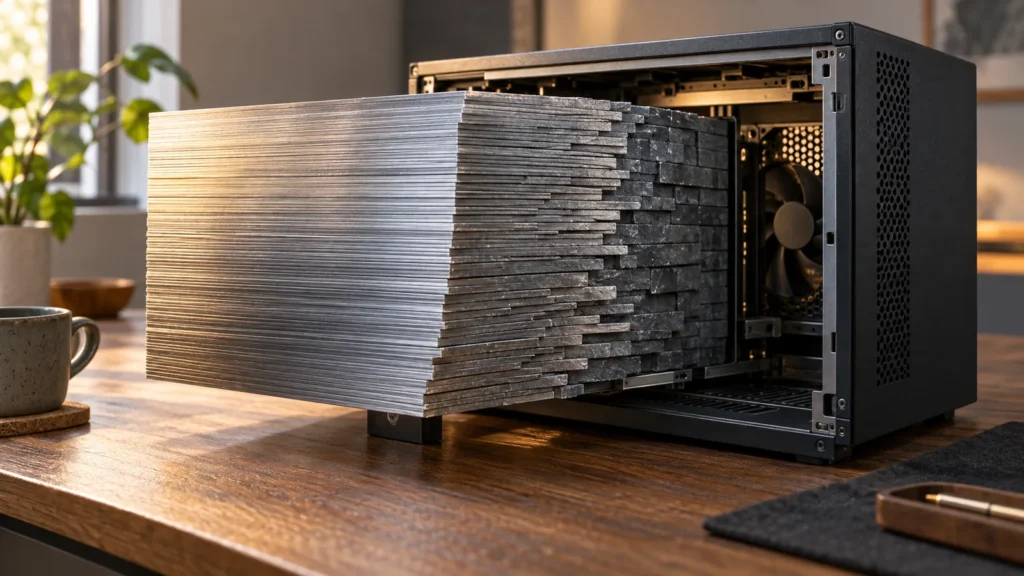


Qwen 3.8 Flash Next can run locally on consumer hardware, according to deployment documentation and community reports, but the requirements depend on the runtime, quantization and memory placement. A gaming GPU alone does not establish whether a machine can run it well. The central questions are where the model’s weights live, which components are compressed, and whether the chosen engine preserves useful output quality.
Two reported routes illustrate the difference. A Daily Dispatch summary of Strata lists an NVIDIA or AMD GPU with at least 12 GB of VRAM, at least 32 GB of system RAM, and Windows or Linux. Unsloth’s local deployment guide describes a 75 GB minimum for its smallest quantized version and recommends a 96 GB RAM or unified-memory device. Those figures describe different deployment paths; they are not interchangeable guarantees.
The available evidence consists of documentation, secondary reporting and user accounts, rather than a controlled test of these configurations. It supports a practical assessment of local deployment, with significant uncertainty around comparable speed and quality.
Why a 125B model still needs substantial memory
Unsloth describes Qwen3.8-Flash-Next as an open-weight, 125-billion-parameter multimodal mixture-of-experts model. Kie.ai’s architecture account specifies 6B active parameters per token and a separate 51B-parameter N-gram Embedding component. The active parameter count describes work performed for a token, rather than the complete weight-storage requirement.
Kie.ai reports that the N-gram Embedding component can be offloaded to host memory and prefetched asynchronously. Unsloth also describes offloading the PLE or Ngram layer to SSD and using mmap to reduce CPU and GPU memory usage. These mechanisms help explain how a model with large weight-storage requirements can be approached on machines with limited VRAM. The supplied evidence does not establish the performance cost of SSD offloading for a particular consumer configuration.
The distinction matters when reading a hardware recommendation: GPU capacity, system memory and storage placement all belong in the deployment description. A successful run on one arrangement does not demonstrate that another arrangement with the same graphics card will behave identically.
Quantization determines the memory budget
Unsloth’s hardware table lists the following requirements, explicitly using total memory—RAM plus VRAM—or unified memory:
| Quantization | Listed memory requirement |
|---|---|
| 1-bit | 75 GB |
| 2-bit | 79 GB |
| 3-bit | 90 GB |
| 4-bit | 96–114 GB |
| 5-bit | 163 GB |
| 8-bit | 200 GB |
| BF16 | 355 GB |
These are Unsloth’s documented figures, not independently measured limits. Its surrounding prose calls for at least 75 GB of RAM or unified memory, while the table counts combined RAM and VRAM. That difference in wording leaves the exact allocation for a mixed CPU/GPU setup unresolved. The separate Strata summary’s 32 GB system-RAM minimum does not explain enough about its memory arrangement to reconcile it directly with Unsloth’s figures.
The smallest checkpoint is also not uniformly 1-bit. Unsloth says its 75 GB version uses 4-bit weights for the Ngram or PLE component and is 79% smaller than the 355 GB BF16 version. The quantization label therefore does not describe every component’s precision.
For multi-token prediction, or MTP, Unsloth advises another 1–2 GB of headroom; the research also records a 91 GB requirement for the 3-bit MTP quant. Treat the base table as a starting point and match the memory budget to the exact variant and runtime.
Choosing a local deployment route
For Unsloth’s path, the documentation directs users to its GGUF weights through llama.cpp or Unsloth Desktop. It says Desktop automatically offloads to RAM and detects multiGPU setups. This supplies a documented route for allocating work across available memory, although it does not establish identical performance across supported machines.
Strata’s appeal is execution on a gaming PC. In the Hacker News discussion, user snehesht reports 124 tokens per second on an NVIDIA 4090 with 128GB DDR5 RAM and a Ryzen 7950x3d processor. That is a much more specific configuration than the minimum requirements in the summary.
For Apple hardware, Kie.ai relays @ivanfioravanti’s report of approximately 65 tokens per second on an M3 Ultra through DwarfStar, alongside Q2 weights and a development branch offered for testing on real 64GB machines. The reported M3 Ultra speed and the invitation to test 64GB machines are distinct claims. The latter does not demonstrate that every 64GB configuration reaches that speed.
The evidence supports choosing a runtime and checkpoint before judging hardware suitability. It does not contain a complete, verified installation sequence for every route, so an exact universal launch command would be unwarranted.
Why the speed reports differ
Kie.ai reports an early RTX 4090 test at about 21 tokens per second for decoding and 364 tokens per second for prefill. That decoding figure differs sharply from snehesht’s 124-token-per-second report. The available accounts do not align their runtime versions, quantization, prompt lengths or other test conditions sufficiently to explain the gap. Neither figure should become a general RTX 4090 expectation.
Unsloth attributes another speed improvement to MTP, which predicts multiple upcoming tokens rather than one token per step. It reports 170 tokens/s on one RTX 6000 PRO GPU against a 100-token baseline. That comparison belongs to Unsloth’s reported setup; it does not measure the gain a consumer PC will receive.
A more useful performance assessment would preserve each measurement’s configuration and distinguish prompt processing from output generation. For an application developer, total task time also matters: faster token generation alone does not establish faster completion of a coding task.
Coding results and a vision warning
User Winfred-zz’s Hacker News benchmark report compares ninfer-3090-qwen3.8-27b, using mixed Q4 and Q5 quantization, with strata-qwen3.8-flash-next-iq3_xxs, using Q3:
| Reported result | Ninfer configuration | Strata configuration |
|---|---|---|
| Code generation | 52/78 (66.7%) | 70/78 (89.7%) |
| Code completion | 40/50 (80.0%) | 44/50 (88.0%) |
| Total | 92/128 (71.9%) | 114/128 (89.1%) |
| API failures | 10 | 5 |
| Generation time | Approximately 122 minutes | Approximately 142 minutes |
Strata scored higher in this account but took longer. The comparison changes model, quantization and inference stack together, so it cannot isolate the effect of Strata or lower-bit quantization. The user describes an RTX 3090 requiring a power cap, a Zen 2 CPU, 64GB DDR4 and a PCIe connection limited to 8x, further qualifying the result.
Quality reports also diverge. In the same discussion, ricardobeat describes mixed results and perceived degradation with IQ3_XXS. This does not invalidate Winfred-zz’s scores, but it limits any broad claim that the quantization preserves quality across workloads.
Vision introduces a separate concern. Jackson__ reports a 50-image object-coordinate test with median error of 154.8 pixels and average error of 168.8 pixels through Strata. With the exact same GGUF and vision adapter weights through llama.cpp, the reported median was 46.5 pixels and the average 81.4 pixels. The report does not establish a cause, but it gives a concrete reason to test the runtime’s vision behavior rather than infer it from coding results.
Validate the workload before committing to the setup
Kie.ai reports a native context window of 262,144 tokens, extendable to 1,000,000 with YaRN. Those model-level limits do not establish that a minimum-memory machine can use the full window at acceptable speed.
Reasoning settings also deserve attention. Unsloth documents reasoning_effort and Preserve Thinking, which retains the previous conversation’s thinking trace. It says preservation increases token use and could improve accuracy in continued conversations. These settings belong in a workload evaluation alongside quantization and runtime choice.
The useful next step is to test the intended task on the exact deployment configuration: record the checkpoint, memory placement, reasoning settings, task completion time and output quality. The reports make local execution plausible, but their unresolved differences leave workload-specific validation as the basis for deciding whether a particular consumer machine is sufficient.