



Apple’s first foldable had been on sale for less than a day when the photos started appearing. On the iPhone Duo subreddit and across social media, owners posted pictures of the iPhone Duo crack running along the hinge of the 7.6-inch inner display, usually followed by a bright horizontal line of stuck pixels across one half of the screen. Some said it happened within hours of unboxing. The phone starts at $1,999. The crack, in the reports, always seemed to land in the same place.
Then a YouTuber named CuriousHagi reproduced the crack, took the phone apart, and found the piece that broke.
The iPhone Duo crack that keeps landing in the same place

One case, reported by MacRumors, comes from an owner in Australia. He had the phone for about six hours and had opened it fewer than 20 times when, showing it to a friend, he felt something around the internal hinge, underneath the screen. As he kept opening it, he heard an audible crack, and the screen broke right along the hinge. There were no marks on the inner screen or the external hinge. His local Apple Store replaced the phone on the spot.
By Sunday, October 25, 9to5Mac had counted about ten unique cases, as reported by Mac to Reality, several of them posted to the iPhone Duo subreddit. The damage looks the same each time: a crack down the centre line of the hinge, followed by a horizontal block of pixels stuck glowing white. A couple of owners said it happened during first setup.
Ten cases is a small number against a launch in more than 70 countries, and 9to5Mac itself says it does not know the true scale. What made the reports stick was not the count. It was the consistency: the cracks all seem to land in the same place, the damage looks the same each time, and some owners report it happening within hours of unboxing.
One screwdriver, one snapped link
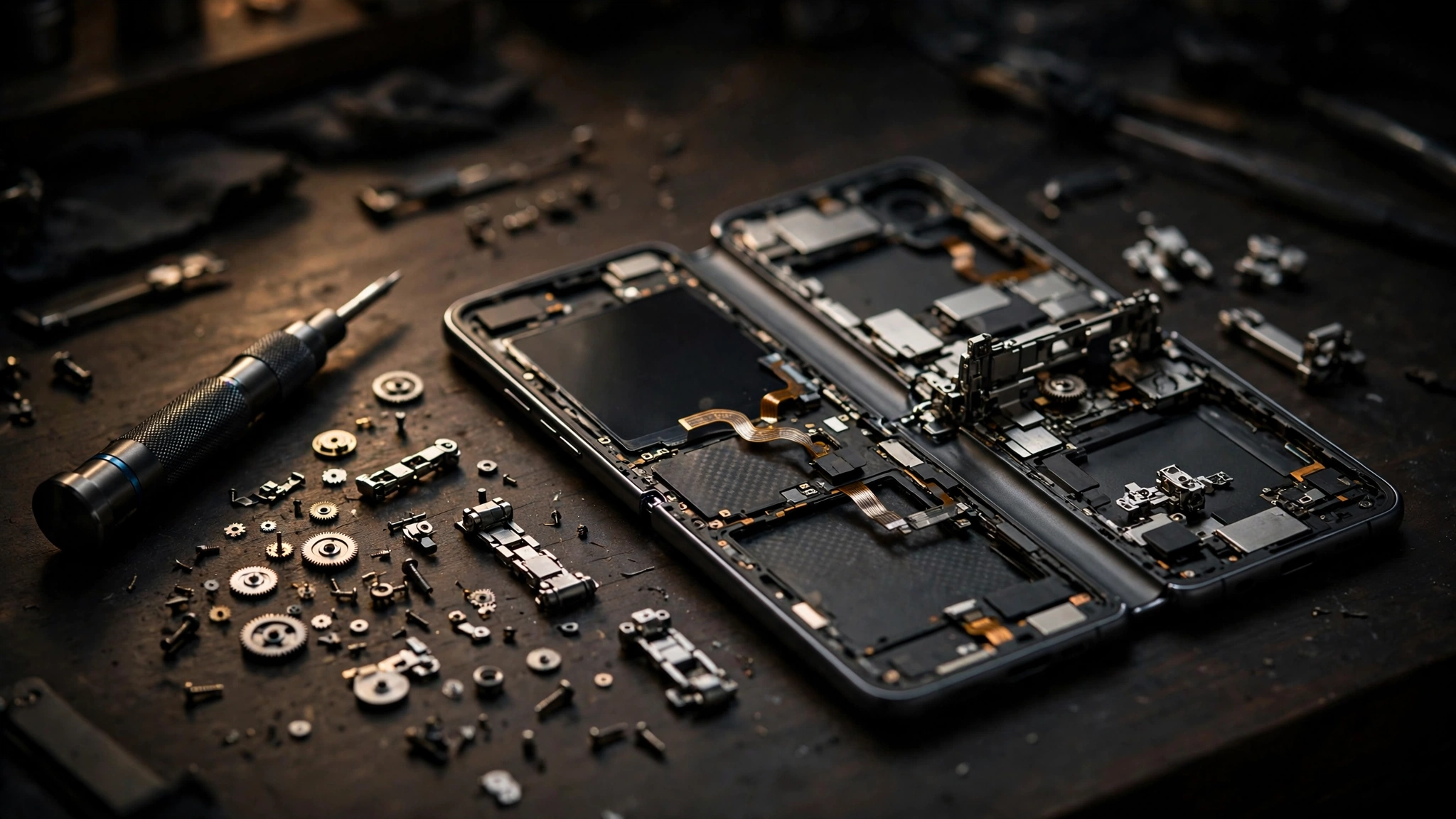
CuriousHagi’s durability testing was not gentle. According to AppleInsider’s account of the video, it involved a lot of dirt and stressing the screen by folding the hinge backwards. He tried to close the iPhone Duo and it would not shut. He tried opening it back from its partially closed state, and heard a loud snap. The screen showed a large white issue running from the crease to one side.
Then he pulled the phone apart. What he found is that the Duo’s hinge is quite complex: a gear-like central hinge and two different types of linking hinges. And one of the links in the middle of the phone — thinner than the links below or above it — had snapped at a small notch, where it would be weakest. It was a hinge element that connects to an upper support plate, and a check of the hinge showed heavy crush marks on a nearby mechanism. He also found marks where the hinge met the support plate, indicating where it may have gotten caught.
That is the whole story in miniature. Not a shattered screen, not a mystery defect, but a single thin link, a notch, and a scuff where metal met metal. A $1,999 phone’s most talked-about failure has a specific, visible weak point — at least in the one phone on his bench.
What one broken phone does — and doesn’t — prove
Here is the part that matters, and the part that is easy to skip past in the excitement of a teardown. CuriousHagi broke this phone deliberately, under stress. That shows the link can fail. It does not show that the same link failed in the phones owners took back to Apple. A second cracked retail unit, opened the same way and found the same way, would settle far more than any number of photos.
iFixit’s own teardown adds to the picture without settling it either. Its team noticed that the central support bar may not retract properly when the Duo closes, which could put excessive pressure on the display, and that curved rails might interfere with the display if they do not move as intended. Numerous structural edges and components converge around the affected area. Two independent teardowns now point at the middle of the hinge, and neither proves a cause. Whether the design is the explanation for the owners’ phones is an open question — one that only an examination of failed retail units could settle.
There is also a counterweight. Some reviewers who received a Duo early subjected it to folding tests and did not experience screen issues, though that is a small sample. In a test MacRumors reported on October 21, as summarised by SaveDelete, Joanna Stern ran her review unit through more than 32,000 folds over four nights on a custom rig. Afterwards the hinge measured slightly stiffer than before the test — and the screen did not break.
So the honest state of play is this: a thin link snapped in one deliberately stressed phone, a handful of owners report the same-looking crack after normal use, and a heavy fold test produced no failure at all. The mechanism is visible. The scale is not.
What Apple has — and hasn’t — said
Apple did not reply to requests for comment from The Verge or 9to5Mac, according to Mac to Reality. The Verge’s own article on the teardown is paywalled after its first three paragraphs, so any further reporting in that piece — including any Apple comment — remains unverified here. Its iPhone Duo hinge troubleshooting page, published on launch day, lists symptoms including “Bent or broken hinge” and “Unexpected noise while opening or closing the device”. It notes that there are no diagnostics or software remedies for hinge issues, and tells technicians to replace the inner display assembly if checks fail. The page does not mention screen cracks, and the specs page gives no fold rating for the hinge. The product page describes the hinge as designed for “smooth, balanced resistance for long-lasting reliability”.
For owners, the practical facts are these. The hinge is not sold on its own: Apple’s repair manual lists no hinge among the Duo’s parts, so a snapped link means the whole inner display assembly — a repair Apple prices at $999 without AppleCare+, and $99 with it, as reported by appdook. Launch-day buyers in the US have Apple’s 14-day return window, running to about November 6. The Duo goes on sale in 28 more countries and regions on October 30, which will put far more hinges into daily use.
What happens next is easy to name and hard to predict. If the count of cracked screens grows as the second wave of countries comes online, that alone will not settle the cause — reading the numbers will need sales and exposure context, and the mechanism will need evidence from failed retail units, not just a count. If the count does not grow, the thin link stays what it is today: a precise, visible weak point in one tested phone, and a reminder that the most complicated part of a folding phone is the part that has to move.