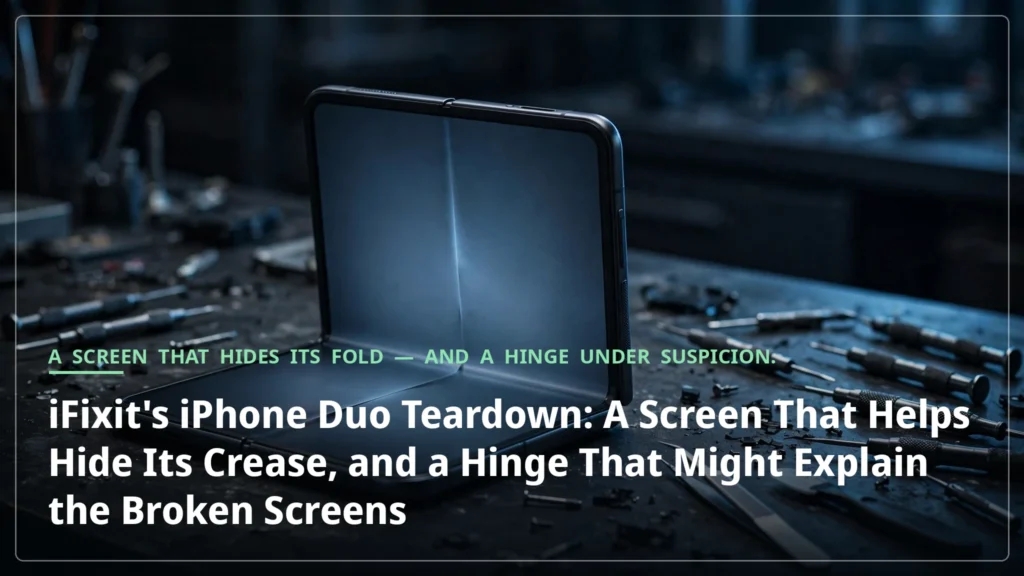



As is tradition, iFixit has torn open the iPhone Duo and laid its parts bare on a table. The teardown turned up two stories at once: a display whose features help mask its own fold, and a hinge that may explain why some of those displays are breaking.
The headline finding is the score. iFixit gave the Duo 5 out of 10 for repairability, a number that sounds mediocre until you hear the rest of the sentence. It is the best score iFixit has ever given a foldable, and the site’s own verdict was wry about it: “This is the most repairable foldable smartphone we’ve seen so far, and it’s still going to be a bear to repair.” The score is provisional, pending the arrival of replacement parts, but the message is clear enough. The most repairable foldable iFixit has seen is still a difficult machine to fix.
How the crease gets masked on the iPhone Duo
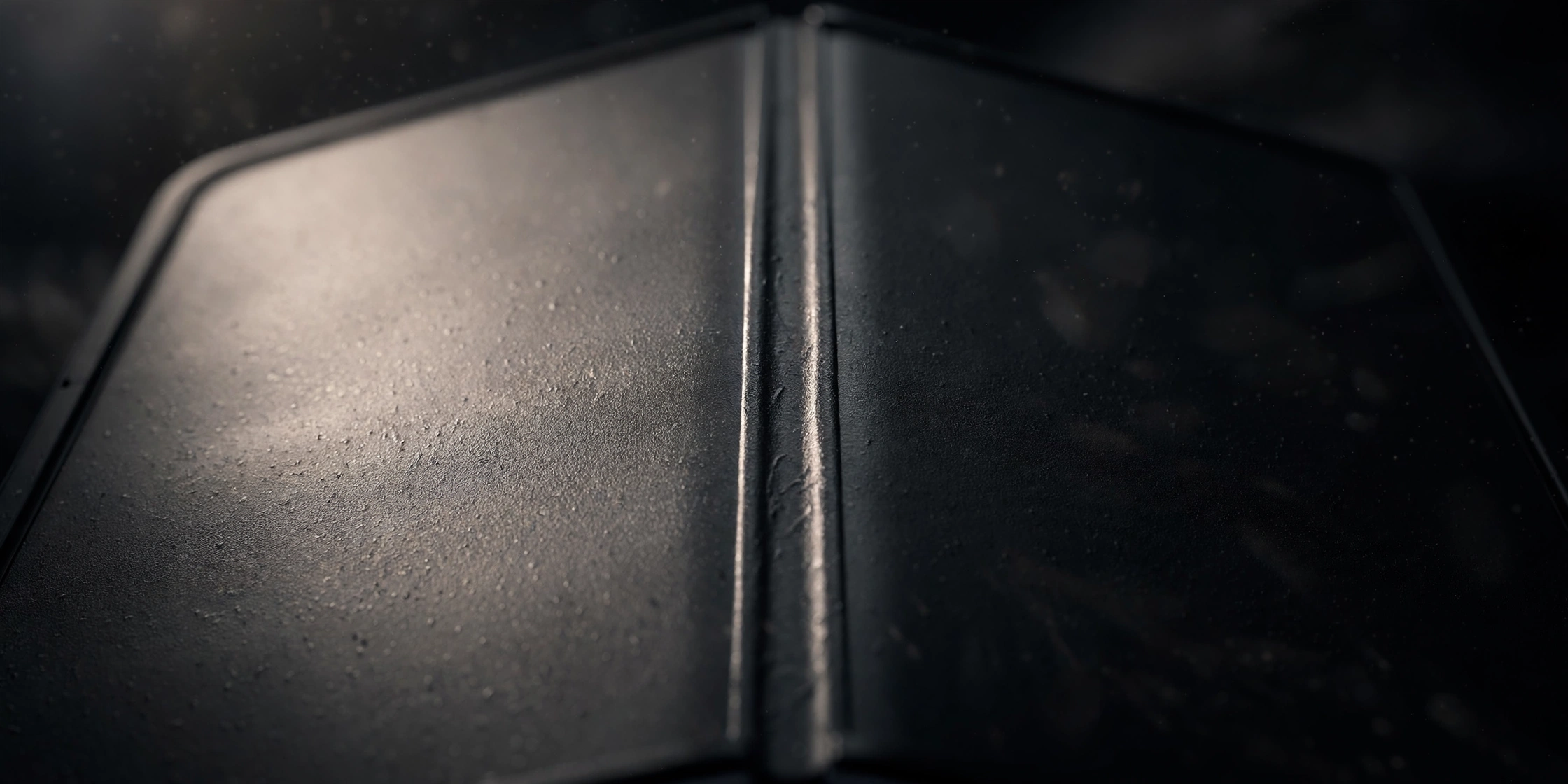
Start with the screen, because that is where Apple did its most delicate work. The Duo’s inner display wears a matte nano-texture cover, and iFixit found it doing two jobs at once. It makes the screen easier to read in bright sunlight, and it helps hide the crease by scattering reflections. Look closer, much closer, under a microscope, and the display reveals a second trick: oval-shaped subpixels arranged at various angles, which iFixit believes are designed to reduce artifacts and further mask the crease down the middle of the display.
That is the display story of the Duo in miniature: a cover that improves sunlight readability and also helps mask the crease, and subpixels that iFixit believes may reduce artifacts around it. The alternative reading is worth stating plainly: these features may exist mainly to make the screen look better, with crease masking as a side effect rather than the design goal. What the teardown establishes is the effect, not Apple’s priority. And the outer layer of that trick is, by foldable standards, almost friendly: the nano-texture layer can be replaced relatively easily without swapping out the OLED underneath. If the display itself needs replacing, though, the kindness ends. As with other foldables, it is an expensive, difficult job.
The hinge with a theory attached

Then there is the hinge, the most intricate mechanism in the phone and the part of the teardown that turns from engineering appreciation into something closer to a detective story. The hinge itself is elaborate: gears, springs and interconnected metal joints, arranged around a waterdrop design that gives the display room to bend without folding too sharply, with curved guides controlling how the joints move to reduce the stress placed on the display as the phone opens and closes.
On its face, it is a remarkable piece of engineering. It is also, iFixit theorises, a possible explanation for the broken screens. There are reports of damaged screens and cracking hinges, and iFixit has a theory about why. The hinge is so complex, the site suspects, that part of it sometimes fails to descend properly. There is also an accordion cable that passes over that exact spot, near the edge of the battery. It is possible, iFixit says, that pressure is concentrating there, and that the pressure is behind the audible crack some users have reported, and the broken screens that followed.
Possible is doing a lot of work in that paragraph, and it should. Both of iFixit’s explanations are theories, and the site is explicit that it is hard to say whether they are the actual causes without more testing. Apple, for its part, did not immediately return a request for comment and has yet to address the screen issues. The hinge is a suspect, not a verdict, and it should stay that way until the evidence says otherwise.
Dust, water, and the crunchy test
One test iFixit did run to completion is the dust test, and the Duo came out of it looking better than its rivals. The phone carries an IP68 rating, dust-tight and able to withstand submersion in water up to six metres deep for thirty minutes, and the glow-dust test found noticeably less dust making its way inside than in the Galaxy Z Fold8 or the Pixel 11 Pro Fold. Some still got in, through the USB-C port, the speaker grilles and the hinge, and the hinge made a slightly crunchy sound afterwards. But compared with other foldables iFixit has tested, relatively little dust reached the hinge at all.
The repair bill
That competence shows up in the rest of the teardown, too. Both batteries release with an electrical current. The outer display came off intact. Apple posted repair manuals for the Duo on day one. Those are the details that earned the Duo its provisional 5 out of 10, ahead of the 4 out of 10 iFixit gave both the Z Fold8 and the Pixel 11 Pro Fold.
But the number that will matter most to owners is not the score. It is the price of the repair the score cannot prevent. Apple charges $999 to replace the Duo’s inner screen out of warranty. Google charges $568 for the same service on the Pixel 11 Pro Fold; Samsung charges $579 on the Galaxy Z Fold 8. With the Duo starting at $1,999, Apple’s screen replacement costs half as much as buying a brand-new phone, and roughly $420 more than either rival charges for the equivalent fix. The inner display and the hinge remain the biggest repair obstacles: a full fix means moving many parts into a new chassis.
So this is where the Duo stands after iFixit has had its way with it: a phone whose display features help mask its fold, whose hinge is an intricate piece of engineering, and whose screens are, in the cases users have reported, cracking anyway. iFixit has offered one possible explanation for why: a hinge that may sometimes fail to descend, and an accordion cable passing over that same spot near the battery, which iFixit theorises could concentrate pressure there. It has also been careful to say that the explanation is, for now, only a theory until further testing says otherwise. The crease is masked, as far as the teardown can show. The crack is still an open question.