


A memorandum, not a launch
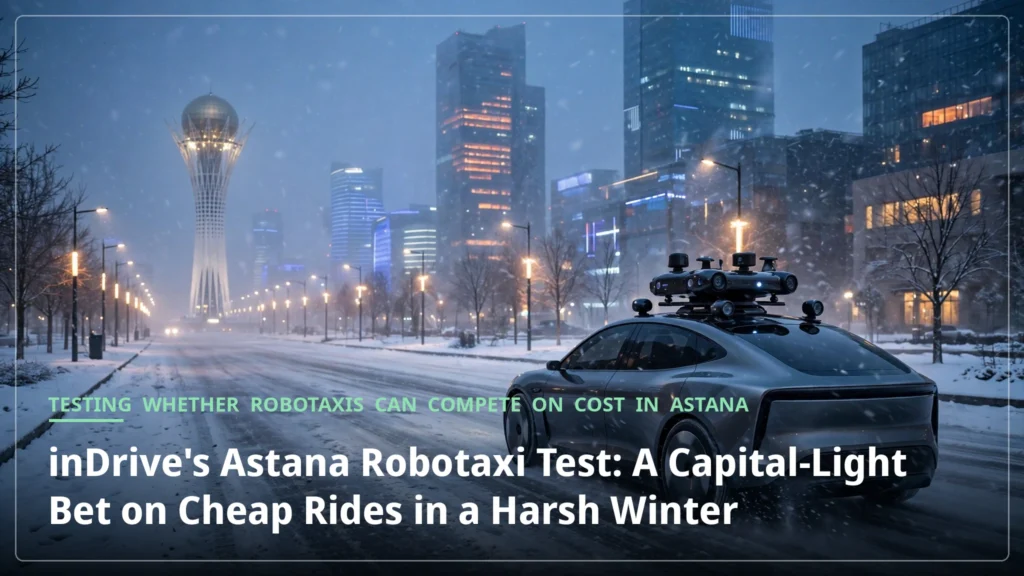
inDrive, Pony.ai and Nvidia have signed a memorandum of understanding to explore bringing Pony.ai’s robotaxis to inDrive’s platform in Kazakhstan, with Astana robotaxi testing planned in the first half of 2027. That sentence deserves to be read slowly, because the most important word in it is explore. Nothing in the announcement is a launch date for a passenger service, a fare, or a fleet size. It is an agreement to test whether a particular division of labour can work: Pony.ai supplies the vehicles, Nvidia supplies the autonomy technology, and inDrive supplies the app and the local operations.
Under the proposed plan, Pony.ai would provide its Gen-7 robotaxis, inDrive would offer them through its ride-hailing app and operate them in Kazakhstan, and Nvidia would supply its Hyperion platform and Halos safety system. Testing would begin with a safety operator aboard, and fully driverless rides are described as the eventual goal rather than the starting point. The modesty of that phrasing is the story. The question the announcement leaves open is whether this division of labour lets inDrive establish a robotaxi service without building the autonomy technology itself.
Capital-light, stated plainly
inDrive chief technology officer Yuri Misnik described the approach in terms the company itself chose: capital-light by design. In his words, inDrive works with a range of partners in different markets, combining their expertise with its own to deliver a better customer experience. That is a strategy statement, not a boast about ownership. The vehicles come from Pony.ai. The computing and safety foundation comes from Nvidia. What inDrive contributes is the thing it already has: a ride-hailing platform, a local operating presence, and a customer base built around affordable rides.
That last point matters more than it first appears. inDrive built its business around affordable rides, and it says it is now looking to bring a similar focus to autonomous ride-hailing. Nvidia vice president of automotive Ali Kani made the connection explicit, saying that the savings from a ready-made foundation of sensors and computing technology are particularly relevant in emerging markets, where ride-hailing is already relatively affordable and autonomous services need to compete on cost. Put plainly, a robotaxi that cannot compete with a cheap human-driven ride has no business in this market, however impressive its sensors are.
The hardware behind the arithmetic

The cost argument has a hardware side. Pony.ai’s Gen-7 robotaxi, according to Gasgoo’s coverage of its launch, carries 34 sensors, including nine LiDAR units, 14 cameras and four millimetre-wave radars, with detection coverage out to 650 metres. More importantly for a market where fares are low, Pony.ai says the autonomous driving kit costs 70 percent less than the previous generation’s, with a domain controller built around four Nvidia Orin-X chips. None of that guarantees a viable fare in Astana. It does explain why the arithmetic is even worth testing: the kit got dramatically cheaper at the same time as the partner model removed the need for inDrive to develop it.
Nvidia’s contribution is the other half of that arithmetic. Its Halos system is described as a full-stack safety system unifying vehicle architecture, AI models, chips, software, tools and services, built on the safety-certified DriveOS operating system and the Hyperion architecture. Nvidia says Hyperion could lower the cost of developing robotaxis by giving companies that ready-made foundation,.
Why the Astana robotaxi test, and why the rules matter
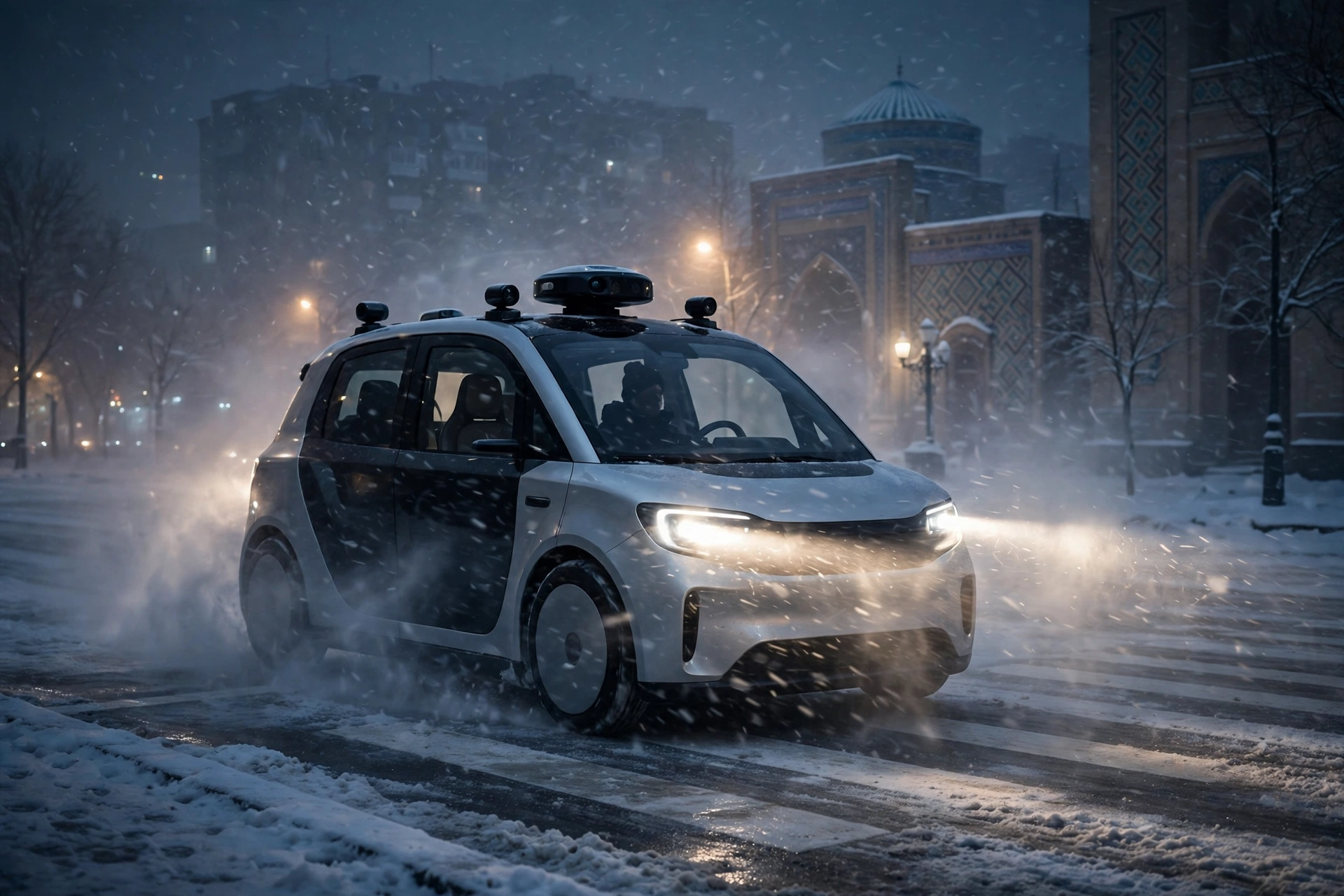
Astana was not chosen at random, and the choice has two distinct attractions. The first is regulatory. Kazakhstan announced plans last month to launch autonomous taxi services in 2027, with initial trials planned in Astana and two other cities, and it introduced rules for autonomous vehicles to be tested on certain public roads. Misnik named exactly that kind of environment as a condition for success, saying one of the main requisites for a successful launch is a favourable and collaborative regulatory environment to facilitate safe and sustainable testing on the roads. A country that has already written testing rules is, for a company in inDrive’s position, a place where a test can actually happen.
The second attraction is the weather, and it cuts the other way. Astana has around 1.7 million residents and faces months of snow and ice, which pose real challenges for autonomous driving systems. inDrive founder and chief executive Arsen Tomsky framed that difficulty as the point, saying that launching in Astana will provide an important opportunity to evaluate autonomous driving technology in challenging winter conditions, and that success there could offer valuable insights for expanding to other locations facing similar challenges. A test that only works in sunshine tells you little. A test in an Astana winter, if it works, tells you something transferable.
Reported pilot rules underline how staged this will be. According to AsiaDaily’s reporting of Kazakhstan’s rules, a vehicle must complete at least 100 hours of accident-free testing at a testing ground before road trials, then travel at least 10,000 kilometres and carry passengers on at least 100 trips without an accident caused by the automated system during the trial period, with 60 million tenge of passenger insurance and continuous sensor and video recording. Those thresholds, if applied as reported, mean the first half of 2027 is a beginning, not a verdict.
A crowded field, and a parallel experiment
inDrive is not entering an empty road. Earlier in October, Uber announced plans to test Pony.ai’s robotaxis in London. The juxtaposition is worth noting without over-reading it: the same vehicle supplier appears in both stories, and no source in this announcement says inDrive is acting because of Uber. What can be said is that in this announcement, inDrive provides distribution and operations while Pony.ai provides vehicles and Nvidia provides the autonomy technology.
inDrive also has a parallel experiment of its own. In December, the company signed a separate agreement with Saudi Arabia’s AI Driver to explore deploying autonomous vehicles powered by Chinese self-driving firm WeRide, starting with Riyadh. The companies had targeted a pilot in the first half of 2026, though it remains unclear whether testing has begun. Two exploratory partnerships are now documented, one with an unclear status: the Saudi pilot’s progress is not established, and the Kazakhstan test is planned rather than underway.
What has to go right
Three things have to go right before this story becomes anything more than a memorandum. First, the memorandum has to convert into something binding, with a timetable beyond the planned Astana tests. Second, the safety-operator phase has to progress toward driverless operation, which is the eventual goal rather than a promise. Third, and most distinctively, the economics have to work where rides are already cheap. The Gen-7 kit’s lower cost and Nvidia’s shared platform help, but no Kazakhstan fare or operating-cost figure has been established, and the article’s own sources are careful to frame the cost point as a reason the test matters, not as a result.
There is also a question the announcement leaves open about control. If the decisive technology sits with partners, then inDrive’s app and local operations have to carry the advantage. That is a conditional risk, not a verdict: partner-stacking may leave a platform with little differentiation if the division of responsibilities leaves the decisive technology elsewhere. The counterweight is that inDrive is not pretending otherwise: its stated strategy is capital-light precisely because it does not own the stack.
For now, the honest summary is narrow. Three companies have agreed to explore a supervised robotaxi test in Astana in the first half of 2027, dividing vehicles, technology, app and operations between them, in a country that has written rules for such tests and a city whose winters will punish any weakness in the system. Whether that combination produces a service that can compete on cost with the affordable rides inDrive already sells is not yet known. That is what the test is for, and the test has not started yet.