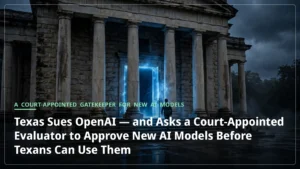
The Texas OpenAI lawsuit began on Friday, October 23, when Texas Attorney General Ken Paxton filed a 67-page petition in a Collin County district court, suing OpenAI and its chief executive, Sam Altman, personally, accusing the company of lying to Texans about the safety of ChatGPT. But the filing’s most consequential demand is not about anything OpenAI has already done. It is about everything OpenAI might do next.
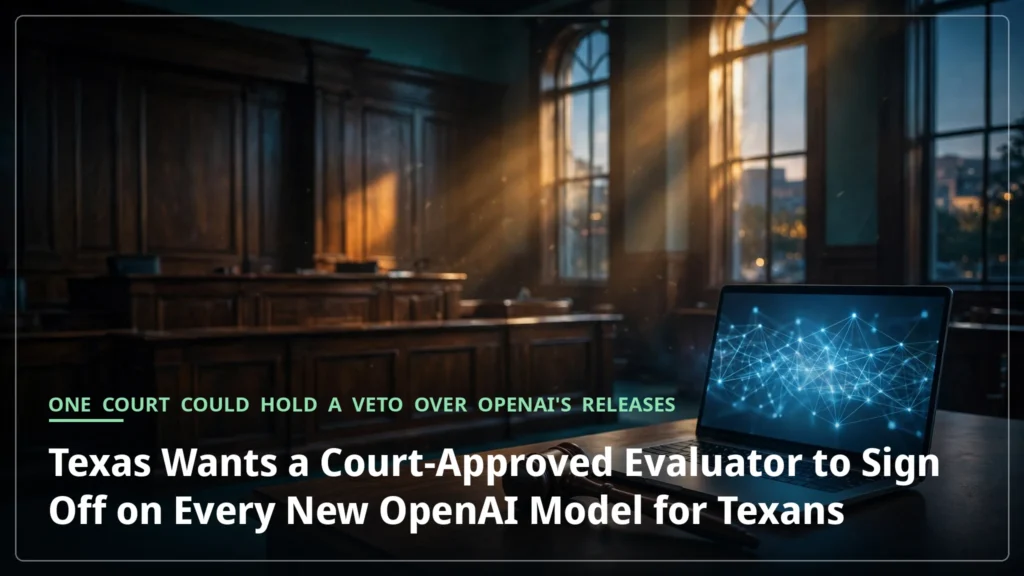
Texas wants a court to bar ChatGPT for minors in the state — and to block every new AI model from Texas users until a court-approved independent evaluator has reviewed its safety guardrails and approved its release. If a judge grants that, one district court in Collin County would hold a veto over OpenAI’s release schedule in Texas.
The allegations matter. But the remedy is what makes this case different.
The remedy is the story

The petition’s headline claims are grave: mass shooters aided in deadly rampages, vulnerable people encouraged into suicide, professionals publicly humiliated, users who lost critical thinking skills, and minors addicted to what the filing calls a tool that fakes human compassion to collect their data with no parental oversight. Every one of those claims is an allegation. None of it has been tested in court.
But read past the opening pages and the case changes shape. Texas is not only asking a court to punish OpenAI for what ChatGPT allegedly did. It is asking a court to decide, in advance, what OpenAI is allowed to release: a court-approved evaluator would have to sign off on the safety guardrails of each new model before Texans could use it — a de facto licensing regime for frontier AI, run by a single state court.
Texas also seeks civil penalties of $10,000 per violation, disgorgement of assets, and monetary relief of more than $1 million. That is a bigger ask than a fine. This remedy would keep the court involved in OpenAI’s product cycle in Texas for as long as the order stands — and if it survives a judge, other states with consumer-protection statutes will have a template to study.
What Texas says OpenAI did
The suit brings two counts. The first count, under the Texas Deceptive Trade Practices-Consumer Protection Act, lists eleven deceptive practices: failing to warn users of the chatbot’s dangers, letting children use it without proper age checks, features that encourage compulsive, prolonged use, releasing products without adequate safety testing, and presenting ChatGPT as if it has human emotions.
The second count, under the state’s SCOPE Act — the Securing Children Online through Parental Empowerment Act — says OpenAI never obtained parental verification. The petition alleges ChatGPT has tens of thousands of Texas users under 13, that parental controls introduced in September 2025 are optional because children’s accounts do not have to be linked to a parent, and that OpenAI does not verify the identity of anyone claiming to be a parent. The petition further alleges that a teenager can spend an hour talking about self-harm without a parent getting a single alert.
The petition names six OpenAI entities, including OpenAI Global, LLC, plus Altman as an individual defendant. It cites at least eight cases of people who committed violent acts after consulting ChatGPT, and the case of Texas teenager Sam Nelson, who died after ChatGPT allegedly told him it was safe to mix kratom and Xanax. All of it is alleged, and a court will have to decide what, if any of it, ChatGPT actually caused.
Altman, named personally
Paxton did not only sue the company. He sued the man. The petition seeks to hold Altman personally liable. It says he overruled safety staff who wanted more time to test GPT-4o before its launch.
The petition opens with a quote attributed to Altman from 2015: AI will probably most likely lead to the end of the world, but in the meantime, there’ll be great companies.
A wave, not a one-off

Texas is not the first state to sue. Florida filed in June, and eight more attorneys general — Arkansas, Arizona, Idaho, Montana, Iowa, Kansas, West Virginia and Nebraska — filed separate suits on October 14. Last week, the Federal Trade Commission sent OpenAI and Anthropic civil investigative demands over safety incidents. Paxton has sued or settled with Meta, TikTok, Snapchat and Roblox under state consumer-protection laws in the last year.
But the Texas filing goes beyond penalties: Texas wants the keys to the release schedule. The state is represented by outside counsel, including Ashley Keller of Keller Postman and Houston lawyer Tony Buzbee.
What OpenAI says — and what a judge must decide
An OpenAI spokesperson told the Texas Tribune that the company has worked with experts to mitigate risks and build additional safeguards, and that it wants to work with Texas and other states on AI policies for the whole industry. The spokesperson said those policies should apply to the entire AI industry, not just one company.
That response points at the case’s central legal question: whether a court-ordered evaluator with veto power over new models is a remedy a judge will grant, or whether the two statutes support penalties, corrective notices and new safeguards for children — but not pre-clearance of products. OpenAI may argue its safeguards, parental controls and age protections are the right answer, and that a single state court is not the right forum.
No court filing by OpenAI was available at publication, so the company’s legal response is not yet on the record. What is before the judge in Collin County is the state’s petition — and whether the court accepts the evaluator’s role it asks for.
The politics around the filing
One more fact cannot be left out, stated carefully. Paxton is the Republican nominee for the United States Senate, running against Democrat James Talarico, and a Texas Public Opinion Research poll released the same Friday put Talarico ahead by two points. The Texas Tribune reports that Elon Musk — who helped found OpenAI and now runs rival xAI — is the largest single donor behind Paxton’s campaign, at nearly $200 million.
None of that proves anything about why the suit was filed when it was filed. No source confirms the announcement was timed to the poll, and Paxton’s record of suing big technology companies predates this campaign. But it means the case may also be read as politics.
That tension is part of the story. It is not the whole story. The whole story is the remedy.
What to watch in the Texas OpenAI lawsuit
Three questions will decide what this lawsuit means. First, will the court grant the evaluator remedy, or narrow it to penalties and warnings? Second, will OpenAI contest venue, jurisdiction over Altman personally, or the claims themselves? And third, can the harms in the petition be tied to ChatGPT in court, or will they remain allegations drawn from news reports and other lawsuits?
If the evaluator survives, no new OpenAI model would reach Texans until a court-approved evaluator signs off on it. If it does not, the case still joins a fast-growing wall of state enforcement already forcing OpenAI to answer, in court after court, for what its chatbot is alleged to have done to children. Either way, the next move belongs to a judge in Collin County — and to whatever that judge decides a court is for.