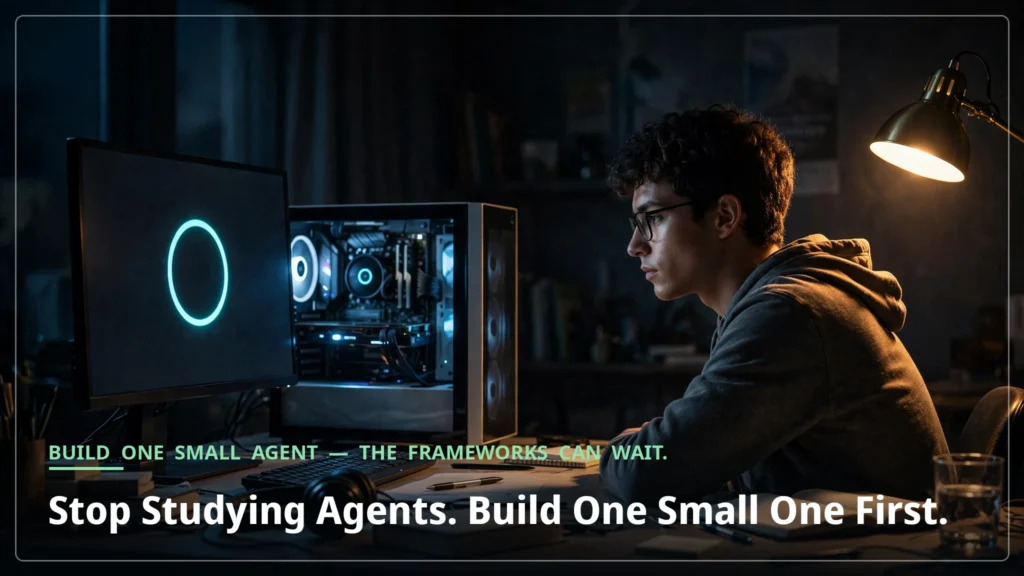



The student with the powerful machine and no clear task
Picture a learner who spent a couple of months working through LangChain, LangGraph, CrewAI, tool use, retrieval-augmented generation, and memory systems. They bought a powerful local machine with 128GB of memory specifically so they could study AI agents properly. And at the end of all that, they still described only scattered pieces rather than an understanding of how to design and build an agent properly — and a machine with no clear job to do.
That is not a story about laziness. It is a story about the order of operations. The learner did the work, yet still ended up with scattered pieces. What the builders in the discussion suggest is that the order was backwards: the frameworks came before the thing the frameworks are for.
Could every new framework reset your confidence?
Could the poster’s scattered understanding reflect a confidence-reset pattern? Each new framework or concept can make earlier learning feel doubtful, so collecting frameworks can feel like progress while it is happening, and like erosion afterwards. That is one possible interpretation of the thread, not something the poster claimed.
The result is the predicament the builders’ advice speaks to.
What finally clicked for AI agent builders
In a recent discussion among agent builders, the advice that kept surfacing was almost embarrassingly simple: stop collecting frameworks and build one small agent end to end with the bare minimum stack. No LangChain, no CrewAI. Just a model and a loop.
One builder said what finally clicked was building one concrete project end to end with the bare minimum stack, and that afterwards the frameworks stopped being mystery boxes and started looking like conveniences. Another put it as a recipe: one small agent you actually want, a model, two or three tools — say, reading a file, searching, and writing a note, as an illustration — and a hard cap on steps, written by hand against a plain API or a local server so you can see exactly where context, tool calls, and errors live.
Notice what is happening in that advice. For this small learning project, the loop is the core: a model plus a loop, with everything else added only when a felt need calls for it.
Why the loop teaches what the framework hides

When you write the loop yourself, the concepts the frameworks sell you become things you have felt rather than things you have read about. State is no longer a chapter heading; it is the variable you pass around and watch grow. Retries are not a feature flag; they are the moment your agent gets stuck and you decide what it should do instead. Errors stop being abstract, because you are the one who sees them arrive and chooses how to handle them.
That is also why the frameworks make sense afterwards. LangGraph, for instance, models agents as stateful graphs: units of work as nodes, routing as edges, and a shared state object that persists across the whole run and acts as the agent’s memory. That is a precise, useful formalism — but it lands very differently once you have already built the loop it formalizes. Before that, it is one more abstraction to memorize. After that, it is a name for something you already understand, plus machinery for the cases your hand-written version cannot handle.
The frameworks are not the enemy of this story. They are the second chapter, mistaken for the first.
The local machine finally earns its keep

There is a second half to the learner’s predicament, and it is the hardware. The poster bought a high-memory machine specifically to study agents, yet had no clear idea how to put it to proper use. Here the loop-first path has a practical advantage: it needs almost nothing to start.
Local model runners expose OpenAI-compatible endpoints, so a hand-written loop can talk to a local model with the standard client library by changing only the base address. Ollama serves models locally on its default endpoint, and llama.cpp — the engine underneath much of this — serves them the same way. The learner’s machine does not need a framework to become useful. It needs a loop, a model, and a task.
That suggests a different way to look at the purchase: the difficulty the poster described was not a lack of capability, but a lack of a clear job to give the machine.
The honest objection
None of this means hand-rolled loops are the destination. They are not. Real agents need state management, retries, memory, and evaluation, and rebuilding all of that by hand means redoing solved problems instead of using the frameworks built for them. The builders in the discussion concede this themselves: the frameworks make sense once you have felt why you need state and retries. The loop-first path is a starting rung, not a replacement.
But that concession is exactly the point. The question was never whether frameworks are useful. It is when they become useful — and the answer the thread keeps giving is: after you have built the thing they are for.
A first project, concretely
So pick one small agent you actually want. Not a platform, not a multi-agent system, not a demo. A single loop: a model, two or three tools, a hard cap on steps. A research assistant that reads your notes, searches, and writes a summary is a good shape, because it forces every part of the loop to earn its place: the model must decide, the tools must return something usable, and the summary must be judged against what you asked for.
Then add one thing at a time. Memory, or a small set of test tasks to measure against. Keep only the additions that measurably help. When state starts to hurt, you will know what LangGraph is for. When retries start to matter, you will know why the frameworks exist. You will have earned them, one felt need at a time.
The way in is not another framework
The learner with the powerful machine did not fail to study hard enough. The builders in the discussion suggest the order was backwards: frameworks first, understanding assumed to follow. Their advice is to build one small agent by hand, watch the loop work, and then let the frameworks in, as conveniences for problems you have actually met. Whether that path works widely, and what should follow the first loop, remain open questions — the thread leaves both unresolved.
The machine is already on the desk. The first loop is a small build, and everything else can wait until it is earned.