Choosing between ai agent frameworks has become one of the more expensive decisions a technical team makes. A framework choice shapes how your agent keeps state, how it calls tools, how it recovers from failure, and how you debug it at 2 a.m. when it loops. The market has matured quickly — several frameworks ship near-weekly, one major lineage has frozen entirely, and open protocols are beginning to matter more than any single vendor’s API. This guide gives you a decision-first map: what frameworks provide, how the common ones compare, a rubric for choosing, and two worked scenarios that land on a recommendation.
What an AI agent framework actually provides
A raw LLM API call is stateless: you send a prompt, you get text back. An agent needs more — a loop that decides when to call a tool, remembers what happened, plans the next step, and recovers when a step fails. As the LangGraph documentation puts it, the framework is “a low-level orchestration framework and runtime for building, managing, and deploying long-running, stateful agents” that “does not abstract prompts or architecture.” The deal, precisely: frameworks provide reusable scaffolding, not your product logic.
The scaffolding typically covers four things. Tool registries: how functions get described, discovered, and invoked by the model, including guardrails around dangerous calls. State management: what the agent remembers between steps — history, intermediate results, checkpoints that survive failures. The control loop: whether the model runs a simple loop, a branching graph, or a multi-agent conversation, and who decides the next step. Observability hooks: tracing, retries, evaluation, and the debugging surface you need when the agent surprises you in production.
What frameworks do not do for you: your domain logic, your evaluation strategy, and your guardrails policy. Teams that outsource those three to the framework learn to regret it — production guidance converges on one point: evaluate full agent trajectories rather than final answers, because autonomy hidden inside a framework cannot be tested, debugged, or budgeted.
The main categories of agent frameworks
Before comparing names, locate yourself on the category map — four main categories, plus evaluation harnesses, the adjacent layer the production research recommends adopting before shipping.
1. Orchestration and graph-based frameworks. Agent behavior as explicit graphs: nodes that do work, edges that route, shared state underneath — with loops, branching, checkpointing, and human-in-the-loop interruptions. This is where you go for multi-step processes you need to pause, inspect, and resume. LangGraph is the archetype; the Microsoft Agent Framework’s workflow engine lives here too.
2. Developer SDKs and abstractions. Higher-level APIs that trade control for speed: you configure an agent with instructions, tools, and guardrails, and the SDK runs the loop. The OpenAI Agents SDK is the clearest example — an agent is “a large language model (LLM) configured with instructions, tools, and optional runtime behavior such as handoffs, guardrails, and structured outputs” — and LangChain’s create_agent layer sits here, running on the LangGraph runtime underneath.
3. Multi-agent coordination frameworks. Specialists in systems of agents: roles, handoffs, conversation patterns. CrewAI’s role-playing agents (role, goal, backstory, tools) organized into crews, AutoGen’s signature multi-agent group chat with a speaker selector, and the OpenAI Agents SDK’s handoffs (decentralized peer delegation) versus manager (centralized, agents as tools) patterns all live here.
4. Low-code and no-code builders. Visual builders for non-engineers: fast to prototype, harder to own when edge cases arrive. Adjacent sit evaluation harnesses — tools for scoring trajectories, regression-testing behavior, and monitoring drift — which the production research recommends adopting before deployment, not after.
One-glance view of the categories:
| Category | Abstraction level | Best fit |
|---|---|---|
| Orchestration / graph-based | Low-level: you own nodes, edges, branching, retries, interrupts | Stateful multi-step workflows, branching, human-in-the-loop |
| Developer SDKs | High: configure an agent, the SDK runs the loop | Speed of development, standard agent loops |
| Multi-agent coordination | Medium: you define roles and handoffs | Systems of cooperating specialist agents |
| Low-code / no-code | Highest: visual assembly | Prototyping by non-engineers |
The common AI agent frameworks, compared
Here are the frameworks the developer ecosystem actually reaches for in 2026.
LangGraph (LangChain Inc). The low-level orchestration runtime: agents as graphs of nodes and edges over shared, persistent state, with durable execution, checkpointing, streaming, and human-in-the-loop. Ships Python and TypeScript SDKs, MIT-licensed; LangGraph 1.2.14 shipped October 6, 2026 on a near-weekly cadence. For stateful, long-running agents where you own the loop. In the Stack Overflow Developer Survey 2026, 30% of respondents reported using LangChain for orchestration.
LangChain (LangChain Inc). The higher-level developer-experience layer on the LangGraph runtime since the joint 1.0 release of October 2025: the framework of abstractions and integrations for models, tools, and agent loops. Choose it for speed; drop down to LangGraph when you need to own the control flow.
CrewAI (CrewAI Inc). An independent Python multi-agent framework: role-playing agents (role, goal, backstory, tools) organized into crews, with event-driven Flows providing deterministic control, state management, and persistence. The production rule from the official docs: “The short answer: Use both. For any production-ready application, start with a Flow,” using a Crew inside a Flow step only when a specific complex task needs a team of agents. Releases through v1.15.28 in October 2026.
OpenAI Agents SDK (OpenAI). The lightweight successor to the experimental Swarm library: Agent, Runner, handoffs, guardrails, tools, sessions, tracing. It splits ownership cleanly: you own the routing between agents, the model owns each node’s loop. Provider-agnostic — OpenAI Responses API by default, 100+ LLMs via LiteLLM. Still pre-1.0 as of October 2026 (Python 0.23.1, TypeScript 0.20.0) — worth knowing before betting a platform on it. 24% of Stack Overflow 2026 respondents reported using it for orchestration.
Microsoft Agent Framework (Microsoft). The enterprise consolidation: 1.0 GA on April 3, 2026, merging Semantic Kernel’s enterprise plumbing (session-based state, type safety, middleware, telemetry, Azure AI integration) with AutoGen’s agent abstractions. Python and .NET SDKs, declarative YAML agents and workflows, graph orchestration (sequential, concurrent, handoff, group-chat, Magentic-One), streaming, checkpointing, human-in-the-loop, OpenTelemetry observability — and native MCP and A2A protocol support. If your stack is .NET, this is the center of gravity.
AutoGen (Microsoft / AG2). In maintenance mode since October 2, 2025 — Microsoft publishes only bug and security fixes to autogen-agentchat (last release 0.7.5, September 30, 2025) and directs new projects to the Microsoft Agent Framework. The name now covers three projects: Microsoft AutoGen (frozen), the AG2 community fork owning the autogen PyPI name (0.14.1, maintenance), and AG2’s new ag2 1.x line. The guidance is blunt: “If you are starting fresh, skip AutoGen and compare Microsoft Agent Framework with CrewAI and LangGraph on your own task.” Do not start a new project on AutoGen in 2026.
Semantic Kernel (Microsoft). The earlier enterprise framework, now in maintenance mode with at least one year of support after MAF’s April 2026 GA. All new feature development consolidated into the Microsoft Agent Framework.
LlamaIndex. A Python agent and RAG framework on the 0.14.x line (v0.14.25, September 2026), with TypeScript packages also available. Its agents — FunctionAgent, ReActAgent, CodeActAgent — run inside an event-driven Workflows runtime; AgentWorkflow supports multi-agent systems where named agents hand work to each other. MCP tools plug into any agent via the llama-index-tools-mcp package. The natural fit when retrieval is central to your agent.
Side-by-side on the decision axes:
| Framework | Control vs abstraction | Orchestration model | Languages | Multi-agent support | Observability |
|---|---|---|---|---|---|
| LangGraph | Explicit control: nodes, edges, branching, retries, interrupts | Stateful graphs (can cycle and branch) | Python, TypeScript | Graph patterns | LangSmith |
| LangChain | High abstraction: agent loops on the LangGraph runtime | Agent loops | Python | Via LangGraph runtime | Via LangSmith |
| CrewAI | Routing delegated to agents by design | Role-based crews + event-driven flows | Python (model access via LiteLLM) | Role-based crews | Not assessed |
| OpenAI Agents SDK | Split: you own routing between agents, the model owns each node’s loop | Handoff chains or manager agent | Python, TypeScript | Handoffs / manager | First-class tracing |
| Microsoft Agent Framework | Typed workflows with checkpointing and pause/resume | Graph workflows: sequential, concurrent, handoff, group chat, Magentic-One | .NET, Python | Handoff, group chat, Magentic-One | OpenTelemetry + Foundry evaluations |
| AutoGen | Maintenance mode — not recommended for new projects | Multi-agent group chat with speaker selector | Python | Group chat | Not assessed |
| LlamaIndex | Agent runtime over event-driven Workflows | Workflows / AgentWorkflow | Python, TypeScript | AgentWorkflow handoffs | Optional OpenTelemetry |
How to choose: a selection rubric
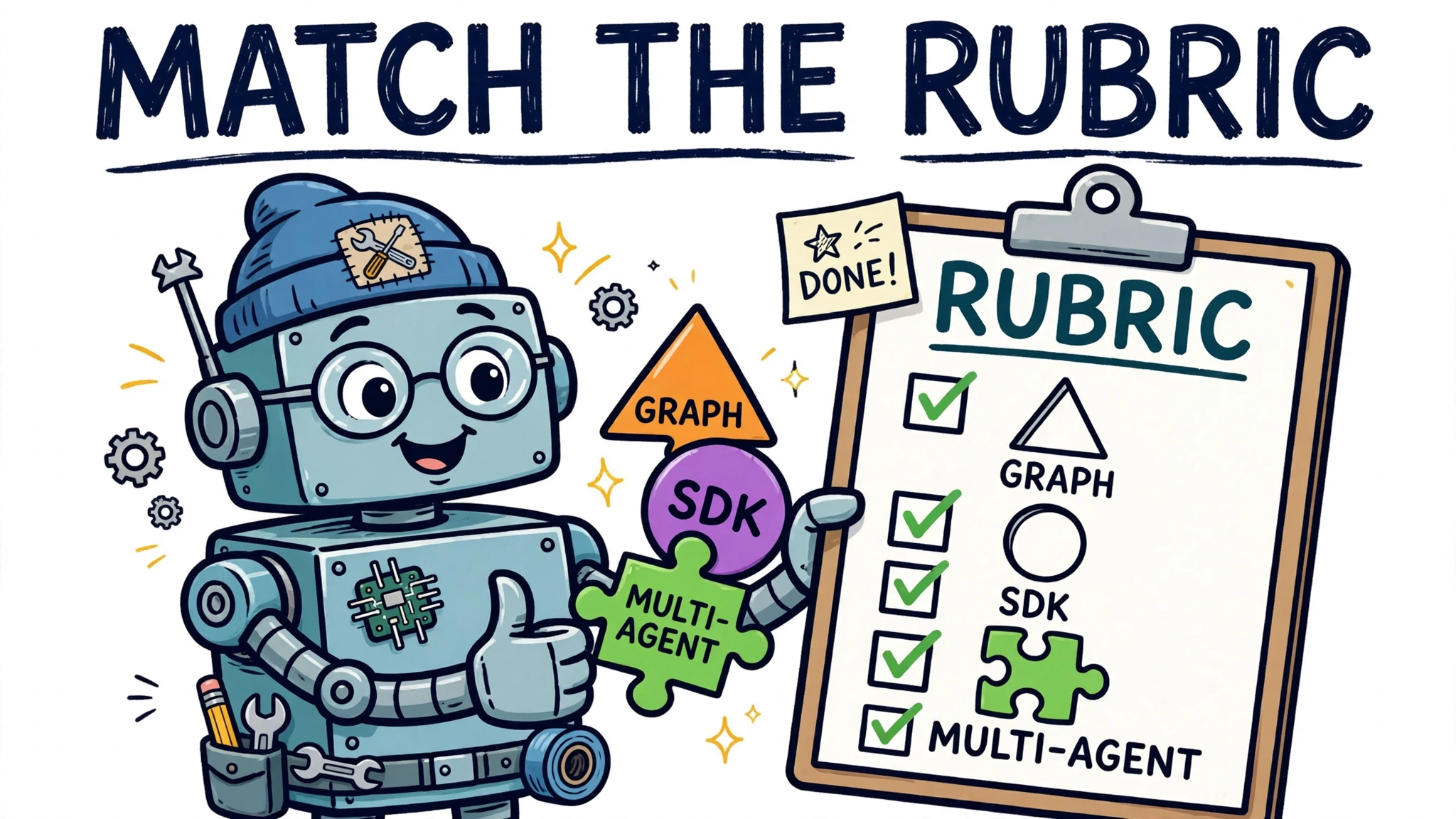
Apply this checklist in order — each question narrows the field.
1. Project complexity. Single task, multi-step workflow, or genuine multi-agent system? A single chain of tool calls does not need a multi-agent framework; adopting one is the classic premature abstraction. If you need looping, branching, retries, and human review gates, a graph-based framework earns its weight.
2. Team stack and ecosystem. Python shops have the widest field (LangGraph, CrewAI, OpenAI Agents SDK, LlamaIndex, Microsoft Agent Framework). .NET shops realistically choose the Microsoft Agent Framework. TypeScript teams can use the TS SDKs and packages of LangGraph, the OpenAI Agents SDK, or LlamaIndex.
3. Control vs speed. How much of the loop do you own? The comparison table above maps each framework on this axis — LangGraph’s explicit node-and-edge control at one end, CrewAI’s agent-delegated routing at the other, the OpenAI Agents SDK’s split in the middle. Match this to how much operational surprise your team can absorb.
4. Evaluation and observability before production. Observability claims vary; check what each framework actually exposes against the production test: “they help only when they expose state, tool calls, retries, and traces. If a framework hides those behind convenience, the convenience is a production liability.” LangGraph debugs with LangSmith; the OpenAI Agents SDK treats tracing as first-class; MAF ships OpenTelemetry-powered observability and Foundry evaluation dashboards; LlamaIndex Workflows offers optional OpenTelemetry instrumentation.
5. Vendor neutrality and lock-in risk. Protocol support is a portability hedge for the tool-interface layer: MCP-backed tools can move between frameworks that implement the protocol. It does not make the whole agent portable — control flow, state, and deployment stay framework-specific, which is exactly why the AutoGen-to-MAF migration requires redesigning control flow rather than renaming calls. The OpenAI Agents SDK ships an mcp_servers config; CrewAI connects via its MCPServerAdapter; LlamaIndex documents MCP tool usage; Microsoft Agent Framework ships native MCP and A2A in both SDKs.
Two worked selection scenarios
Scenario A: a customer-support agent for a mid-size team. Answer customer questions from an internal knowledge base, escalate to a human when confidence is low, log everything. The rubric: multi-step but single-agent (retrieve → draft → possibly escalate), so multi-agent orchestration is premature abstraction; the team is Python; escalations and review gates are compliance-relevant, so control matters; evaluation before production is a must. Recommendation: LangGraph with LangSmith — retrieve, draft, and escalate as nodes with explicit human-in-the-loop interrupts, checkpointing for resume-after-failure, and the tracing and evaluation surface the support team will need when the first mis-escalation gets reviewed.
Scenario B: an autonomous research agent chaining tools and memory. Take a research brief, plan web searches, database queries, and document reads, maintain memory across hours of work, produce a structured report. The rubric: genuinely multi-step with long-running state and tool diversity — an orchestration framework is warranted; the team is .NET-heavy and Azure-native; checkpointing and human review of expensive tool calls required; vendor neutrality argues for MCP-backed tools. Recommendation: Microsoft Agent Framework — graph workflows with checkpointing and pause/resume for long research loops, native MCP keeping the tool inventory portable, and a declarative workflow format that documents the research protocol for the whole team:
The minimal starting point is small enough to show its shape — the example below is illustrative pseudocode, not executable framework syntax:
# Illustrative pseudocode — the shape of a minimal agent setup
agent = create_agent(
    name="research-assistant",
    instructions="Research the brief, verify each claim, report findings.",
    tools=[web_search, document_store],
)
agent.run("Summarize the findings.")
From there, scale up the control the research documents: graph-based workflows with checkpointing, streaming, and human-in-the-loop approvals for the expensive or irreversible steps. Both the Microsoft Agent Framework’s 1.0 workflows and LangGraph’s graph runtime provide checkpoint-and-resume primitives. Where the agent’s work gets expensive, a human review gate on tool calls beats a retry policy.
Common mistakes when picking a framework
Choosing the most-hyped framework instead of the one matching your complexity. The survey figures stated above are adoption numbers, not recommendations. Match the framework to the rubric, not the leaderboard.
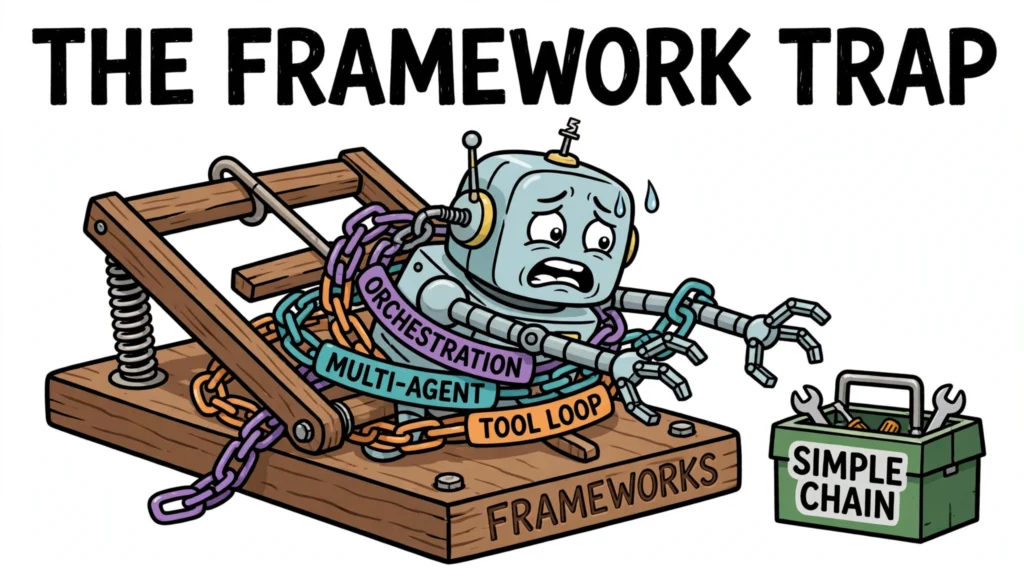
Premature abstraction. Multi-agent orchestration for a task a single chain handles. The cost is concrete: independent benchmarking reported a query consuming 487 tokens through the direct OpenAI API and 1,017 tokens through LangChain — about 2.09x as many tokens, or roughly 109% more — scoped to that single reported benchmark. (The source labels it a “2.7x overhead,” but its own numbers work out to ~2.09x.) Every framework header, tool schema, and routing instruction displaces working memory the agent could have used. Start with the least autonomous architecture that satisfies the task.
Skipping evaluation until after production. Gartner’s early-2026 survey of 3,412 enterprise AI projects projected that more than 40% of agentic AI initiatives will be canceled by 2027. Separately, practitioner guidance is clear: evaluate full trajectories, not final answers, before you ship — because agents that work in demos can degrade in the wild. The projection and the advice come from different evidence; treat both as reasons to evaluate early.
Ignoring framework churn and maintenance risk. AutoGen’s three-way split is the cautionary tale: old tutorials’ pip install autogen now yields AG2’s frozen classic while pyautogen yields Microsoft’s frozen 0.7, breaking import autogen — and porting to the Microsoft Agent Framework means redesigning control flow, not just renames. Check maintenance status and release cadence before committing a roadmap to any framework.
Where agent frameworks are heading
Three trends are reshaping what “framework choice” means.
Convergence toward standard agent protocols. MCP (Model Context Protocol, Anthropic’s open standard, donated to the Linux Foundation’s Agentic AI Foundation in December 2025) connects agents to tools; A2A (Google’s agent-to-agent protocol, v1.0 stable March 2026, Agent Cards for discovery, Tasks as the unit of delegated work) connects agents to agents. By mid-2026 more than 10,000 MCP servers were reportedly deployed in production, and 150+ organizations had A2A in production. The strategic point is optionality at the tool-interface layer — with the caveat from the rubric: protocol support shrinks the migration surface to each framework’s own abstractions, but control flow, state, and deployment stay framework-specific.
The shift from framework features to agent infrastructure. The differentiator is moving off the framework itself and onto surrounding infrastructure: evaluation services, memory services, identity and permissions for agents, hosted deployment. The practitioner guidance cuts across the whole debate: “choose the least autonomous architecture that satisfies the task, then add agentic flexibility only where the workflow genuinely needs a runtime decision.” The research-backed rationale for investing in eval and observability is simple: teams that do are better positioned to survive framework churn than teams chasing the newest framework API.
When to revisit your choice. Three signals your framework is holding you back: you are fighting its abstractions more than using them (the framework should not abstract your architecture); maintenance-risk checks start failing (frozen releases, three-way forks, conflicting install instructions); or your tool integrations are trapped in framework-specific adapters while the industry standardizes on MCP. A graph-based, protocol-friendly choice made today is the easiest kind to evolve tomorrow.