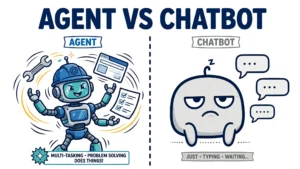
Ask what separates an autonomous agent from a chatbot with tools, and the honest answer is planning. Autonomous agent planning is the component that turns a vague goal — “research this market,” “fix this bug,” “draft the report” — into an ordered, revisable sequence of actions, and then keeps that sequence on track as the world pushes back. This article explains what planning does inside an autonomous agent architecture, the three patterns modern systems actually use, where the planner lives, what real plans look like, where planning breaks, and how to decide how much of it your agent needs.
Planning, defined: the part of the agent that decides what to do before doing it
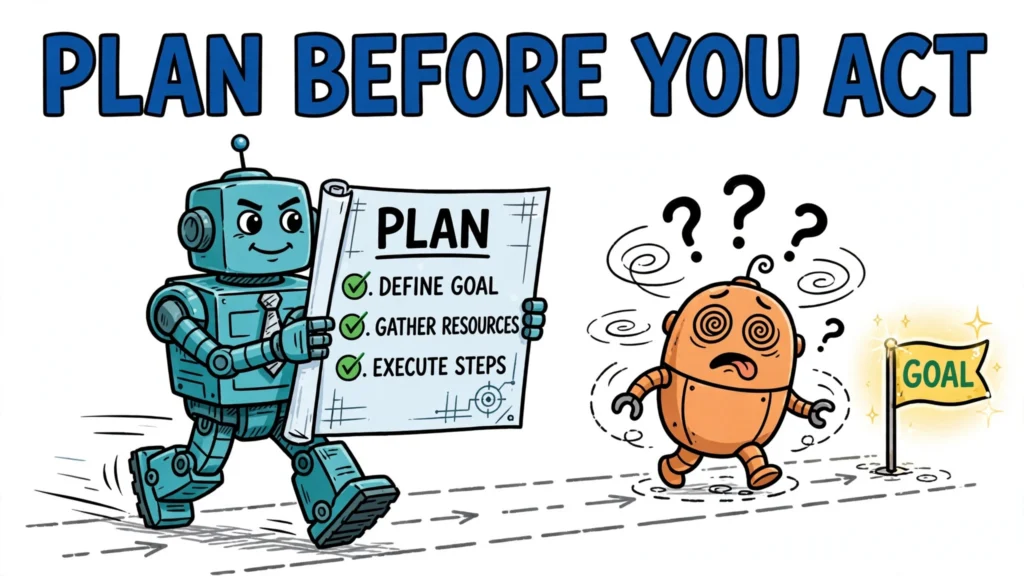
Planning is the commitment to a multi-step course of action. It sits above two jobs it is easy to confuse it with. Reasoning decides what to do now: given this observation, which action is best? Tool use is the doing itself: calling the API, running the query, writing the file. Planning is the layer above both: given the goal, what is the sequence of actions that gets there, and how will the agent know when to change it?
An agent without planning is purely reactive: it selects each action from the current observation, with no explicit model of where it is in a larger task. That can be enough for short, predictable jobs. It becomes fragile as tasks gain structure — dependencies between steps, information that must be gathered before deciding, or failures that call for a different approach rather than a retry of the same one. Planning gives the agent an explicit model of the whole task, not just the next move.
Why autonomous agents need planning at all
Human goals are underspecified. “Prepare the quarterly summary” says nothing about which sources to check, what to do when a source is down, or how to verify the numbers. Planning bridges the gap between that intent and concrete tool calls: it turns one fuzzy instruction into steps with an order, dependencies, and a notion of done.
That bridge offers three potential benefits. Efficiency: choosing each action against a sequence rather than in isolation can cut down on wandering. Explainability: a plan is inspectable — a human or reviewer system can read the intended sequence and see what the agent thought it was doing. Recovery: when a step fails, the failure maps to a specific plan node, so the agent can revise that node instead of restarting the whole task. The counterpoint is honest: for single-step or fully predictable tasks, planning can be pure overhead — tokens spent on structure the agent never needed.
The three planning patterns in modern agent architectures
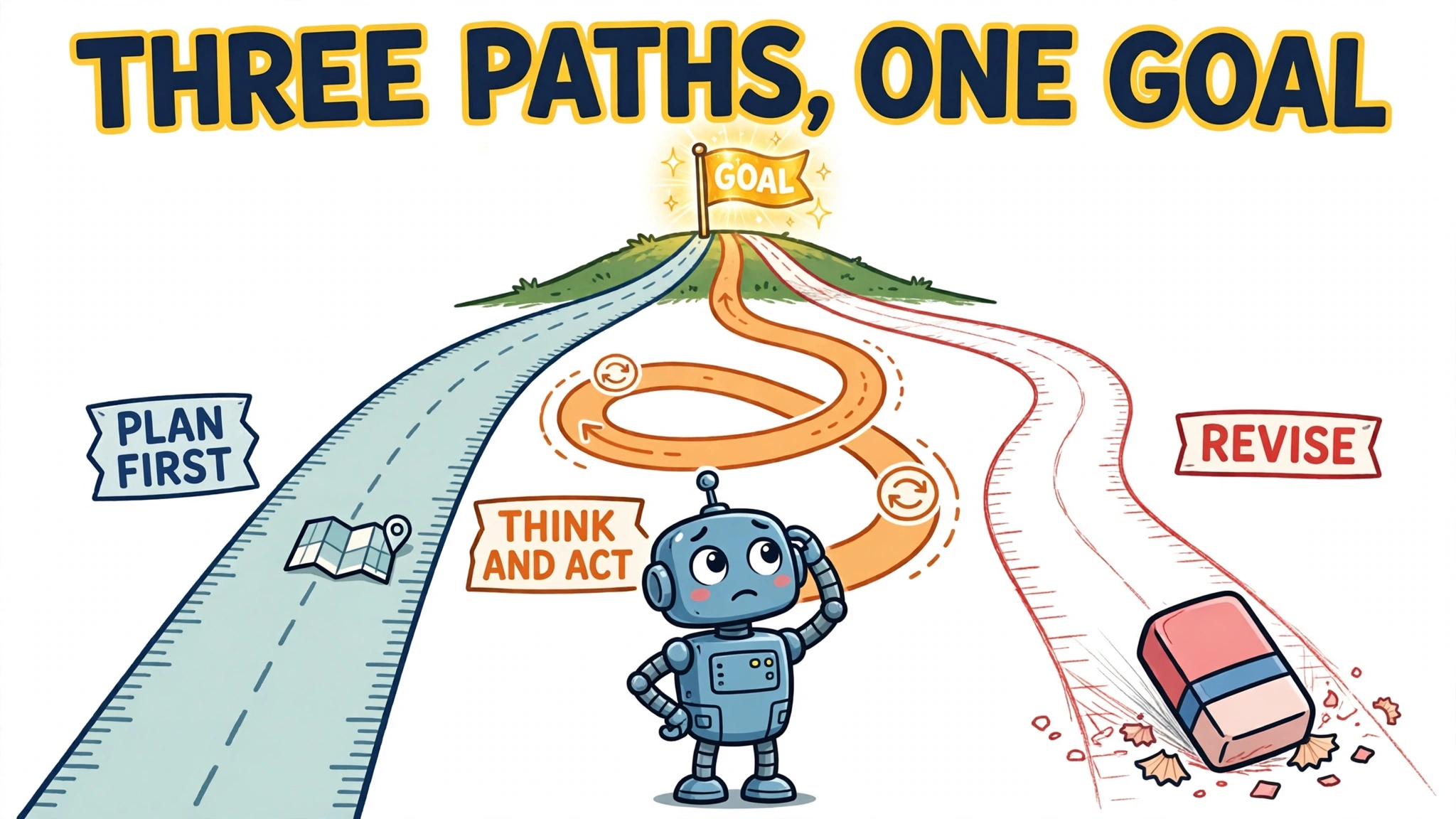
Strip away the framework branding and agent systems use three planning patterns — distinct answers to the question of when the plan gets made. They are not mutually exclusive; real systems combine them.
1. Decompose-then-execute: the plan comes first. The agent breaks the goal into subtasks up front, then works through them in order. Planning first guards against the missing-step problem of pure step-by-step reasoning, where the model can skip a necessary step without noticing. The plan is explicit from the start, which makes it easy to inspect — but also means any flaw in the initial decomposition propagates into every step that follows.
2. Interleaved plan-and-act: the plan emerges step by step. The agent thinks, acts, observes the result, and thinks again, in a tight loop. Reasoning traces let the model track and revise its implicit plan as observations arrive, while each action grounds the next round of reasoning in something actually observed rather than assumed. There is no separate planning phase; the plan lives in the ongoing reasoning and adapts continuously.
3. Reactive replanning: the plan is revised when reality disagrees. The agent maintains an explicit plan and rewrites it when observations diverge from expectations. Each executed step is compared against its expected outcome; when a step fails or an observation contradicts an assumption, the affected plan steps — or their dependencies — are revised rather than blindly retried. The plan stays a living document instead of a one-time script.
These patterns can also be combined: an agent might decompose up front, run an interleaved loop inside each step, and trigger replanning when a step fails. Whether to combine them is a design choice, not a requirement.
Where autonomous agent planning lives in the architecture
The dedicated planner. In planner-executor designs, planning is a separate component whose only job is to output a step list. An executor runs the steps, and failures route back to the planner for revision. The plan is an explicit artifact the system can inspect, log, and revise — which also makes it the natural place to enforce constraints before anything irreversible happens.
In-loop planning. In agents without a planner module, the main model plans inside its own reasoning: each round of thought can adjust the implicit plan based on the latest observation. Maximally flexible, but the plan exists only as text in context — harder to audit, version, or hand to another component.
The hybrid: plan as a persistent artifact. A high-level plan from a dedicated planner, low-level improvisation at execution time, and the plan persisted in memory across sessions — shared state that multiple agents, or a human supervisor, can read and modify.
The trade-off between these placements is consistent: dedicated planners buy control and auditability at the cost of rigidity and design effort; in-loop planning buys flexibility at the cost of opacity and token spend.
What a plan actually looks like: representations that work
Plans come in three common shapes. Sequential plans are ordered step lists — simple and readable when steps have few dependencies. Task graphs (directed acyclic graphs) add dependencies: step C needs the outputs of A and B, which can run in parallel. Plan-as-code expresses the plan as pseudocode or an actual program, giving the executor control flow — loops, conditionals, retries — directly.
Whatever the shape, robust plans share one property: every node carries its inputs, its expected outcome, and a fallback. The fallback is what makes a plan robust instead of merely optimistic. A plan node without a fallback is a wish; a plan node with one is a contingency. Here is a worked mini-plan for a realistic goal, in a shape an executor could consume. Step s2 declares term_sheet_schema as a structured output, and step s3 references it by its exact declared path. The dotted paths (s1.output, s2.outputs.term_sheet_schema) are an illustrative reference convention used in this article; production frameworks define their own resolution rules:
{
  "goal": "Summarize key terms and renewal dates from three vendor contracts",
  "steps": [
    {
      "id": "s1",
      "action": "retrieve_contract",
      "inputs": {"vendor": "Acme Corp", "source": "contract_repository"},
      "expected_outcome": "Full contract text for Acme Corp in context",
      "fallback": "If retrieval fails, ask the user to upload the document"
    },
    {
      "id": "s2",
      "action": "extract_terms",
      "inputs": {"document": "s1.output", "fields": ["term_length", "renewal_date", "termination_clause"]},
      "outputs": {
        "term_sheet": "Structured term sheet for Acme Corp",
        "term_sheet_schema": {"term_length": "string", "renewal_date": "date", "termination_clause": "string"}
      },
      "expected_outcome": "Term sheet and its schema available for downstream steps",
      "note": "Downstream steps must reference s2.outputs.term_sheet and s2.outputs.term_sheet_schema by these exact paths",
      "fallback": "If extraction is ambiguous, quote the clause verbatim and flag for review"
    },
    {
      "id": "s3",
      "action": "extract_remaining",
      "inputs": {"vendors": ["Globex", "Initech"], "schema": "s2.outputs.term_sheet_schema"},
      "depends_on": ["s2"],
      "outputs": {"term_sheets": "Term sheets for Globex and Initech, same fields as s2.outputs.term_sheet_schema"},
      "expected_outcome": "Two more term sheets with fields identical to s2",
      "note": "Each remaining vendor is processed as retrieve-then-extract, mirroring s1 and s2",
      "fallback": "If a vendor's contract is missing fields, mark them unknown rather than inferring"
    },
    {
      "id": "s4",
      "action": "summarize",
      "inputs": {"term_sheets": ["s2.outputs.term_sheet", "s3.outputs.term_sheets"]},
      "depends_on": ["s3"],
      "expected_outcome": "Comparison table with renewal dates highlighted",
      "fallback": "If summaries conflict, surface the conflict instead of reconciling silently"
    }
  ]
}
Dependencies prevent wasted work, expected outcomes give the executor something to check against, and fallbacks pre-decide what happens when — not if — something goes wrong.
Where planning breaks: failure modes and hard limits
Unreliable self-verification. A plan’s fluency is not evidence of its validity. Treat every generated plan as a draft until something independent checks it — a verifier, a test, or a human reviewer.
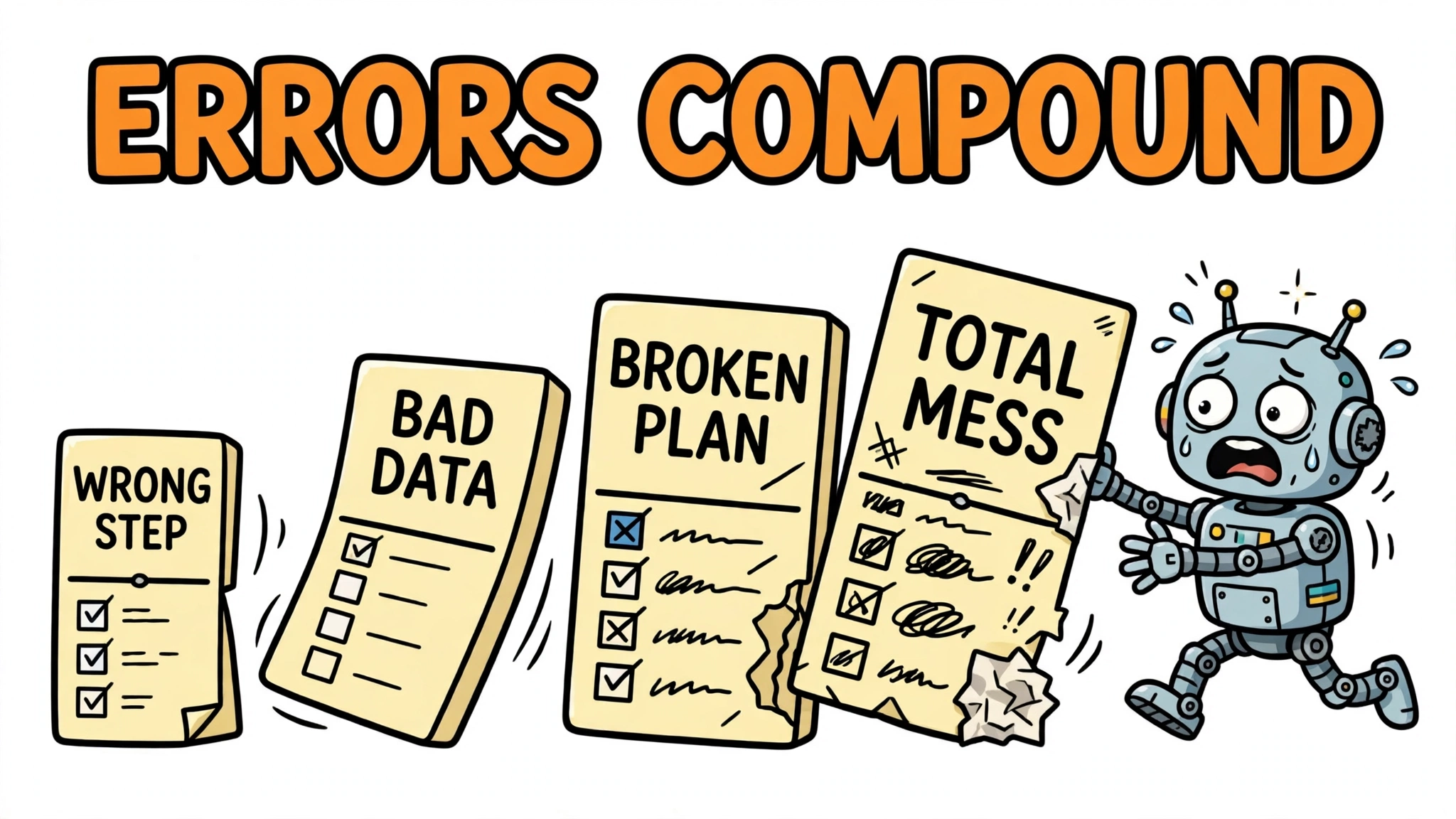
Error compounding. In a multi-step task, an early mistake poisons everything downstream: the wrong document retrieved in step one corrupts every analysis built on it, and the agent has no signal that the foundation is rotten. That is why explicit plans give every node an expected outcome: each step gets checked against something before the error spreads.
The planning fallacy. Plans tend to under-specify steps and overestimate the odds of success. A step like “analyze the data” hides five sub-steps; a plan that lists it as one node will declare victory early and often. The defense is explicit completion criteria: each node should say what “done” looks like, so under-specification is visible before execution rather than discovered after.
Brittle plans and cost. A plan is a bet that the world stays still long enough to execute it; in fast-changing environments it goes stale faster than the replanner can revise it. Upfront-planning designs need an explicit answer for this case, which is one reason reactive replanning exists. And planning burns tokens and time: planner calls, validation, retries, and replanning loops all add up, with diminishing returns per layer. For latency- or cost-sensitive deployments, the planning budget is a real constraint.
How much planning does your agent need: a practical decision guide
Four factors determine the answer. Task horizon: longer sequences with more dependencies repay planning; a simple, predictable, low-risk two-step lookup is a case where a separate planning phase may add little value. Environment dynamism: stable environments reward upfront decomposition, volatile ones reward interleaved planning and fast replanning. Cost of a wrong action: reversible actions (a search query) can be tried and revised; irreversible ones (sending an email, charging a card) deserve verified plans. Need for auditability: high-stakes settings need the plan as an artifact a human can approve and review — which alone pushes toward dedicated planners and persisted plans.
Three common mistakes. Over-planning a volatile task — a beautiful twenty-step plan for inputs that change hourly. Under-planning a long deterministic workflow — letting a reactive loop wander through what could have been a checklist. No replanning trigger: a plan with no defined condition for revising it leaves the agent retrying the same failing step forever or silently drifting off-plan.
The rule of thumb: plan proportionally to the irreversibility of the actions. Cheap, reversible steps can be improvised; expensive, irreversible ones should be planned, validated, and replanned when the world disagrees.