Ask an AI agent a question today, then ask a follow-up next week, and you will discover quickly whether it actually remembers you. Understanding ai agent memory retention means understanding the machinery that sits around the language model: the stores, summaries and retrieval steps that let a stateless model behave as if it has a past. This article explains how that machinery works, where it breaks, and how to choose the right approach for an agent you are building or evaluating.
What ai agent memory retention actually means
Start with a distinction that clears up most confusion. A context window is not memory. It is the working space a model can read in a single request: the conversation so far, the instructions, and whatever retrieved material you place in front of it. Memory is everything that persists outside that window and gets selected back into it later.
That gives us two kinds of retention. Short-term retention covers what the agent holds within one session or task: the recent turns, the tool results, the decisions made a few minutes ago. Long-term retention covers what survives across sessions: facts about the user, preferences, past outcomes, and lessons from earlier work.
There is a reason this layer exists at all. A language model on its own is stateless between calls: the client resends the conversation history with every request. Without an external memory layer, every session starts from zero, and every long task eventually outgrows the window it is working in. Memory is the engineering answer to both problems.
How agents retain context within a single run
Within a run, the simplest strategy is to keep the whole transcript and send it again each time. That works until it does not: the transcript grows, cost grows with it, and response quality degrades as the active context gets larger. So production agents manage the window actively.
The most common technique is summarization, sometimes called compaction. When the conversation approaches a token threshold, the system asks a model to summarize the older turns and replaces them with that summary. Anthropic’s documentation describes it plainly: when a conversation approaches the context window limit, the model summarizes earlier messages so the conversation can continue seamlessly. In the Claude API, server-side compaction can be configured with a default trigger of 150,000 input tokens and a minimum of 50,000.
Compaction keeps the thread of the conversation but drops verbatim detail. That trade is usually worth making, but it has a known cost: exact figures, long quoted passages and detailed instructions from early in the conversation can blur or disappear. The defence is to tell the summarizer explicitly what must survive, such as identifiers, decisions and outstanding tasks, rather than accepting a generic summary.
Other in-session strategies sit alongside summarization. A sliding window keeps only the most recent turns and drops the rest, which suits short, task-oriented interactions. When the window fills, the agent can also restate its goal and start a fresh context, carrying over only a short summary. The right choice depends on how much of the early conversation the later steps genuinely need.
How agents remember across sessions

Cross-session memory needs a store that outlives any single conversation, plus a way to find the right items again. The reference design comes from Park and colleagues’ Generative Agents paper from 2023, which wrapped a language model in an architecture with three parts: a memory stream, reflection, and planning. The memory stream records experiences in natural language, and the design scores memories for retrieval.
Retrieval in that design scores every memory on three components: recency, which decays exponentially over time; importance, a rating the model assigns when the memory is created; and relevance, the similarity between the memory’s embedding and the current situation. Only the highest-scoring memories are placed into the prompt for the next decision. Retrieving a small relevant subset, rather than everything, is still the core idea behind modern agent memory.
Modern frameworks split the store into layers. In LangChain v1, short-term memory is the conversation thread itself, saved by a checkpointer keyed by a thread identifier, while long-term memory is anything that should carry across threads, kept in a store of namespaced documents or in an external memory service.
The retrieval mechanism for the long-term store is usually vector search. Past exchanges or facts are converted into embeddings and stored in a vector database; at query time the agent embeds the current situation and retrieves only the most semantically similar items. This is why retrieval-augmented memory grounds recall in stored records rather than in the model’s weights: the agent is reading its own notes, not trying to remember something it was never trained on.
How agents decide what to remember and what to forget
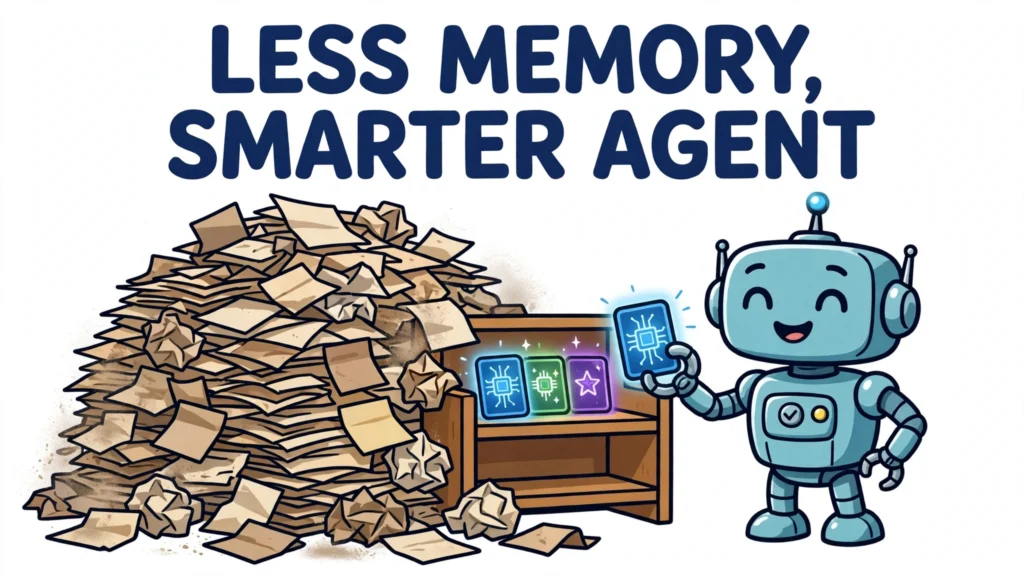
Retention is an active design choice, not automatic storage. If an agent stored everything verbatim forever, retrieval would drown in noise and cost would grow without bound. So memory systems filter, compress and expire.
Importance scoring is the first filter. Following the Generative Agents pattern, a memory can be scored when it is created, so that a breakup or a job change outranks eating breakfast.
Summarization is the second filter. The agent periodically synthesizes higher-level conclusions from recent material, a process the Generative Agents paper calls reflection. When accumulated importance passes a threshold, the agent generates reflections from recent memories and stores those reflections back in the stream, where they can be retrieved like any other memory. Reflection adds conclusions to the stream rather than replacing it: whether older records are summarized, replaced or deleted is a separate retention policy, distinct from reflection itself.
Forgetting is the third mechanism, and it is just as important. Memories can decay with time, expire after a set period, or be deleted on user request. ChatGPT’s memory illustrates the user-control side: it keeps discrete saved memories that users can view, edit and delete individually, alongside a broader reference layer drawn from past conversations. Deleting a chat does not delete memories created from it, and turning off reference chat history deletes what was learned from past chats within 30 days. Any agent memory design needs the same clarity about what deletion actually deletes.
A practical memory architecture, step by step
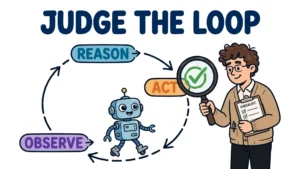
Putting the pieces together, a workable architecture has five steps that repeat on every turn. First, observe: the agent records what happened, as a short natural-language entry with a timestamp. Second, write: the entry goes into the short-term thread and, if it clears an importance bar, into the long-term store as well. Third, retrieve: before acting, the agent queries the long-term store with the current situation and pulls back the most relevant memories. Fourth, use: the retrieved memories join the recent turns in the prompt, and the model acts. Fifth, update: the outcome is recorded, and older material is summarized or expired on schedule.
A single memory record in such a system might look like this:
{
  "text": "User prefers concise answers with no introductory summary.",
  "created_at": "2026-10-14T09:32:00Z",
  "last_retrieved_at": "2026-10-28T16:05:00Z",
  "importance": 8,
  "source": "user statement in session 41"
}
In this example architecture, four metadata fields make the policies above workable: creation and retrieval timestamps support recency decay, an importance score supports prioritization, and a source supports auditing and correction. They are useful defaults for this design, not requirements every memory system must carry: other designs prioritize using relevance and recency alone, or track provenance differently.
Where does each memory type live in this flow? The short-term thread holds the current session. The vector store holds semantic facts and past exchanges worth retrieving by meaning. A structured store holds entities the user mentions, such as people, projects and preferences, where exact lookup beats similarity search. And a summary store holds reflections and session summaries, the compressed version of history that keeps long tasks affordable.
Where agent memory breaks down
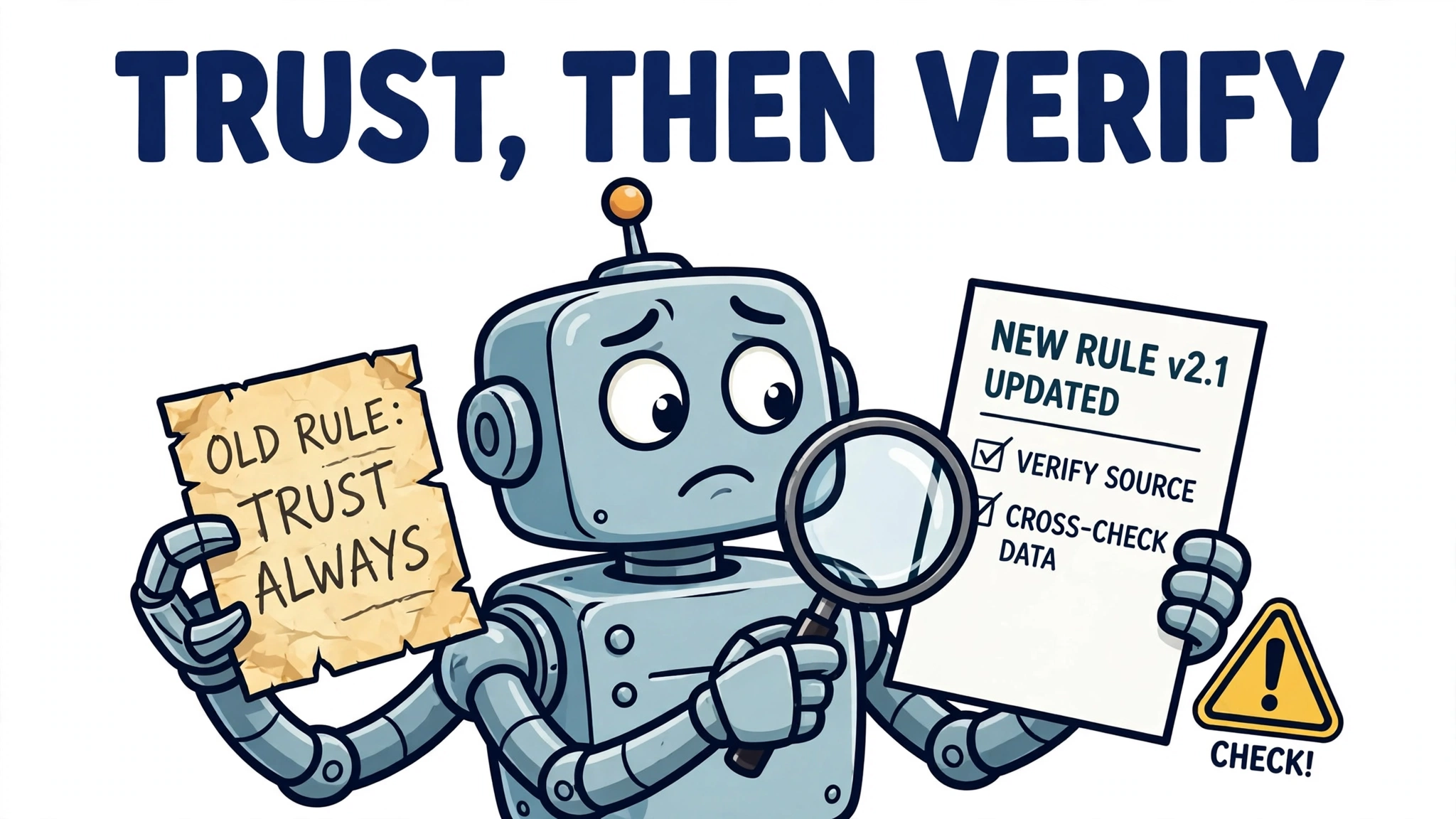
Memory failures are not edge cases; they are the normal failure modes of the architecture, and a good design names them in advance. The first is staleness. Stored facts go out of date, and a memory system that never revisits its entries will confidently apply last year’s preference to this year’s user. OpenAI redesigned ChatGPT memory in June 2026 for exactly this reason, because manually managed memories went stale and contradicted each other.
The second is hallucinated recall. A summary can invent a detail that was never in the original conversation, and a retrieved memory can be misread as applying to a situation it does not describe. The mitigation is provenance: keep the source of each memory, and let users inspect and correct what the agent believes.
The third is the long-range recall gap, and benchmarks have now measured it precisely. LoCoMo, a benchmark of 50 multi-session dialogues averaging over 300 turns and 9,000 tokens across up to 35 sessions, tests recall across single-hop, multi-hop, temporal and open-domain questions. A 2026 benchmark comparing memory strategies found that on LoCoMo’s long-range questions, where the needed turn sits many sessions back, window-based, summary-based and graph-based strategies retrieved almost nothing, while dense retrieval over an external key-value store reached a Recall@5 of 0.573. The lesson is blunt: if your agent must recall distant facts, a longer window is not a substitute for a real retrieval store.
Finally, there are privacy, security and cost trade-offs. A persistent memory store is a sensitive database: it accumulates personal facts, it can leak across users if scoping fails, and every retrieval adds latency and token cost. LongMemEval, a 500-question benchmark covering knowledge updates, temporal reasoning and multi-session recall, shows accuracy falling by 30 to 60 percent as histories lengthen, a reminder that longer memory is not automatically better memory.
Choosing the right memory approach for your agent
So how do you choose? Start with what the agent must recall, how large its context gets, and how long information must persist. If every task fits in one short session, session-only memory with a sliding window or a summary is often enough, but short sessions can still benefit from cross-session preferences, such as a standing user preference recalled across many brief chats. If users return and expect continuity, a persisted conversation thread can carry state forward, and a separate long-term retrieval store becomes useful when recall must reach across threads or beyond what the retained context holds. If tasks run for hours or days, compaction can keep a single run going with persisted thread state carrying it forward, and you should budget for the summarization passes as real cost.
Then ask three questions before adding a memory layer. First, what must be recalled verbatim, and what can safely live as a summary? Verbatim needs dominate the design: they push you toward stored records with provenance. Second, how will a stale or wrong memory be detected and corrected? If there is no answer, the memory layer will eventually mislead with confidence. Third, who can see, export and delete each stored item? If deletion does not reach every copy, including summaries derived from the original, you do not have a deletion story yet.
A short checklist captures the rest. Scope every memory to one user or tenant with enforced access isolation; a shared underlying store is acceptable when namespaces isolate tenants correctly. Record source and timestamps on entries where provenance and recency matter for retrieval. Set an importance bar for long-term storage, and an expiry or review policy for what gets in. Prefer dense retrieval over longer windows for distant recall. And treat summaries as lossy by design: instruct the summarizer on what must survive, and verify the summary on the facts that matter most. Signs you need less memory, not more, include rising retrieval noise, growing cost without better outcomes, and users correcting the agent about things it claims to remember.
AI agents do not remember the way people do. They store, summarize, retrieve and forget, each step governed by a design decision someone made. Get those decisions right, and an agent can carry context across sessions without drowning in it. Get them wrong, and it will remember confidently, at length, and incorrectly. The difference is not a bigger context window. It is a memory architecture built for the horizon you actually need.