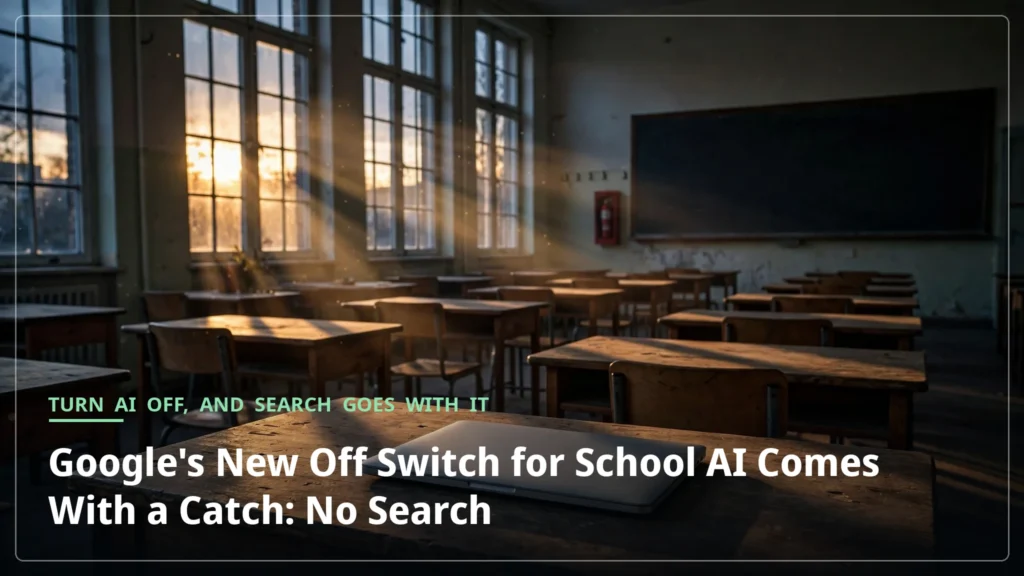



Google has a new answer for schools that are uneasy about artificial intelligence in the classroom: turn it off. The catch, announced in the same breath, is that turning it off may also turn off something schools have relied on for years — Search itself.
On Tuesday, Google said that access to Gemini, Gemini Notebook, Gemini in Classroom, and Google Search will be entirely off for K-12 student accounts until a school administrator explicitly turns them on. The change, planned for next year, follows consultations with schools, teachers, leading researchers, and policymakers, according to Google. More specifics are promised in the coming months, ahead of the rollout.
That sounds like control, handed back to the people who run schools. And in part, it is. The trouble is in the fine print of how Search now works — or, more precisely, how it no longer works on its own.
The choice that is not quite a choice

Google’s vice president and general manager for education, Chris Phillips, told The New York Times that “Search and AI are deeply integrated.” The consequence, as reported by TechCrunch, is blunt: if a school chooses to restrict AI altogether, students “will not have access to search, and they’ll see a message from their school that indicates it’s not available.”
Schools that want to keep Google Search, TechCrunch reports, will have to accept its AI features. That is the trade at the heart of the announcement. A school administrator is not being offered a dial with a separate setting for AI and a separate setting for Search. For Search, at least, the two come as one.
There is one important qualification, and it matters. Google clarified to Engadget that administrators will be able to enable the products individually, and that the change is not an all-or-nothing deal. A school can, in other words, switch on Gemini and leave something else off. What it apparently cannot do is switch on an AI-free version of Search, because Google says no such separable product exists inside its current design.
That distinction is where the drama of this story really sits. The off switch is real, but its reach stops at the search box.
Why the search box matters so much
Consider a teacher who does not want students using AI to complete an assignment, but still wants those same students to be able to search for sources and learning materials. Under the new arrangement, those two wishes cannot both be granted through Google’s tools.
A district that rejects the bundle could adopt another search engine or other classroom tools instead of staying inside Google’s suite. That option is available to schools that choose it.
The announcement also lands in places that have already made up their minds about AI in schools. Engadget notes that several jurisdictions have limited generative AI in schools, including a one-year moratorium in New York City in September for public school students through eighth grade, and a similar ban in Los Angeles that same month. For those districts, the question is no longer abstract: what happens to Search access for the students covered by their restrictions is now a practical problem to solve, not a hypothetical to debate.
A reversal, and a tutor in the same announcement

Google’s move is also a reversal. Engadget reports that in August, Google enabled certain AI features by default in Classroom, a shift that prompted backlash from educators, as reported by The New York Times, leading Google to reverse course. The new default-off setting is, in that light, a reversal of that August change, which Engadget reports followed educator backlash.
Alongside the controls, Google is promoting a different vision of classroom AI. Guided Learning, which coaches students through problems step by step rather than giving direct answers, is globally available in Google Classroom from Tuesday for activities assigned by a teacher.
Search is next. Google is building Guided Learning into Search for student accounts, so that Search will walk students through the topic step by step, without going directly to the answer. A pilot in select U.S. schools starts later this month, with expansion to other districts in the coming months.
What Google is really asking schools to decide
Phillips frames the change in the language of trust. “Our goal is simple,” he wrote in Google’s blog post, “provide school leaders the control and confidence to use AI products in classrooms as they see fit.”
Take that at face value, and the announcement is a genuine concession: no more AI by default, administrators in charge, a study tool designed to teach rather than tell. Take it alongside the Search condition, and the concession looks narrower. School leaders do get control — over which Google products to switch on, and over whether to accept the bundle that Search has become.
That is not a trivial distinction, and it is not a conspiracy either. If AI features are genuinely built into Search, as Google says they are, then there may simply be no AI-free Search left to offer. The counterargument deserves its weight: the bundling may be a technical reality, not a bargaining tactic, and default-off is still more control than schools had under the August default-on change.
But technical realities have consequences too. A school that restricts AI altogether loses Google Search access for its affected student accounts, while a school that accepts the bundle keeps it. That is the documented trade-off, and it falls on the schools that choose restriction.
The questions still unanswered
Several questions remain open, and they are the ones administrators will actually need answered before they can decide. What exactly counts as restricting AI “altogether”? Is there any configuration that preserves ordinary searching without AI features? When, precisely, do the new controls roll out next year? And what will districts with existing AI restrictions do about Search access in the meantime?
Those are not rhetorical questions. They are the difference between a control that schools can use and a choice that schools can only accept. Google says it will share more specifics in the coming months so schools have time to prepare. Until then, the headline of this announcement is accurate in both halves: Google is giving schools an off switch for AI. It is just also telling them, plainly, what that switch turns off along with it.