

AI agent data integration is how an AI agent reaches information that lives outside its own training and outside the current conversation. A language model on its own can only work with what it was trained on and what has been put into its context. When a question needs a live order status, a private company document, or a record in a business system, something outside the model has to supply that information, in a form the model can use, and check what comes back. This article explains the three main ways that happens — tool calling, retrieval, and standard connectors — how to choose between them, and how to build an integration that stays safe when it goes wrong.
How an agent reaches outside data: the basic loop
The core pattern is a loop, not a single lookup. The agent reasons about the task, selects a tool or a retrieval step, receives a result, and then reasons again in light of that result. The result becomes new context for the next step. It does not become new training: the model has not learned the fact permanently, it has simply been shown it for this task.
That distinction matters. Because the result is only context, the agent can be shown fresh information, private information, and information that changed after training, without retraining anything. It also means the quality of the answer depends on the quality of what the loop retrieves. If the loop fetches the wrong record, an out-of-date document, or a partial result, bad input can lead to confident but incorrect reasoning, and checks in the loop help detect or reduce this risk.
Every method in this article is a variation on that loop. They differ in what the loop reaches for, how it describes what it wants, and how much the outside system is allowed to do in return.
Tool calling for AI agent data integration: live APIs and actions

Tool calling is the most direct route to a live system. The application declares a set of functions the model may call, each described by a JSON schema that gives the function’s name, a natural-language description of what it does, and the arguments it takes, including their types and which ones are required. The model decides which function, if any, fits the current step, and fills in the arguments from the conversation. The application — not the model — then executes that function, for example by calling an API, querying a database, or sending a message, and feeds the result back to the model for interpretation.
Here is what such a declaration looks like in outline:
{
  "type": "function",
  "name": "lookup_order",
  "description": "Look up a customer order by its order ID.",
  "parameters": {
    "type": "object",
    "properties": {
      "order_id": {
        "type": "string",
        "description": "The order identifier."
      }
    },
    "required": ["order_id"]
  }
}
The description is doing real work here. It is the model’s manual for the tool: it tells the model when to use it and what the arguments mean. A vague description produces vague tool choices, so good tool definitions are written as carefully as good documentation.
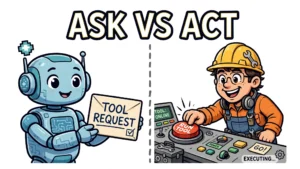
Tool calling is also the route by which an agent does things, not just reads things. A tool can look up a record, but it can also create a ticket, update a record, or send a message. That is why the application, not the model, must remain the authority that actually runs the tool. The model proposes; the code around it disposes, checking the arguments, the permissions, and whether the action is allowed at all before anything changes.
Retrieval over documents and knowledge bases
Not every question needs a live system. Many need a document: a policy, a manual, a support article, a piece of internal guidance. Retrieval-augmented generation, usually shortened to RAG, is the pattern for that case. It comes from a 2020 paper led by Patrick Lewis that combined two kinds of memory: parametric memory, the knowledge stored in the model’s trained parameters, and non-parametric memory, information held outside the model and retrieved when needed.
In a RAG system, documents are prepared for search in advance — split into passages and indexed, often as numerical vectors, though keyword search, SQL queries, metadata filters, and hybrid search can all serve as the retrieval step. At answer time, the system retrieves the passages most relevant to the question and supplies them to the model together with the question itself. The model then generates an answer grounded in those passages, rather than relying only on what it remembers from training.
That grounding is the point, and also the limit. Retrieval can reduce the model’s reliance on recalled text, but it does not guarantee accuracy. The right document may not be retrieved at all, the retrieved passage may not actually support the claim attached to it, or the model may fall back on its internal knowledge when the retrieved context is weak. A grounded-looking answer can still be wrong, especially if the source itself contains an error. Retrieval therefore suits questions where the answer should come from a specific, approved body of material — FAQs, manuals, policies, internal knowledge bases — and where the system has a way to say it could not find a reliable answer, rather than guessing fluently.
Standard connectors and protocols for tool access
Hand-wiring every integration can repeat connection and configuration work. Each new system can mean a new description format, a new authentication arrangement, and a new client. A standard connector protocol tries to remove that repeated work by agreeing, once, on how a client discovers and calls tools on an external server.
The Model Context Protocol, introduced by Anthropic in November 2024, is an example. It is an open standard for connecting AI applications to the systems where data lives, including content repositories, business tools, and development environments. Developers expose data through MCP servers, or build MCP clients that connect to those servers. Pre-built servers exist for systems such as Google Drive, Slack, GitHub, Git, and Postgres. A server exposes three kinds of capability: tools, which are callable functions; resources, which are readable data such as files or database rows; and prompts, which are reusable templates.
The benefit is reuse: a tool written once as a server can be reached by compatible clients that speak the protocol and support its capabilities, subject to authentication, permissions and versions, instead of being rewritten for each framework. The work that does not go away is everything around the connection — authentication, permission scoping, and versioning at each server, and deciding which tools a given client should even be allowed to see. A protocol standardises the conversation; it does not decide who is allowed to have it.
Structured versus unstructured sources: choosing the right route
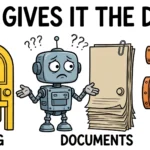
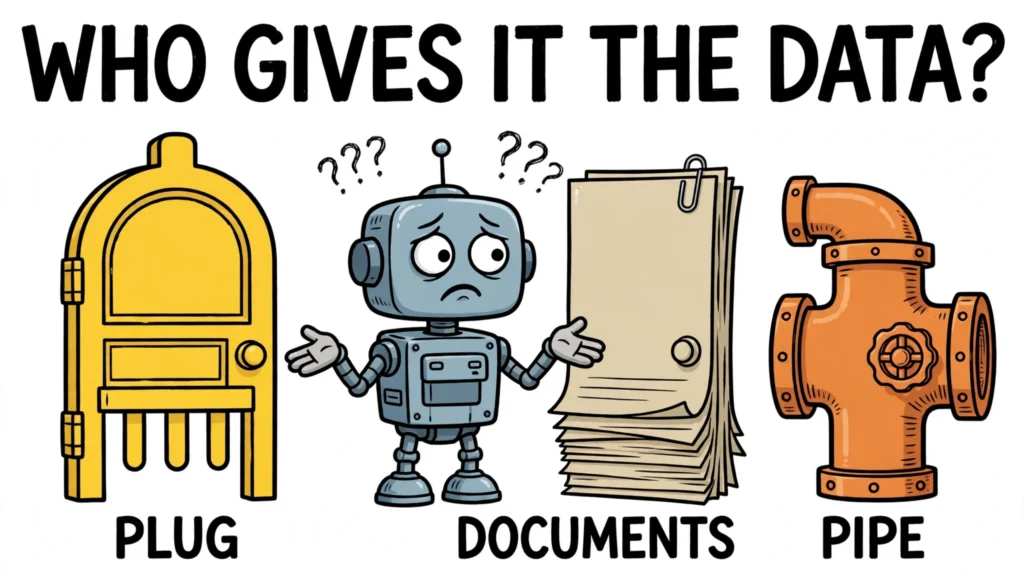
With three methods available, the practical question is which one a given source calls for. The decision rule is simpler than the catalogue:
Use live APIs and tool calling when the data is current, transactional, or permissioned — an order status, an inventory level, a calendar, a record that only the owning system can vouch for, or any action that changes something. For such records, a live API is the preferred route when the task requires authoritative current state or an action.
Use retrieval when the answer lives in documents, history, or knowledge that changes slowly — a policy, a manual, a set of past support cases, an internal wiki. Here the point is not freshness to the second, but finding the right passage in a large body of material and showing the answer’s grounding.
Use a standard connector when the same source will be reached by more than one agent, application, or team, and the cost of maintaining a custom integration for each of them outweighs the cost of adopting the shared protocol. In practice, many agents combine methods in a single task: retrieve the policy that governs a refund, then call the live API to check the order, then call another tool to issue the refund, with each step’s result feeding the next.
Building an integration, step by step
Building an integration well is mostly a matter of doing the boring steps in order, before widening access.
First, define what the agent may read and what it may change. Write that down as a boundary, not as a hope: which systems, which records, which operations, and which operations are explicitly out of bounds. Second, choose the integration route per source using the rule above, and declare each tool precisely — a clear name, a description that says when to use it, and arguments with types and required fields. Third, authenticate with least-privilege credentials: a separate identity for the agent, only the scopes the task needs, and short-lived credentials where possible. Test each tool in isolation, with real arguments, before the agent ever chooses it on its own.
Fourth, add grounding, validation, and error handling before widening access. Validate tool arguments in code, not in the prompt: check types, ranges, and that identifiers belong to the right tenant or record. Decide what happens when a tool fails, returns nothing, or returns something unexpected — retry, ask for clarification, or stop and escalate, rather than improvising. Fifth, log every tool call: the tool, its arguments, its result, and the decision that followed. When something surprising happens in production, that log is an important basis for tracing and reconstructing what the agent actually did, as opposed to what it was supposed to do.
Permissions, freshness, failures and common mistakes

One failure mode for agent integrations is stale or partial data producing a confident but wrong answer: a retrieved document that has been superseded, an API result truncated by a page limit, a search that returned the nearest match rather than the right one. The defence is to check freshness and completeness at the point of use, and to prefer saying that the evidence is missing over filling the gap with a guess.
The second is over-broad permission. A read-only question becomes an unintended action when the agent holds a tool it does not need, or a credential with more scope than the task requires. Least privilege is a property of the execution path, not of the prompt: the model may propose a tool call, but it must not be the authority that grants it. Sensitive or irreversible actions need a human approval step, enforced in code outside the model, so that the check still holds when the model is confused or manipulated.
The common mistakes follow from those two. Trusting tool output without checking it. Skipping pagination and result limits, and therefore reasoning from the first page as if it were the whole answer. Giving the agent every available tool instead of the small allowlist the task needs, which turns every misunderstanding into a larger blast radius. And treating a prompt instruction — “be careful”, “only read” — as if it were a permission control. It is not. The permission list, the argument validation, and the approval step are the controls; the prompt is only a suggestion to a system that can be mistaken, or misled, about what it was asked to do.
Done well, AI agent data integration is unglamorous in the best way: the agent asks the right system, through the right method, with the least access it needs, and every step leaves a trace. The model supplies the reasoning; the integration supplies the facts, the actions, and the limits. Keep those jobs separate, and the agent stays useful instead of becoming a confident stranger with the keys to your systems.