


Introduction to Indegene and its role in life sciences.
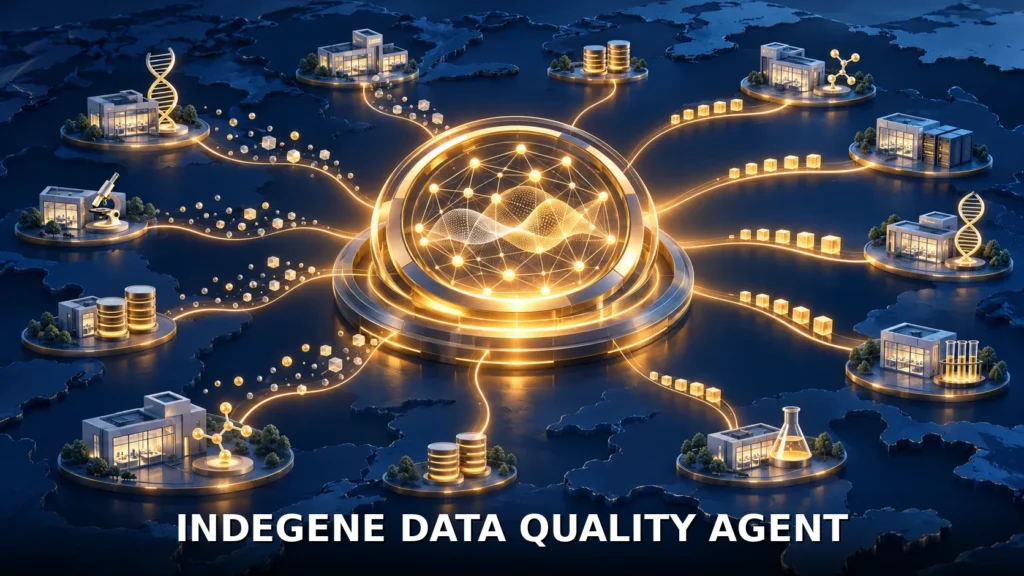
Indegene has built a large language model-powered Data Quality Agent inside its NEXT Unified Data Platform (NEXT UDP) on AWS. The system recommends data quality rules using enterprise and reference knowledge, generates SQL and Python for approved rules, and places human review within a centralized governance workflow. Its purpose is to reduce the work of creating and maintaining checks while keeping those checks connected to business context.
The development addresses a practical question for life sciences organizations adopting enterprise AI: how can they maintain trusted data as datasets, platforms, and business definitions multiply? Indegene’s answer combines conventional profiling and anomaly detection with generative AI that helps translate contextual knowledge into validation rules.
The details come from an AWS account co-written with Indegene. That account describes the agent as production-grade. It provides an architecture and workflow, but the supplied evidence contains no quantified implementation results or independent benchmark. The documented design therefore supports analysis of how the system works; claims about productivity and enterprise-scale improvement remain attributed to the companies presenting it.
Indegene describes itself as a strategic operating partner to life sciences businesses, working across commercial, medical, research and development, and safety operations. This context matters because data quality involves more than checking whether a record has the right structure. The same data must also make sense within the business process that uses it.
NEXT UDP brings commercial, medical, clinical, and enterprise data into a governed environment spanning ingestion through analytics. The Data Quality Agent sits within that broader platform, alongside agents for ingestion, orchestration, data cataloging, and SQL generation. The source says these agents can operate individually within data pipelines or be customized for agent-to-agent communication. It does not establish that every deployment uses coordinated agents.
Challenges in maintaining data quality in growing enterprise data.

The central difficulty described in the source is a split between technical and business ownership. Data engineers typically create rules that establish structural correctness. Business teams supply the operational definitions that determine whether otherwise valid data is meaningful. Those bodies of knowledge often live in different places and change through different processes.
For a Healthcare Professional ID, or HCP ID, technical checks might confirm that a value is present, correctly formatted, unique, and connected to a valid reference record. A business rule asks a different question: does an HCP’s prescription activity align with their specialty and eligibility criteria? Passing the structural checks alone does not answer that question.
The source gives another business example: checking that product market share totals 100 percent within a territory. That requirement depends on the meaning and scope of the data. It illustrates why checks for missing values, data types, uniqueness, and referential integrity remain necessary while leaving additional work for domain-specific validation.
Maintaining the relationship between these rule types becomes harder when technical rules reside in code and business definitions reside in glossaries, standard operating procedures, and subject-matter expertise. A change to a definition can affect the meaning of a check without being expressed as a schema change. The engineering task is consequently tied to governance: organizations need to know which interpretation a rule represents and how it is maintained.
The source describes a repeated workload for each new dataset: profiling, rule definition, SQL development, validation, and ongoing maintenance. Rules may be distributed across scripts, pipeline code, spreadsheets, catalogs, and tool-specific configurations. Changes to schemas, thresholds, or business definitions then create work across those locations.
According to the AWS and Indegene account, the operational consequences include slower dataset onboarding, engineering effort spent maintaining rules across hundreds of datasets, and reduced business confidence when validation logic is hard to understand or trace. These are descriptions of the problem, rather than measured results from a controlled comparison.
The implication is that generating more checks cannot, by itself, resolve fragmented ownership. Useful automation must connect the check to its business meaning and retain a governed record of what was approved. That requirement explains the emphasis on knowledge retrieval, human review, and a central rule repository in Indegene’s design.
Overview of the Data Quality Agent and its capabilities.

The Data Quality Agent combines two knowledge bases. An Internal Enterprise knowledge base contains business glossaries, data dictionaries, standard operating procedures, regulatory guidance, approved rules, validated scripts, profiling results, historical anomalies, and expert feedback. Content is ingested, vectorized, and retrieved through retrieval augmented generation, or RAG, to ground recommendations in enterprise material.
An External Reference knowledge base supplies approved standardized data quality frameworks, reference values, and validation practices. The source says this collection is periodically updated through approved material, web search, and controlled web scraping. Those are described capabilities of Indegene’s system, not additional evidence gathered for this article.
For a National Provider Identifier, or NPI, column, the source says the agent can identify relevant standards, recommend the required 10-digit numeric format, and perform reference-validation checks. This example shows the intended relationship between metadata and retrieved context: identifying the column’s meaning helps determine which checks are relevant.
The user workflow begins by connecting to a supported source, such as Amazon Redshift or Snowflake, and choosing a database, schema, and table. Users can inspect rule counts and active rule status. The system then computes quality metrics and column patterns, flags anomalies against historical baselines, and exposes issues and affected records for review.
Users can review existing rules or create new ones in Column Level, Table Level, or Custom Query mode. Recommendations draw on metadata, profiling results, anomalies, existing rules, and knowledge base context. Each suggested technical or business rule carries a severity, and users edit or approve the recommendation before code generation.
The agent then produces SQL and Python for approved rules and passes that code through a validation step. Approved rules enter a central repository for execution, monitoring, and audit. This sequence makes human participation part of the documented process: the system recommends and generates, while reviewers refine or approve the rules.
The architecture assigns distinct responsibilities to AWS services:
| Component | Documented role |
|---|---|
| AWS Glue Data Catalog | Captures schemas, tables, columns, data types, and rule coverage. |
| AWS Lambda and Amazon DynamoDB | Compute profiling statistics and historical anomaly comparisons, and store results. |
| Amazon Bedrock Knowledge Bases | Retrieve enterprise knowledge and external reference standards. |
| Strands Agents and Amazon Bedrock AgentCore | Support the agent implementation and managed runtime. |
| Claude Sonnet 4.5 on Amazon Bedrock | Generates rule recommendations and code in the described configuration. |
| AWS Step Functions and supporting services | Coordinate processing, execution, status updates, and human review. |
The source also describes AgentCore Gateway exposing knowledge bases as tools, AgentCore memory retaining reviewer feedback, and AgentCore Code Interpreter supporting code checks before approved scripts are stored in Amazon S3. Rule metadata in DynamoDB includes identifiers, status, authorship, severity, and version details. These records give the generated logic a place within an auditable workflow.
The architecture lists alternatives for several layers, including other foundation models available through Amazon Bedrock and additional execution services. Those options should be read as supported design choices, rather than evidence that every configuration has equivalent performance.
Impact of generative AI on data quality processes.
The main change is where automation enters the process. Conventional checks establish patterns such as missing values and duplicates. Indegene adds a language model that can use retrieved knowledge and dataset context to propose rules reflecting business meaning. Its contribution is therefore tied to the context assembled around a dataset and the review applied to its recommendations.
The source explicitly recognizes existing capabilities such as AWS Glue Data Quality, which already recommends rules from data statistics. Indegene’s proposed differentiation concerns the harder contextual questions: whether data fits a business purpose and whether validation reflects enterprise definitions. This is a complementary role for generative AI within the described workflow, with conventional profiling still supplying essential inputs.
The approach connects several activities that otherwise require separate effort. Profiling and anomaly detection inform recommendations; approved recommendations become code; approved rules and their metadata enter a central repository. In editorial terms, the architectural value is the continuity between those stages. A rule can move from an observed issue through review into a stored, executable check within the platform.
That continuity could reduce repeated translation between business definitions and engineering artifacts, which is consistent with the source’s stated productivity aim. However, the supplied evidence does not quantify time saved, reductions in defects, deployment costs, or rule accuracy. It cannot establish the size of any improvement or how results vary between organizations.
The distinction between rule validation and proven correctness also matters. The source documents a validation step and says Strands Agents evaluation tools help test rule accuracy. It does not supply test results, acceptance thresholds, or error rates. The existence of those mechanisms supports an account of the controls in the design, without demonstrating that generated rules always capture the intended business meaning.
Human review consequently remains central to understanding the product. Users inspect profiling results, review anomalies, and refine or approve recommendations. AgentCore memory retains reviewer feedback to improve future recommendations, according to the source. That is a described feedback mechanism; it is not a reported measurement of learning quality or a guarantee that subsequent rules will be correct.
Security and governance are also part of the architecture. The source lists authentication through Amazon Cognito, request filtering through AWS WAF, and services for access management, encryption, secrets, auditing, and threat detection. It highlights sensitive healthcare professional and patient information as relevant to life sciences use. These controls describe how the solution is structured; the supplied account does not establish a blanket regulatory compliance outcome.
The supported interpretation is thus specific: generative AI helps create and operationalize context-aware checks inside a governed platform. The evidence is less complete on the operational result. Indegene’s broader statement about delivering measurable outcomes does not substitute for implementation-specific measurements of this agent.
Conclusion on the future of data quality in life sciences.
Indegene’s Data Quality Agent offers a concrete example of how generative AI can be embedded in enterprise data management. It combines enterprise knowledge, external reference material, dataset profiling, generated rules, code production, and human approval in a single workflow. Its relevance to life sciences follows from the need to reconcile structural checks with business definitions across governed operations.
The most useful lesson is the relationship between context and control. Retrieved definitions give the agent material for its recommendations; review, validation, and versioned rule records provide mechanisms for governing what follows. The architecture makes those dependencies visible rather than treating language-model output as the end of the process.
What remains unresolved is how well this design performs in practice across deployments. The supplied evidence describes capabilities and intended benefits but does not quantify accuracy, effort reduction, costs, or comparative outcomes. Those gaps limit any claim that the approach has already transformed data quality across life sciences.
For organizations assessing similar systems, the case directs attention to the connection between a business definition, an approved rule, its generated code, and the record of its execution. Indegene documents a way to connect those elements. Establishing the scale of the resulting benefit requires evidence beyond the architectural account available here.