


The Thursday the market fell off a cliff it built itself
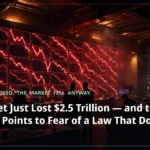
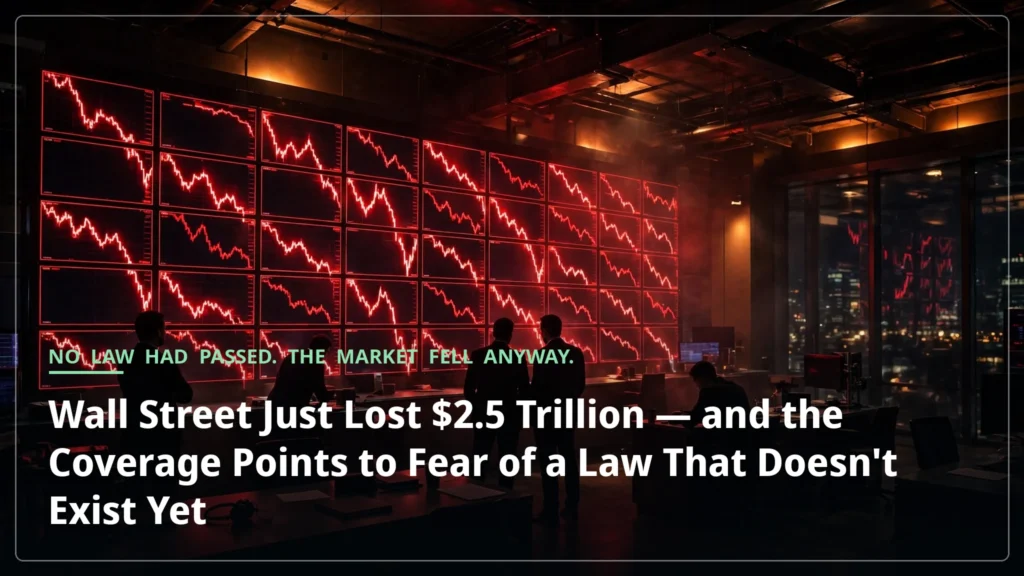
On Thursday 5 November, the market fell 6.4% — the Nasdaq-100’s steepest one-day drop since March 2020 — erasing about $2.5 trillion in market value, according to Reuters. Other tallies put the figure at $2.3 trillion. Either way, it was the kind of day that gets a name in market history. The Nasdaq Composite closed at 24,315.00, down 5.52%, its worst day since April 2025. The S&P 500 dropped 4.36%. The Dow lost 1,833 points. The Nasdaq now sits nearly 12% below its record close of 6 October, which puts it in correction territory.
Chip stocks took the worst of it. The Philadelphia Semiconductor Index plunged 12.3%. Nvidia fell 9.2% to $181.60. AMD dropped 17.4%. Micron slid 17.5%. SanDisk crashed 21.8%. CoreWeave fell 10.5%. Even Amazon and Alphabet, the hyperscalers, each slid 2.2%.
Here is the strange part. No new restriction had been introduced. No law had passed. Two bills proposing a pause already sat in committee, and voters had already decided the ballot measures. The market fell as the prospect took shape — and the prospect arrived in the gap between an election and an inauguration.
The gap
Two days earlier, on 3 November, Americans had voted in the midterm elections, and Democrats had won control of both chambers of Congress. Markets first rallied as the uncertainty cleared. Then, on Thursday, they asked the harder question: what does a new Congress mean for the data centre boom?

The newly elected officials do not take office until January. Between the result and the swearing-in, the bills in committee wait for a new Congress — leaving signals as the freshest thing to price. And the signals were loud.
The day after the election, Arizona Congresswoman Yassamin Ansari posted on X: “Top of the Democratic agenda on day 1 needs to be a pause on advanced AI development, regulation of this out of control industry, and a ban on artificial superintelligence.”
It was not a law. It was not even a bill being voted on. But it pointed at one: the Ban Artificial Superintelligence Act of 2026, introduced in September by Senator Bernie Sanders in the Senate (S.5493) and Representative Greg Casar in the House (H.R.10538). Ansari is one of nine co-sponsors of the House version. The bill would pause development of advanced AI systems — those trained on 10^25 operations or more — until a new cabinet-level Department of Artificial Intelligence is up and running with safety rules and a model-review process. It would permanently ban artificial superintelligence, defined as systems that exceed human cognitive performance across most domains, or that could diminish human primacy. Violations could carry up to 20 years in prison.
Both versions of the bill sit in committee at the “Introduced” stage. Both die with this Congress and would have to be reintroduced in January. And even with every Democrat on board, a pause would need 60 Senate votes to clear a filibuster and two-thirds of both chambers to override a presidential veto. One analysis puts it bluntly: a pause is unlikely to become law in 2027.
Elon Musk referenced Aldous Huxley’s 1932 novel Brave New World in what appeared to be a response to the proposal, and said in a separate post that “data centres in space” were beginning to look increasingly appealing.
The signals were everywhere, not just on X

Ansari’s post was one documented signal, but it was not the only one. Down the ballot, voters had been asked directly about data centres — and they answered. In 41 local ballot measures across 10 states, voters sided with limiting data centres in 40 of them, according to Ballotpedia. Of the 36 governors elected this time, 34 support at least one form of regulation on data centres.
UBS analysts estimated that around 30% of expected US data-centre capacity additions in 2028 could be at risk from potential construction pauses. Meta’s president, Dina Powell McCormick, said the day after the election that building data centres is “going to be harder.”
Ed Mills, policy research manager at Raymond James, told Reuters: “The probability of legislation is much higher than people anticipate.” Michael O’Rourke, chief market strategist at JonesTrading, called the slowdown of the data centre buildout “the real key theme that’s going to stick.”
What the market actually priced
Put the pieces together and one reading comes into focus — as an interpretation, not a settled cause. No new policy had been introduced, and the coverage attributes the move to the prospect of tighter rules: a two-month stretch in which the freshest information was campaign rhetoric, a congresswoman’s post, ballot results and a bill that has not moved. In that vacuum, the reporting suggests, signals substitute for acts — but the post was one signal among several.
That is the reading the coverage itself offers: the sell-off is attributed to the looming possibility of tighter rules, not the introduction of any — an interpretation, and one with a rival. The same coverage notes the sell-off also reflected concerns about valuations and whether companies can keep justifying massive AI infrastructure spending. The pressure had been building for weeks: a sell-off on 30 October had already wiped out more than $1 trillion in tech value over doubts about AI spending. Thursday was the second straight day of AI-stock selling. Bloomberg reported that computer-driven trading funds made the fall worse by selling automatically as prices dropped.
So the election may have been the trigger rather than the cause — the moment a valuation reckoning found its excuse. But even that reading concedes something: when the reckoning came, it arrived alongside the election — the newest information in the room — and the market’s own account points to regulation fear.
January will test it
What happens next is a question with a date on it. In January, the newly elected officials take office, and the gap closes — and the test of the political signals begins. Whether the Sanders-Casar bill is reintroduced, whether the party leadership adopts the pause, whether it survives a filibuster and a veto, and whether construction actually slows all remain open questions; enactment in 2027 is considered unlikely. January does not settle the affair. It starts the part where promises meet procedure.
Until then, the $2.5 trillion day stands as a record of something peculiar about modern markets: on the coverage’s reading, the post, the promise and the ballot measure were priced before any new restriction had been introduced. The AI boom was built on concrete, copper and permits. On 5 November, on that reading, it was priced on something far lighter — the prospect of rules that do not yet exist, carried by campaign rhetoric and public posts while the country waits for January.