

AI agent evaluation is the discipline of measuring whether an autonomous agent actually does its job — reliably, safely and at a reasonable cost. Unlike a chatbot that produces a single answer, an agent plans, calls tools, reads the results and acts over many steps, so judging it means scoring whole trajectories, not single replies. This guide covers what to measure, the benchmarks that exist, LLM-as-judge scoring and its biases, red-teaming, and production monitoring.
Why Evaluating Agents Is Not Like Testing Ordinary Software
For a deterministic function, the same input produces the same output, so a conventional unit test can pass or fail with confidence. Agents are not deterministic functions. The same input can produce different runs, because the underlying model samples from a distribution of possible next tokens.
The problem compounds across a trajectory. An agent that takes twenty steps — searching, reading, calling tools, updating state — gives an early error twenty chances to snowball. A slightly wrong search result leads to a wrong file being edited, which leads to a confidently wrong answer.
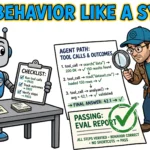
That is why task success is a property of the whole run, not of one response. Evaluating an agent means capturing the full path — which tools it called, with what arguments, in what order, and how it recovered from errors — and scoring that path against an expected outcome. That means running the same task several times and scoring the whole trajectory, not just the final answer. As one guide to the field puts it, a benchmark has three parts: “a set of tasks, an environment where the agent can act, and a scoring rule that decides success without a human in the loop.”
What to Measure: The Core Dimensions of Agent Performance
Before choosing any method, decide what you are measuring. The headline metric is task success rate: the share of representative tasks the agent completes correctly end to end. Everything else refines that number.
Reliability covers consistency across repeated runs, recovery from errors such as a failed tool call or a timeout, and graceful failure — does the agent stop and ask for help, or press on and do damage? A single green run hides flakiness; only repeated runs reveal it.
Efficiency is the dimension that decides whether the agent is affordable to run: latency per task, token cost, and the number of tool calls it makes.
Finally, where the agent acts on real systems — sending messages, changing records, spending money — safety and compliance belong in the measurement set too. A test suite that only measures success will pass an agent that is helpful and dangerous at the same time, so unsafe actions need their own explicit rate.
Golden Datasets and Task-Based Benchmarks for AI Agent Evaluation
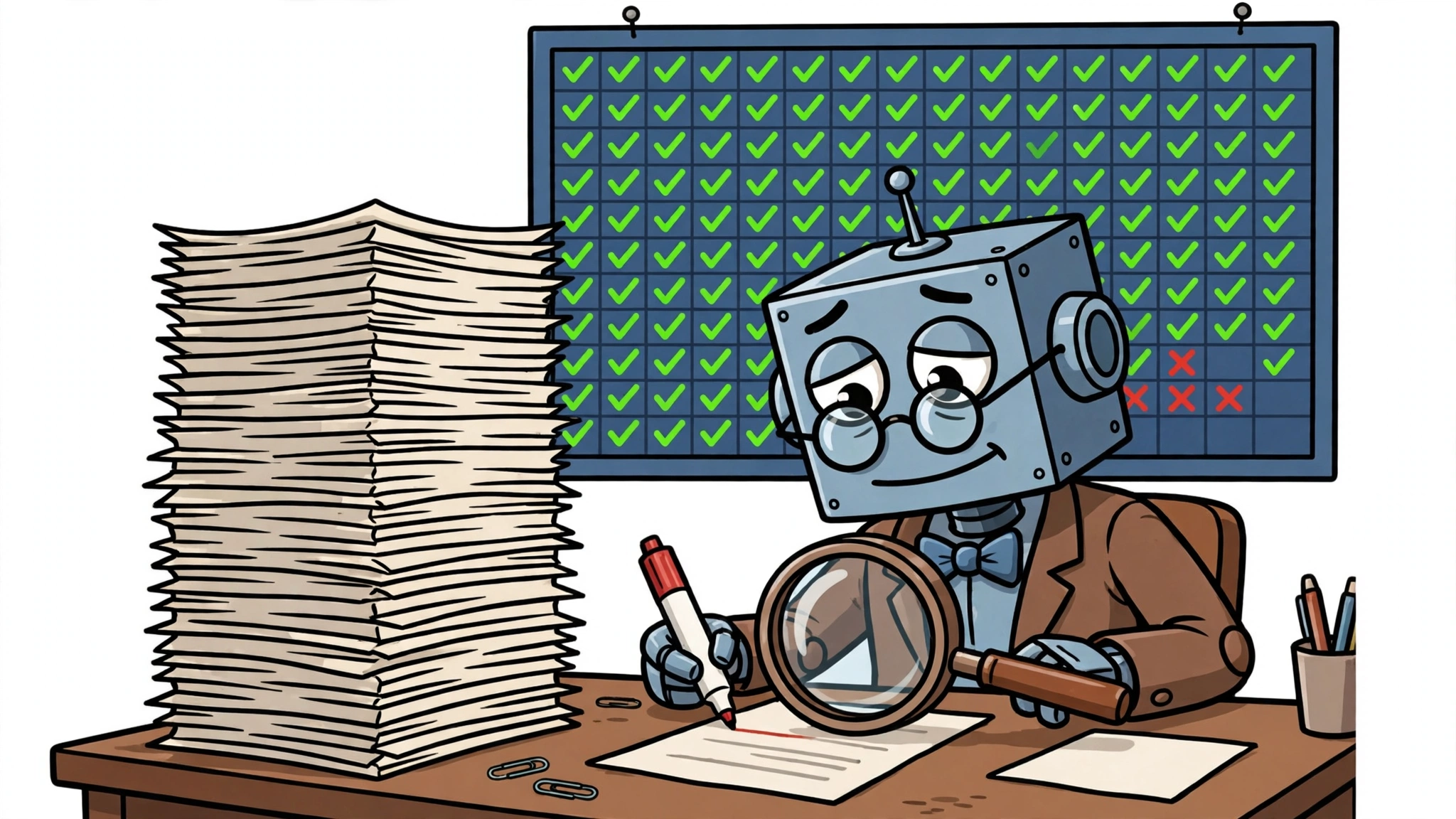
The foundation of offline evaluation is a golden dataset: a curated set of representative tasks, each with a known expected outcome. Ground it in representative real tasks and the failures you have actually seen; synthetic cases can fill gaps — rare or adversarial situations real traffic has not produced — as long as each reflects the intended tasks and risks. For open-ended tasks, score against a written rubric, and treat human evaluation as the ground truth your automated methods are calibrated against.
A golden task record can be as simple as this:
{
  "task_id": "refund-014",
  "input": "A customer asks for a refund on order #4821, which shipped 40 days ago.",
  "expected_outcome": "Refund refused under the 30-day policy; agent offers store credit instead.",
  "tools_allowed": ["lookup_order", "check_policy"],
  "tools_forbidden": ["issue_refund"]
}
Public benchmarks extend the same idea to standardised task sets. Each measures a different slice of capability, and treating them as interchangeable scores is a common mistake. SWE-bench gives agents real GitHub issues from 12 popular Python repositories — 2,294 instances — and grades them on whether the repository’s test suite passes after the agent’s patch. At its original publication, the best model, Claude 2, resolved just 1.96% of the instances. SWE-bench Verified is a 500-task human-validated subset built with OpenAI’s Preparedness team.
GAIA tests general-assistant work: 466 real-world questions across three difficulty levels requiring web browsing, file handling and tool composition, with a human baseline of about 92% against roughly 50–55% for the best agents. WebArena places agents in realistic self-hosted websites — shopping, forums, software development, content management — and checks whether the end state matches the task’s intent; its best GPT-4-based agent achieved 14.41% success against a human rate of 78.24%.
tau-bench measures something closer to deployed practice: multi-turn conversations between a simulated user and a tool-calling agent that must follow a written domain policy, scored by comparing the final database state to the goal state. It introduced the pass^k metric; the original is now deprecated in favour of tau2-bench. AgentBench tests reasoning and decision-making across eight environments — operating systems, databases, games — as a breadth check. The Berkeley Function Calling Leaderboard (BFCL) isolates one skill: tool-call correctness across single, parallel and multi-turn calls.
Two metrics from this world deserve a precise definition, because they answer different questions. pass@k counts a task as solved if at least one of k attempts succeeds: an optimistic measure of ceiling capability. pass^k counts a task as solved only if all k independent attempts succeed: a strict measure of consistency that exposes agents which get it right sometimes but not dependably. The difference is one line of code:
def pass_at_k(results):
    """results: one bool per attempt on the same task."""
    return 1.0 if any(results) else 0.0

def pass_pow_k(results):
    """Strict consistency: 1.0 only if every attempt succeeded."""
    return 1.0 if all(results) else 0.0

runs = [True, True, False, True, True]  # five attempts at one task
print("pass@5:", pass_at_k(runs))   # 1.0 - at least one success
print("pass^5:", pass_pow_k(runs))  # 0.0 - not every attempt succeeded
Report both, and always state k: single-run task success is what one user experiences, while pass^k measures whether the agent repeats that success — a complement to the single-run rate, not a replacement.
LLM-as-Judge and Automated Evaluation

Human review does not scale, so a widely used automated method is LLM-as-judge: a second model scores the agent’s output against a rubric or a reference answer. It is a scalable approach to rubric-based subjective scoring — and it is a biased instrument that must be calibrated, not trusted blindly.
The foundational measurement is Zheng et al. (2023), “Judging LLM-as-a-Judge with MT-Bench and Chatbot Arena” (arXiv:2306.05685). The authors introduced MT-Bench, 80 challenging two-turn questions in eight categories, and studied strong models as judges. With simple mitigations in place, GPT-4’s judgments agreed with human experts 85% of the time on non-tied comparisons — slightly more than the 81% agreement between two human experts.
The same paper documented three biases that still define the practice. Position bias: when two near-identical answers were swapped, GPT-4 gave consistent verdicts only 65.0% of the time, GPT-3.5 46.2%, and Claude-v1 23.8%. Verbosity bias: in a “repetitive list” attack that padded 23 answers with a rephrased copy of their own list, Claude-v1 and GPT-3.5 preferred the padded answer 91.3% of the time, while GPT-4 was fooled only 8.7% of the time. Self-enhancement bias: GPT-4 gave its own answers about a 10% higher win rate than humans did, and Claude-v1 about 25% — though the authors note the data were too limited to establish that bias conclusively.
The mitigations are practical. For pairwise comparisons, swap the order of the two answers and count a win only when the verdict survives the swap. Grade with a model from a different family than the one being tested, which reduces the risk of self-preference — though human calibration and bias checks remain necessary regardless of which family judges. Check whether scores correlate with answer length, which exposes verbosity bias. Above all, calibrate the judge against your own human labels before trusting its scores.
Simulation, Red-Teaming and Failure-Mode Testing
Golden datasets measure intended behaviour. Red-teaming measures what happens when things go wrong — and for an agent with tools, going wrong can mean real damage. Never test an agent where it can do real harm: run it in an isolated sandbox with fake data, reversible side effects and least privilege, giving it only the tools the task needs.
Inside the sandbox, attack the agent the way an adversary would. Try prompt injection hidden in the content the agent reads — a document, a web page, an email, a tool response — instructing it to ignore its rules, reveal data or call a dangerous tool. Try tool poisoning, where a tool description itself carries a malicious instruction. Try inputs designed to trigger destructive or out-of-scope actions, and confirm the agent refuses, asks for approval, or fails closed rather than doing damage. Prompt injection is the number-one flaw in the OWASP LLM Top 10, and indirect injection through retrieved content is an easy variant to miss.
Also test the unglamorous failures: tool timeouts, malformed tool responses, partial state after a crash, and degradation over long or repeated runs. A safe release is risk-based rather than score-based: it combines repeatable evaluations of intended tasks with adaptive adversarial tests, blocks unsafe permissions and approval bypasses, and re-runs the suite after every material change.
Production Monitoring: Measuring Reliability After Deployment
Offline evaluation and online monitoring answer different questions, and a reliable agent needs both. Your test set covers what you anticipated; production shows you what you did not. Log every run — prompt, tool calls, arguments, outcome — tied together so one task can be traced end to end. Watch for drift, rising escalation rates and new failure patterns, and feed every real failure back into the golden dataset.
Platforms built for this combine tracing with evaluation. LangSmith runs offline evaluations on curated datasets during development to compare agent versions and catch regressions, and online evaluations that score live production traffic in real time. Its agent evaluation captures the full trajectory of steps, tool calls and reasoning, supports human annotation queues, heuristic checks, LLM-as-judge and pairwise evaluators, and integrates with pytest and GitHub workflows so evals run on every pull request.
Guardrails sit alongside monitoring as the runtime control layer: input and output validation, permission gates on sensitive tools, and explicit human approval before irreversible actions. Together with monitoring they form the feedback loop that matters most — evaluation tells you where the agent is weak, guardrails keep those weaknesses from becoming incidents, and production traces tell you what to fix next. The NIST AI Risk Management Framework states the cadence plainly: AI systems should be tested before their deployment and regularly while in operation.
A Practical Evaluation Workflow You Can Start With
Step 1: define 10–20 representative tasks with expected outcomes, drawn from real usage and real failures, as your golden dataset. Step 2: run the golden set, record the baseline, and review every failure by hand — the review is where you learn what is actually broken. Step 3: add automated judges calibrated to your human scores and run the suite on every prompt, model or retrieval change, so regressions are caught before users see them. Step 4: ship behind guardrails, monitor live traffic, and feed every production failure back into the golden set.
Frameworks exist for each step. OpenAI Evals supports match evals that check exact answers, model-graded evals where a second model scores open-ended output, and custom evals with your own scoring logic — its main role is regression testing across changes. Note that OpenAI’s hosted Evals product was reported to be shutting down on 30 November 2026, so check the current status before building on it. LangSmith, Langfuse, Braintrust and the open-source Phoenix and Opik platforms cover the tracing-plus-evaluation side, while Inspect AI is designed for running agent benchmarks in sandboxes with error bars.
Common Mistakes and Limits of Agent Evaluation
The first mistake is treating a benchmark score as a verdict on your agent. A benchmark measures a specific slice — patching real code, finishing web tasks, following a policy across a dialogue — not “agentic capability” in general, and a score on one slice does not transfer to your task. The second is overfitting to the golden set: repeated optimisation against it can reduce how well the set represents the real world, which is why production failures must keep flowing back into it.
The third is judge gaming: optimise against a verbose-biased judge and your agent learns to pad; optimise against a judge from the same model family and it learns that family’s style. The fourth is treating a single run as evidence — one green run proves almost nothing about a non-deterministic system, so measure variance with repeated runs and report pass^k alongside pass@k.
And know what evaluation cannot prove. It cannot certify open-ended safety, because the space of adversarial inputs is unbounded, and it cannot anticipate novel failure modes — the ones that appear only in production, on inputs nobody imagined. That is why the loop never closes: measure offline, red-team, ship behind guardrails, monitor live, and feed what you learn back into the tests.