
An AI agent that works beautifully in a demo can still fail in production, because readiness depends on more than the model: workflow evaluations, permissions, oversight and operations all have to hold up. This guide is a concrete readiness checklist for AI agents production deployment: the conditions, thresholds and safeguards that turn a promising pilot into a system you can trust with real users and real consequences.
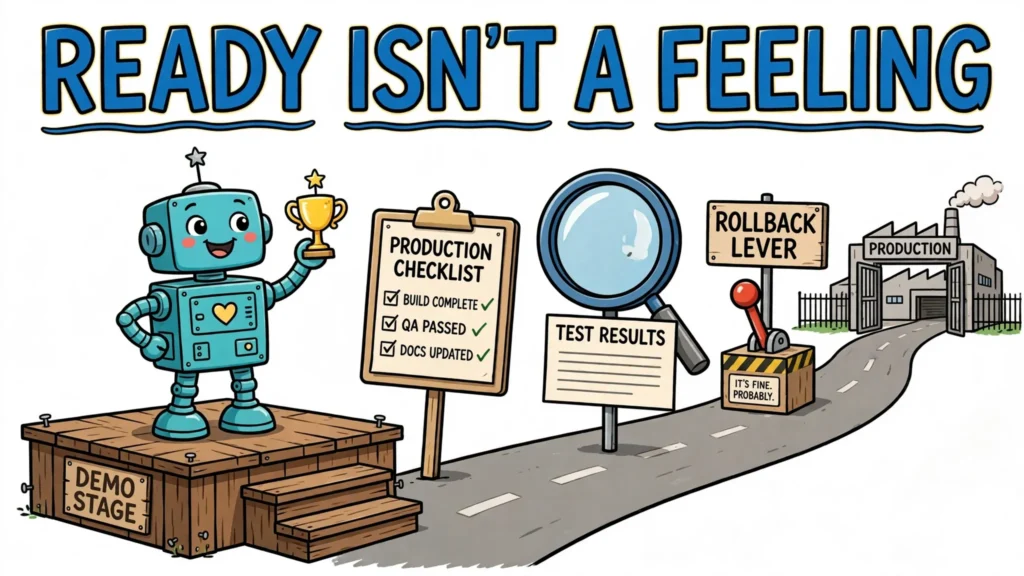
A demo is one good run on one chosen input. Production is thousands of runs on inputs nobody chose, with side effects that cannot be undone by refreshing the page. Readiness is not a launch date or a feeling of confidence. It is a set of conditions you can check, measure and defend.
What production ready means for an AI agent
Production readiness for an AI agent is a threshold on reliability, safety and operability, not of feature completeness. An agent is ready when a defined workflow repeatedly reaches an accepted outcome, failures are bounded and recoverable, and the economics include human review where it matters.
Three stages are often confused. A demo proves a capability exists. A pilot proves a small group of friendly users can get value under supervision. Production means the agent runs on real traffic, with real permissions, under monitoring and risk-based oversight, and the organisation can detect, diagnose and respond to its mistakes. How much autonomy it has depends on the action and on demonstrated reliability: irreversible actions are prevented or approved in advance, while recoverable effects can be reversed where possible.
Agents need a higher bar than a deterministic service because their behaviour is not fixed. The same input can produce different outputs on different runs, the agent takes several steps, calls tools and changes the state of other systems, and can fail halfway through a task in ways a single API call cannot. A readiness checklist built for ordinary software will miss risks that are specific to agents: variable outputs across runs, multi-step tool use, and failures halfway through a task.
Accuracy and reliability thresholds
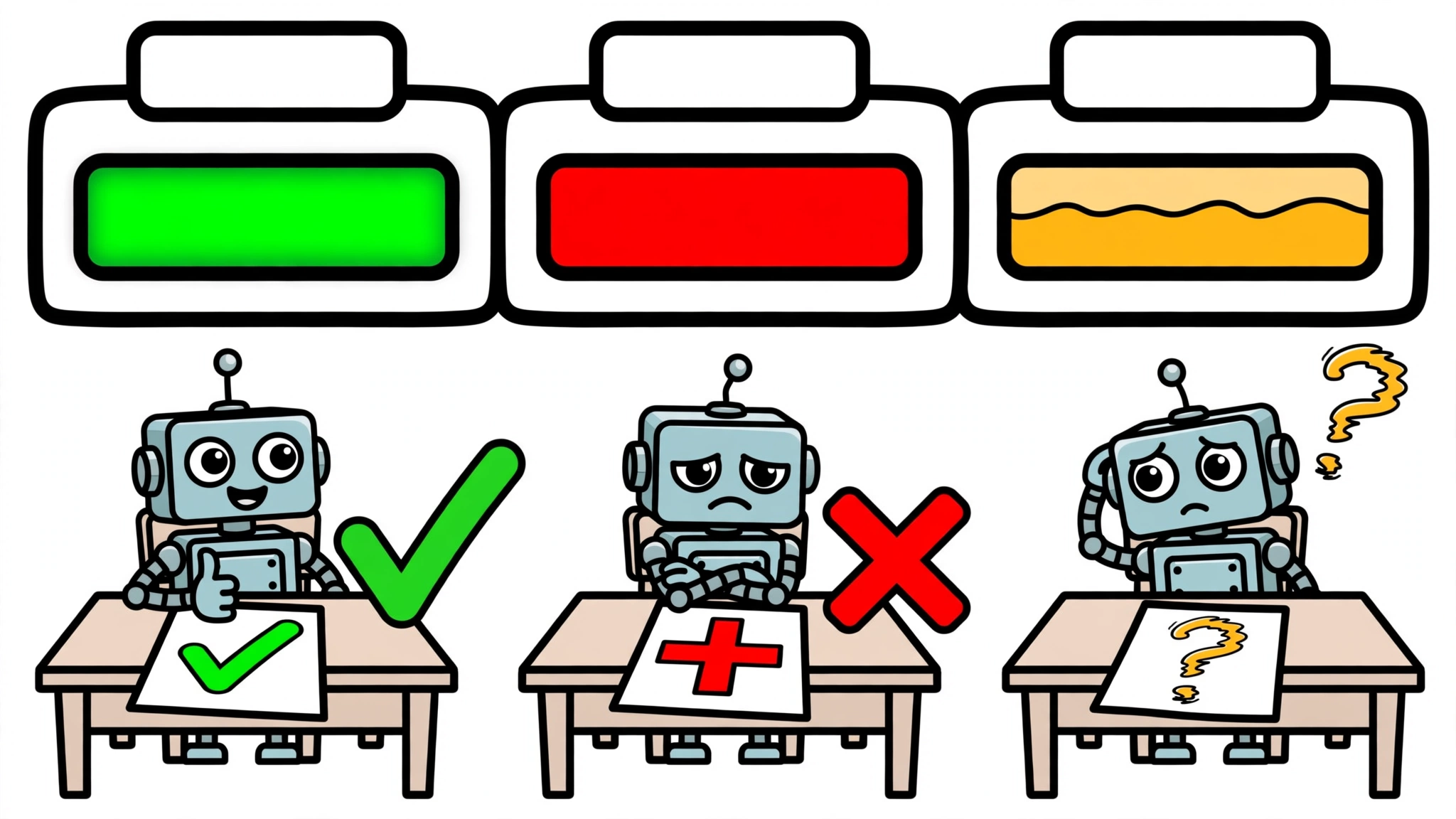
The primary readiness signal is a task-success rate measured on your own work, not a benchmark leaderboard. Build an evaluation suite from the job itself: real tasks drawn from real failures, written the way real users write them, with starting states that make trials repeatable and success criteria stated as checks on the outcome. Anthropic’s engineering guidance suggests starting small, with roughly 20 to 50 simple tasks taken from real failures, rather than waiting until hundreds exist.
Measure reliability across repeated trials, not single runs. A 75% per-trial success rate compounds to roughly 42% for pass^3, which is why multi-trial metrics such as pass@k and pass^k are the honest readiness measure. The tau-bench authors reported in 2024 that state-of-the-art function-calling agents succeeded on fewer than half of the tasks, with pass^8 below 25% in the retail domain.
Include cases that must escalate or refuse, not only cases that should succeed, and score each stage of a run separately so the cause of a failure is visible. Re-run regression evals after every change to the prompt, tools or model. OpenAI’s deployment playbook puts it plainly:
“Evals are run at every stage and before each gate. Their frequency and discipline often determine whether a system moves beyond pilot to a trusted, production-ready solution.”
Set an error budget for agent tasks, the same way you would for a service’s uptime, and define in advance what happens when it is spent. There is no universal success rate to copy. Benchmarks differ in tasks, scaffolds, time limits and definitions of success, so thresholds must be set per use case and risk level. A customer-support agent that drafts replies can ship at a lower bar than an agent that moves money, and your checklist should say so explicitly.
Safety, guardrails and human oversight
Guardrails are the controls that limit what an agent can do and catch mistakes before they matter, and they must live in code, not in the prompt. Telling a model “never delete records” is guidance. Configuring the agent’s permissions so it cannot call any record-deletion API is a guardrail, and it holds even if the model is given malicious input or behaves unexpectedly.
Start by listing every action the agent can take and assigning a risk tier. Read-only actions such as searching a knowledge base can run automatically and be logged. Actions that affect external parties, touch sensitive data or are irreversible, such as refunds, payments, deletions and contract changes, always need approval or strict rule-based thresholds. Approval gates work best when they are fast: one screen showing the proposed action, the evidence and the agent’s reasoning, with one-click approve, edit or reject.
Human-in-the-loop does not mean a human reviews everything. It means a human is in the loop for the decisions that warrant it. Start conservative, then practise earned autonomy: as the agent proves reliable for specific case types, measured against your evaluation set, move those case types from approve to auto-with-audit.
Hard limits prevent runaway behaviour. Cap the maximum steps or tool calls per task so the agent cannot loop, cap tokens or spend per task so costs cannot blow up, cap wall-clock time so users are not left waiting forever, and set rate limits per user and per tool. When a limit is hit, the agent should stop and escalate, not try harder, and a kill switch any team member can trigger without a deployment is part of the same layer.
Observability and evaluation in production
Readiness includes the ability to see failures and catch regressions live. Production observability for agents means full traces, a complete record of every step, tool call and intermediate result, plus dashboards and alerts on cost, latency, error rate and failure-rate drift, not just crashes. Platforms such as LangSmith provide this tracing and evaluation layer, including 24/7 monitoring of production traffic for regressions.
The gap is common. Cleanlab’s 2025 production survey found that weak observability and immature guardrails were the most common pain points among teams with agents actually running in production, and more than 65% listed improving observability as their top investment priority for the year ahead.
Run continuous evaluation on sampled production traffic, not only on your offline suite. When a failure appears in production, the trace should become a regression task, so the same failure is caught automatically next time. Alert on failure-rate drift and on new failure clusters, because a long-tail failure hides in the average. Read transcripts before trusting scores: a 0% pass rate across many trials usually points to a broken task or grader, not an incapable agent.
Cost, latency and scale readiness
One agent task can mean dozens of chained tool calls, so cost and latency are harder to predict than for a single model call. Load-test multi-step agent runs, not single calls, and measure cost per successful task rather than cost per call. Set latency budgets and timeouts for chained tool calls, and define what happens when a call times out: retry once, degrade gracefully, or escalate to a human.
Plan for the model provider being slow or unavailable. Fallbacks might mean a smaller, cheaper model for low-risk steps, a cached response for repeated queries, or a queue that holds work until the provider recovers. Whatever you choose, test it, because a fallback that has never fired is a hope, not a control. Rate limits and concurrency caps also protect you from one runaway task consuming your entire quota. Someone must be on call in the first weeks, with a runbook for failures already seen in evals and shadow mode.
Security, privacy and compliance checks
Before launch, decide exactly what the agent can read, write and retain. The principle is least privilege: the agent should have access to exactly what it needs to complete its task, and nothing more. Give it narrow, purpose-built tools instead of generic powerful ones, and make it act with the permissions of the user it serves.
OWASP’s agentic AI guidance catalogues the controls that matter: separate instructions from data, limit tool authority, validate tool arguments, isolate credentials, monitor actions, and require confirmation for consequential changes. Treat content the agent reads from the web or user uploads as data, never as instructions: agents processing untrusted content are subject to prompt-injection risk, which browser use amplifies.
Keep an audit trail of everything the agent did and why: every tool call, its inputs and outputs, cost per task, trace identifiers, escalation events and boundary-breach attempts, with the model and tool versions pinned. Check data-retention and regulatory requirements before launch, including what may be logged and how long transcripts are kept. These checks are gates, not paperwork to finish after shipping.
AI agents production deployment: a staged rollout plan

Rollout should be a sequence of gates, not a single switch: shadow mode, then a small canary, then a controlled ramp, then full rollout, with explicit promotion and rollback criteria defined before deployment begins.
Shadow mode mirrors live traffic to the candidate agent but discards its outputs and suppresses side effects, so you validate behaviour at zero blast radius. The agent processes real inputs while humans or the existing system remain the source of truth, and you compare what it would have done against gold labels or human outcomes. Typical shadow runs last two to four weeks depending on volume. As Cordum’s deployment guide puts it:
“Shadow mirrors live traffic to the new agent but discards its outputs and suppresses side effects, so you validate behavior at zero blast radius.”
Canary then routes a small, growing slice of real traffic to the agent, commonly around 1 to 5% first for high-risk flows, then 5%, 25% and 50%, behind explicit numeric gates: a minimum sample size, a pass threshold, and rollback deltas such as an error-rate rise above twice the baseline or an approval backlog breach. Promotion should rest on scored distributions over real traffic, compared against a baseline calibrated to the workflow, traffic volume and risk tier — a recent production baseline such as a rolling seven-day window is one design choice, and a fixed threshold set from your own evaluation data is another.
Write the gates down as a configuration, not as a meeting decision. The example below is an illustrative release-gate configuration showing the shape of the thresholds; calibrate every number to your own baseline and risk tier before using it.
# Example release gate for an AI agent (illustrative thresholds — calibrate to your own baseline)
release_gate:
  require_no_critical_policy_failures: true
  minimum_task_success: 0.96
  minimum_tool_contract_pass: 1.00
  maximum_cost_per_success_usd: 0.30
  maximum_p95_completion_seconds: 12
  compare_by_cohort: true
  rollback_triggers:
    - error_rate_delta_gt: 2.0
    - guardrail_trip_rate_above_baseline: true
    - new_failure_cluster: true
Rollback must be mechanical. Keep the triggers in configuration so the flip happens on the next request, keep the previous version available for an observation period calibrated to operational risk — a full business cycle is one example — and test the rollback rather than just documenting it. Reverting traffic alone is not enough: semantic caches keyed on the candidate can keep serving bad answers for hours after a rollback, so cache invalidation must be part of the rollback plan.
Common mistakes that ship too early
The most common mistake is shipping on demo prompts instead of production traffic evals. A handful of hand-picked examples proves nothing about the thousands of inputs the agent will actually see, and a leaderboard score is no evidence that a specific agent is ready for a specific job.
The second is launching with no rollback plan and no one watching the agent live. A rollback that has never been tested and a first week with no on-call owner are both signs the launch is premature. The third is treating a single good eval run as proof of readiness. One success is not enough when the same input can produce different outputs on different runs, and a score should be reasonably stable between runs before you trust it.
Other red flags: guardrails written in the prompt instead of enforced in code, approvals that reviewers rubber-stamp, no cost or latency budget, and no audit trail.
None of this means agents should stay in pilot forever. Klarna’s customer service agent now handles two-thirds of all service chats and cut average resolution times from 11 minutes to 2, which is what a production agent looks like after it has passed its readiness gates. The question is not whether agents can be ready for production. It is whether yours has earned it, and the answer is a checklist you can measure, not a feeling you can argue about.