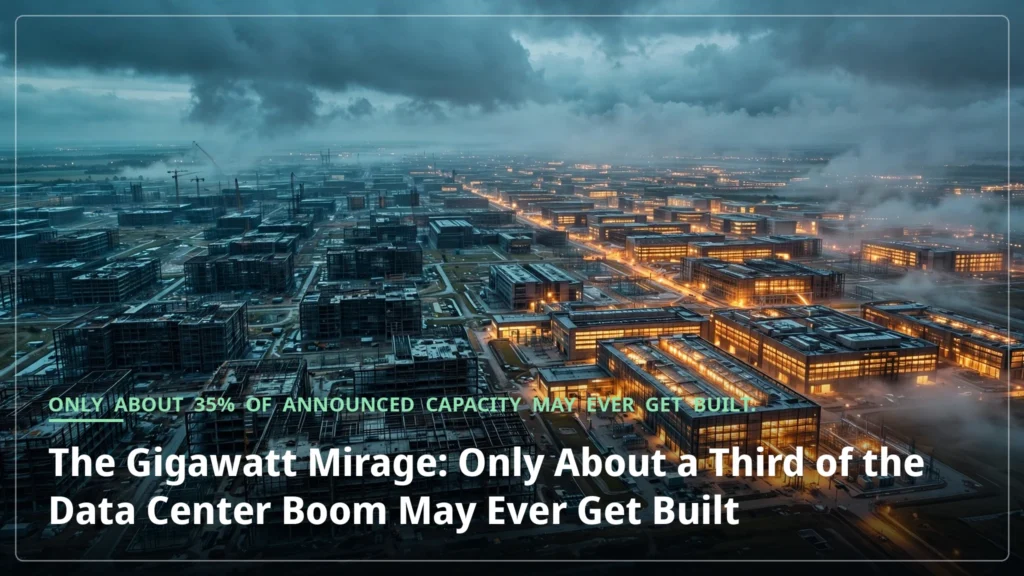


Somewhere between the press release and the power station, the AI infrastructure boom loses about two-thirds of itself.
Bernstein Research, after analyzing thousands of planned data centers in the United States, concluded that only about 35% of announced capacity is likely to become reality. The rest is a forecast of a forecast.
That does not mean the boom is fake. It means the boom is smaller, slower, and stranger than the numbers suggest — and the gap between announced and built is now the story.
The Australian exhibit
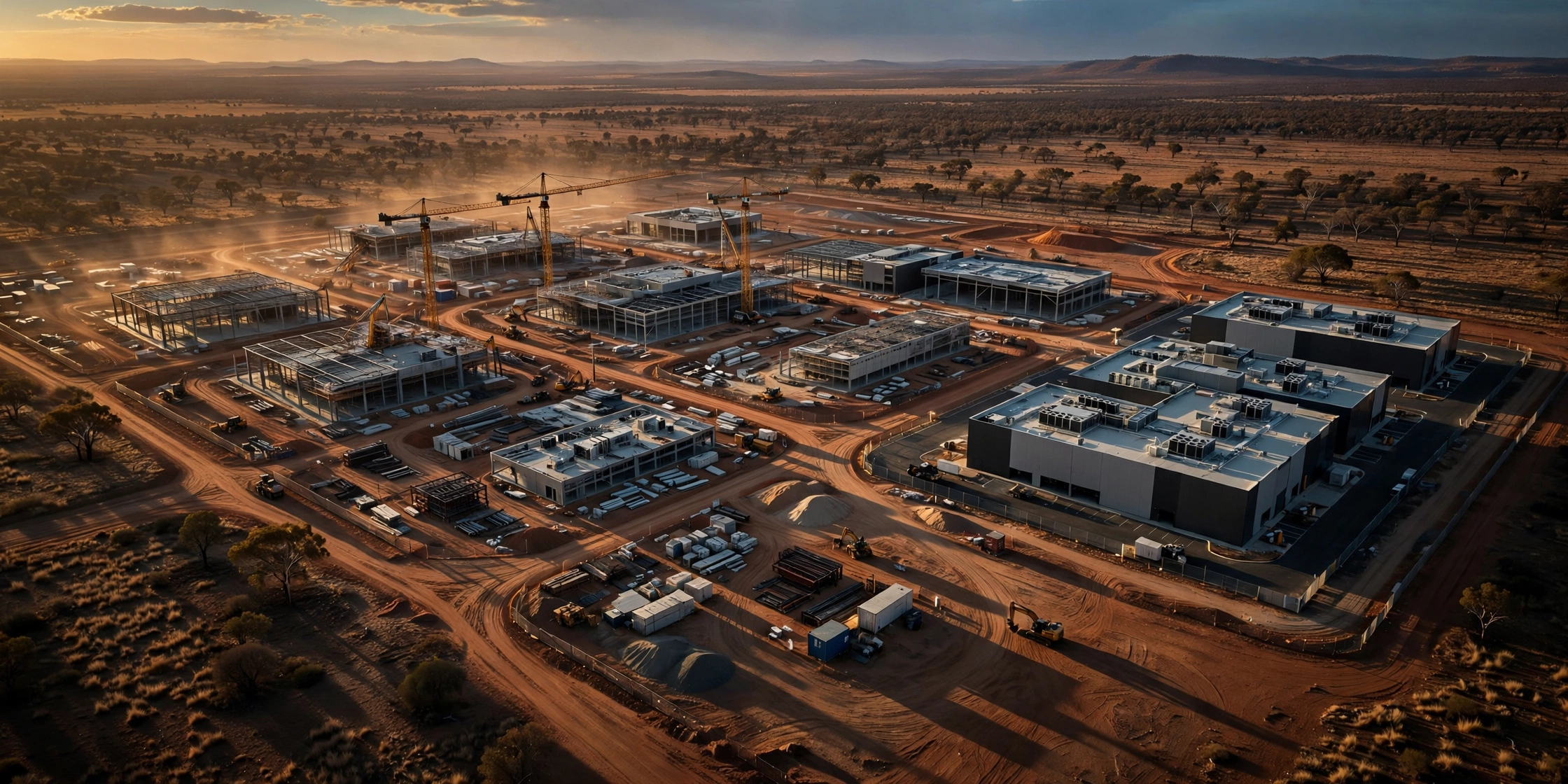
The clearest picture of the gap comes from Australia, where Commonwealth Bank’s economists did the unglamorous work of comparing what has been announced with what could plausibly be built. About 23 gigawatts of data center capacity has been publicly announced across the country. CBA puts the feasible pipeline at about 7 gigawatts.
Only 24% of the announced pipeline is under construction, being expanded, approved, or even in pre-construction. The remaining 76% is in planning or at an earlier stage, so its timing and eventual scale remain uncertain. The median project carries just a 28% chance of progressing from its current stage to completion.
Then there is the queue. Data from the Australian Energy Market Operator shows 225 projects seeking almost 67 gigawatts of grid connection — nearly three times the announced pipeline. More than a third of connection requests made in the past year were withdrawn.
“The high degree of attrition and duplication in AEMO’s connection data demonstrates even meaningful progress through the connection process does not guarantee delivery.” — Lucinda Jerogin, Associate Economist, Commonwealth Bank
“This reinforces our scepticism of the gross 23GW pipeline,” Jerogin added. The 23 gigawatts is not a lie. It is a gross figure, and gross figures flatter.
The same demand, counted several times
How does a pipeline end up nearly three times larger than the capacity it describes? Commonwealth Bank’s answer is disarmingly simple: the gross figure is likely overstated “because applications can overlap and developers may be competing for the same customers.” One hyperscale tenant, pursued by several developers, can appear in the pipeline several times — once per hopeful suitor.
In the US market, reporting describes the same pattern in blunter language. Business Insider has written about “ghost projects” and “bragawatts” — enormous announcements for projects that have not secured electricity, construction permits, or customers. In Texas, connection requests have reached more than five times the state’s existing electricity supply. GlobalData rated just 6% of the projects announced in 2025 as high-likelihood to execute.
A grid-queue position and a land option hold real value even if the first project dies. But a pipeline built partly out of options and overlapping applications is not a construction schedule. It is a market — developers staking claims, tenants shopping for sites.
The grid is the hardest thing to fix
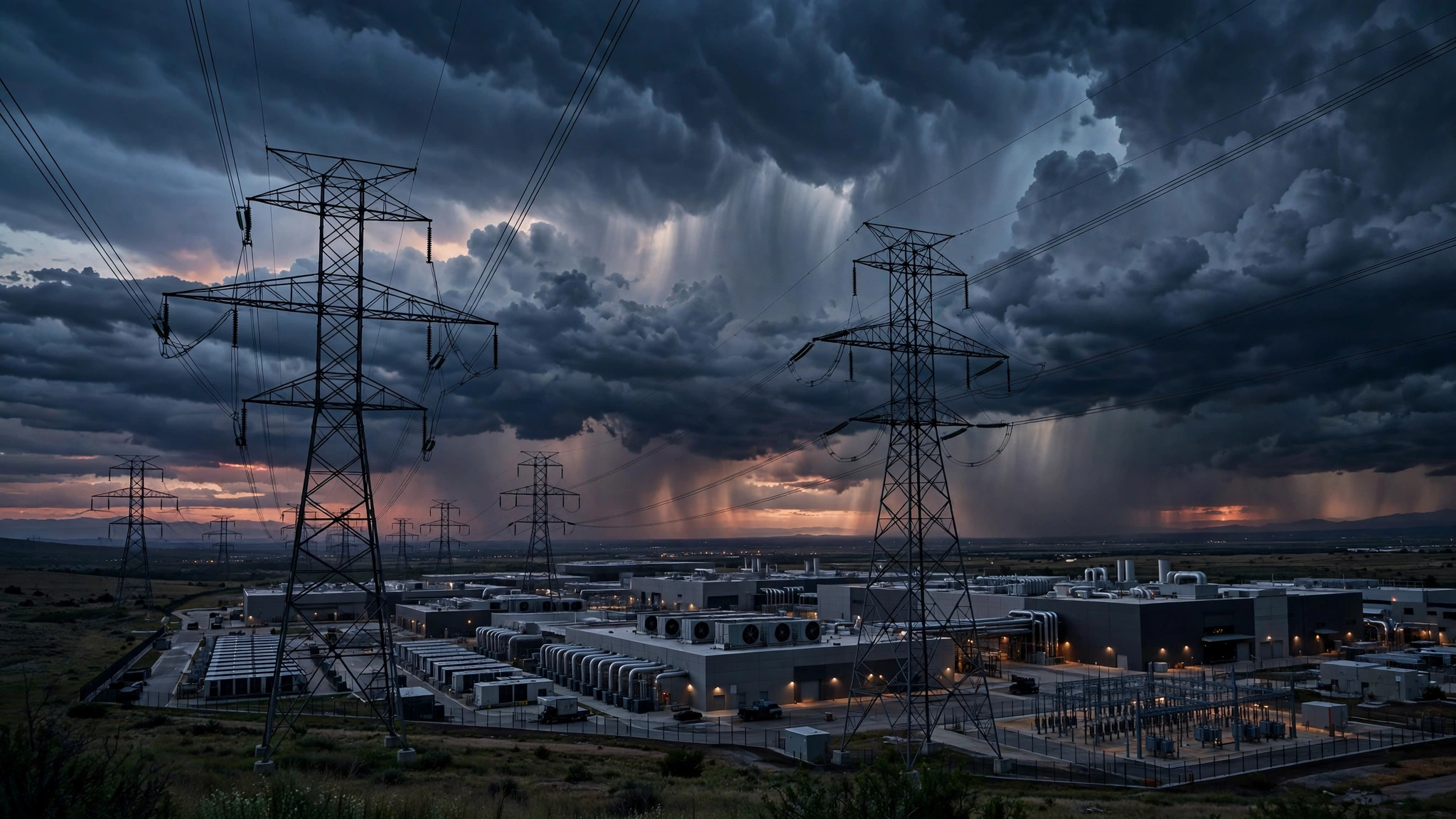
Even the projects that are real run into physics. GlobalData found that data center projects breaking ground between the third quarter of 2025 and the third quarter of 2026 waited an average of just over two years after being announced — up from about 18 months for projects that started construction between early 2020 and mid-2025. The wait is lengthening.
“The grid is the hardest to fix because it is structural: new grid infrastructure takes five to 15 years to build, while a data center takes one to three.” — Martina Raveni, senior analyst, GlobalData
Luis Fernandes of IDC put it more bluntly: grid access is “by a long shot the biggest cause for delay in projects, to the point that we haven’t seen delays in projects for any other reason, given that the lack of grid connection halts the entire exercise.” Developers in Europe’s main data center hubs can wait up to a decade for a connection.
GlobalData forecasts annual data center electricity consumption rising from 590 terawatt-hours in 2025 to 1,520 terawatt-hours in 2030. Sightline Climate estimated in February that 30 to 50% of the data center capacity expected to come online in 2026 may not be delivered on schedule.
The neighbors have a vote
Then there is a constraint that funding alone does not solve: the people who live next to the proposed site. Data Center Watch counted at least 75 US data center projects worth about $130 billion blocked or delayed in the first quarter of 2026 alone. The number of organized opposition groups grew from 396 at the end of 2025 to 833 by March 2026, spanning 49 states. More than 300 state data center bills were filed in the first six weeks of 2026, and at least 69 local government units had enacted bans as of May.
The cases read like a tour of American local government. In San Marcos, Texas, a developer proposed a $1.5 billion five-building campus on roughly 200 acres, with projected power demand that could reach two and a half times the city’s peak electrical load. More than 100 residents spoke against it. The city council voted 5–2 against rezoning the site, effectively blocking the project.
In New Brunswick, New Jersey, the council removed data centers as a permitted use before any formal proposal had been submitted. In Montour County, Pennsylvania, regulators denied a Talen Energy rezoning request near the Susquehanna nuclear plant. In Monterey Park, California, officials issued a 45-day moratorium while activists gathered roughly 5,000 signatures. Maine’s House voted 82–62 for a moratorium through 2027; the governor vetoed it.
“There’s a growing tension between the demand for AI infrastructure and communities’ willingness to accommodate the physical facilities required to support it.” — Ya-Han Brownlee-Chen, vice president of data center strategy, DP World
Community resistance can disrupt projects even when developers have customers and funding. The concerns are concrete — electricity bills, water, noise, land use — and they run through zoning boards whose timelines are hard to predict. Capital can solve an engineering problem. It cannot guarantee a faster zoning hearing.
The politics of the plug
All of this lands in a changed political moment. On TechCrunch’s Equity podcast, Brent Nelson of Ascend Analytics — the analyst who calls the pipeline “wildly inflated” — argued that Democrats, fresh from midterm wins, should take their shot at permitting reform now rather than wait for a more favorable political moment. Energy projects, he noted, are stuck in a permitting loop that administrations of both parties helped create.
It is a striking argument: permits, grid connections, and zoning approvals are documented constraints on the AI buildout, and — in Nelson’s view — the party that just won an election has a window to fix the plumbing. Whether that window gets used is an open question.
Nelson also punctured one of the industry’s favorite fallbacks. Natural gas, he argued, is not necessarily the reliable backup developers think it is, particularly during extreme winter weather. His less obvious alternative: pair battery storage with a grid connection that can be temporarily curtailed during periods of high demand — a data center that bends instead of demanding the grid bend for it.
The AI infrastructure boom is still real
None of this is an obituary. Even if only about a third of announced capacity is ever built, as Bernstein forecasts, that is still the largest private infrastructure buildout in decades. Hyperscaler spending is real money, not announcements — the four largest US hyperscalers set aside around $725 billion for data centers and equipment in 2026. And delays are not cancellations: IDC’s Fernandes expects delays to be more common than outright cancellations, with some stalled projects changing hands instead.
But that is precisely the point. The boom is real, and the numbers are theatre, and both can be true at once. The question is not whether AI infrastructure gets built. It is how much of the announced total survives contact with the grid, the permitting office, and the neighbors — and which developers, holding which tenants, are left standing when the count is done.
The gigawatt headlines are not a build plan. Bernstein’s forecast — about 35%, likely, not certain — is the number worth watching: a projected realization rate, not an observed one. Everything else is a rendering.