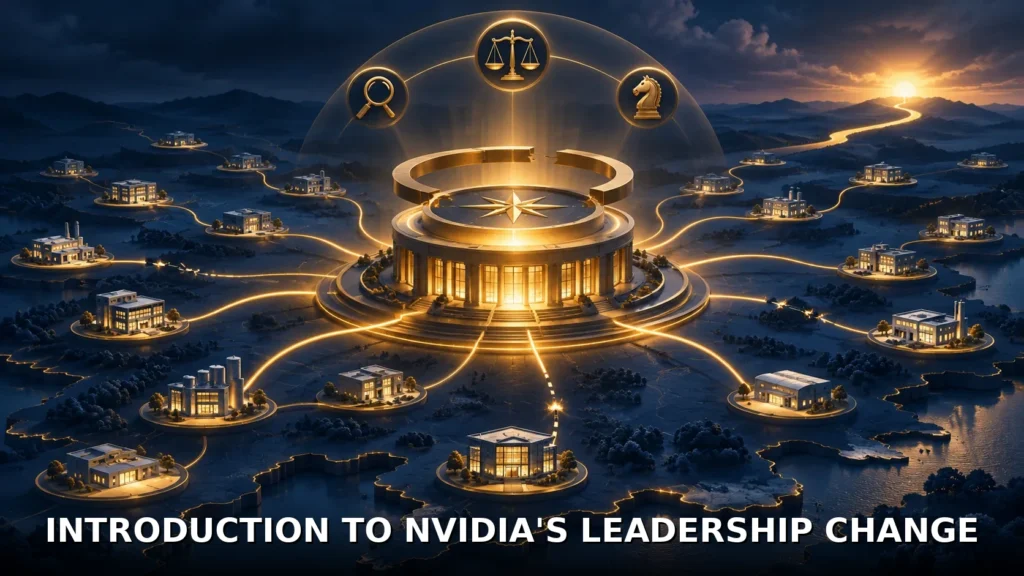



Introduction to Nvidia’s leadership change: the Nvidia CEO resignation
The Nvidia CEO resignation reported by TechCrunch on November 16 leaves the company facing questions about leadership, chip distribution and board oversight after Jensen Huang’s departure. The immediate test falls to Colette Kress, whom the publication identifies as interim CEO and longtime chief financial officer, as she prepares to present third-quarter results on Tuesday. The central issue is whether Nvidia can explain how authority and accountability will work after a founder whose influence extended across the company. TechCrunch
The report connects several developments: Huang’s reported resignation following personal misconduct allegations, Nvidia’s promise of an internal investigation, questions about restricted chips allegedly reaching China, and public pressure for his return. These developments raise related governance questions, but they do not establish a single explanation for everything under scrutiny. Alleged misconduct, disputed chip distribution and future strategy each require their own evidence.
The available reporting also leaves substantial gaps. It does not provide a completed internal investigation, a permanent succession decision or Kress’s forthcoming earnings remarks. Its discussion of her likely approach to deals is an expectation, rather than an announced policy. Those distinctions matter because a leadership transition can generate speculation faster than it produces decisions.
For readers assessing Nvidia’s direction, the useful dividing line is between what the reporting says has happened and what management still needs to explain. The departure and interim leadership are reported developments. The extent of Huang’s continuing involvement, the investigation’s findings and any strategic changes remain unresolved in the supplied evidence.
Details of Jensen Huang’s resignation

TechCrunch reports that Huang was forced to resign the previous week after admitting to an affair with an executive at a customer. It also reports accusations of two additional affairs with Nvidia employees and an allegation that the customer executive was a Chinese spy. The latter assertions remain allegations in the available account; the supplied material does not establish them as findings. TechCrunch
That distinction is essential to understanding the story. An admission concerning one relationship does not independently verify separate accusations. Nor does an allegation about a customer executive establish that Nvidia knowingly permitted restricted chips to reach an unauthorized destination. Questions about relationships, customer oversight and chip distribution may intersect, but the evidence does not justify collapsing them into a proven chain of misconduct.
The leadership consequences extend beyond the circumstances of the resignation. TechCrunch describes Huang as having roughly 60 direct reports and extensive involvement throughout Nvidia. On that account, replacing him involves more than changing who presents financial results: it raises questions about how responsibilities previously concentrated around the founder will be assigned and supervised. This is a governance implication of the reported management structure, rather than evidence that a particular restructuring has begun.
Kress’s interim appointment provides a named executive to lead the forthcoming results presentation. It does not, by itself, resolve permanent succession. TechCrunch identifies the search for a new CEO and Huang’s ongoing role as subjects on which management should provide clarity. The supplied reporting does not identify a permanent successor, specify a search timetable or describe formal limits on the founder’s future involvement.
The immediate information gap is therefore concrete: who will make which decisions, and under whose oversight? A transition can be assessed more meaningfully once those responsibilities are explained. Until then, describing the resignation as the completion of Nvidia’s governance response would go beyond the evidence.
Public reaction and calls for reinstatement

Pressure for Huang’s return is visible in a petition that TechCrunch reported had attracted 180,000 signatures and was continuing to grow. That figure documents participation in a reinstatement campaign at the time of the report. It does not establish the views of Nvidia’s shareholders, employees or customers as a whole, and the supplied evidence provides no representative survey of those groups. TechCrunch
The reporting also contains competing signals about a possible comeback. TechCrunch relays a Financial Times report that Huang may have been attempting to return. It separately cites CNBC, relying on unnamed sources, as reporting that Nvidia was not in talks to reinstate him. These accounts describe different things: a possible effort by Huang and the reported absence of company negotiations. Neither establishes that the board has agreed to bring him back, and the available material does not resolve his intentions or the company’s future position.
Another strand of reaction concerns open AI models. In a November 16 commentary, POND Foundation writer Steven Vincent presents Huang’s departure as exposing the open-model ecosystem’s dependence on an influential corporate supporter. Vincent draws on other commentators’ concerns about the loss of that support, then argues that distributing capability and control across many participants would provide a stronger foundation than finding another powerful patron. Steven Vincent’s POND commentary
This is an argument about institutional dependence, rather than evidence of a new Nvidia policy. Vincent advocates smaller, specialized models and networks of human and machine intelligence. His commentary does not demonstrate that Nvidia has withdrawn support for open models, that a specific regulatory outcome will follow or that distributed systems eliminate operational risk. Indeed, he acknowledges security problems associated with local models and distributed systems.
The petition and the open-model debate illuminate different concerns. One seeks the restoration of an individual leader; the other asks whether an ecosystem should depend so heavily on any individual. Neither settles the board’s responsibilities. Public enthusiasm can explain pressure on directors, but it cannot substitute for findings about conduct or a clear allocation of executive authority.
Nvidia’s internal investigation and implications
TechCrunch reports that Nvidia promised to conduct an internal investigation. The available text supports a commitment to investigate, but it does not provide findings, a completion date or details about the investigation’s independence and scope. Those omissions limit what can responsibly be said about its progress or conclusions. TechCrunch
The reporting places that commitment alongside questions about Megaspeed, the customer associated with the executive involved in Huang’s admitted affair. According to TechCrunch’s account of earlier New York Times reporting, the United States was investigating Megaspeed in October 2025 over allegations that restricted Nvidia chips were being diverted to China. An investigation into alleged diversion is not a finding that diversion occurred, and the supplied material does not establish a legal outcome.
Nvidia’s reported statements about the customer leave an important chronology to explain. TechCrunch says Nvidia vouched to CNBC that Megaspeed was legally using chips for its cloud. It also says Nvidia later told The Wall Street Journal that it had voluntarily blocked Megaspeed from receiving additional chips in June 2025. Both statements appear in the supplied reporting; neither should be omitted to make the account simpler.
They are not necessarily incompatible. A statement about the use of chips already supplied and a decision to stop further deliveries could address different circumstances. But that is only a possible interpretation. The evidence does not explain the reason for the block, the precise scope of the legality assurance or how the company reconciles the two accounts. It therefore supports questions about the sequence of decisions, rather than a conclusion that one statement disproves the other.
Revenue disclosure adds another layer. TechCrunch reports that Singapore accounted for 22% of Nvidia’s total revenue in the second quarter of the preceding year. It says Nvidia subsequently changed its geographic reporting basis from shipping address to customer headquarters, after the Megaspeed investigation became public. On TechCrunch’s account, the change obscured the visibility of Singapore sales and Megaspeed’s contribution.
The TechCrunch report later uses a rounded 20% reference when discussing the Singapore cloud business, without reconciling it with the earlier 22% figure or establishing an identical scope. The more precise figure should not be treated as a measurement of Megaspeed’s individual contribution. The supplied evidence gives no such breakdown, and geographic revenue reporting alone does not establish where chips ultimately operated.
Together, these issues make the investigation’s scope important. A useful account would distinguish personal conduct, customer relationships, decisions to restrict deliveries and the visibility of downstream chip use. That is an editorial standard for evaluating a future explanation, not a claim that Nvidia has announced those investigative workstreams.
External scrutiny is also reported. TechCrunch says Huang was directed to answer questions in a closed-door congressional session involving three Republican-led committees, while leading Democrats had vowed to investigate Nvidia. The source does not supply testimony or resulting findings. Political scrutiny increases the number of questions the company faces; it does not answer them.
Future outlook for Nvidia’s governance and strategy
Nvidia’s next strategic direction remains an open question in the supplied reporting. TechCrunch identifies three areas to watch in Kress’s remarks: policy toward chip sales to China, commitments supporting the AI infrastructure build-out and the concentration of power inside Nvidia. Its article previews an earnings appearance; it does not report decisions announced at that appearance. TechCrunch
On China, the publication describes Huang’s argument for selling less powerful Nvidia chips as a way to maintain Chinese dependence on Western technology, given his view that China would continue developing advanced AI models regardless. It contrasts that position with opponents’ argument that supplying powerful chips helps an adversary. These are competing policy positions in the reporting. The package supplies no evidence that Kress has adopted a different position or that the leadership change has altered export restrictions.
The distinction between commercial policy and compliance is particularly important here. Whether Nvidia should seek opportunities to sell permitted products is a strategic question. Whether restricted chips reach unauthorized destinations is a question about distribution and compliance. Management’s explanation would be more informative if it addressed both, rather than leaving a statement about market strategy to stand in for an account of customer oversight.
On financing the AI build-out, TechCrunch says Kress reportedly tried unsuccessfully to push back against Huang’s aggressive dealmaking. The article anticipates that she may take a more conservative approach and raises questions about existing commitments. That expectation should remain attributed to the publication. The available evidence includes neither announced changes nor transaction-level information sufficient to calculate their financial effects.
Governance is the thread connecting these strategic questions. If the reported concentration of direct reports and influence around Huang is accurate, the board’s challenge is to explain how decisions will be reviewed under the interim leadership and a future permanent CEO. Relevant signals would include clear decision rights, an intelligible succession process and an explanation of the investigation’s findings when available. These are criteria for scrutiny, not reforms the evidence says Nvidia has adopted.
Vincent’s commentary supplies a related concern outside the company: dependence on a single influential executive can leave an ecosystem uncertain when that person departs. His proposed answer is distributed capacity, but it remains advocacy rather than a demonstrated consequence of Nvidia’s transition. Steven Vincent’s POND commentary
For Nvidia, the practical test is more immediate. Its next explanation needs to make the boundaries of leadership, customer oversight and strategic commitment understandable. The supplied evidence establishes a reported departure, an interim chief executive and a promise to investigate. It leaves the quality of the governance response—and the substance of any strategic change—to be judged from decisions and findings still missing from this record.