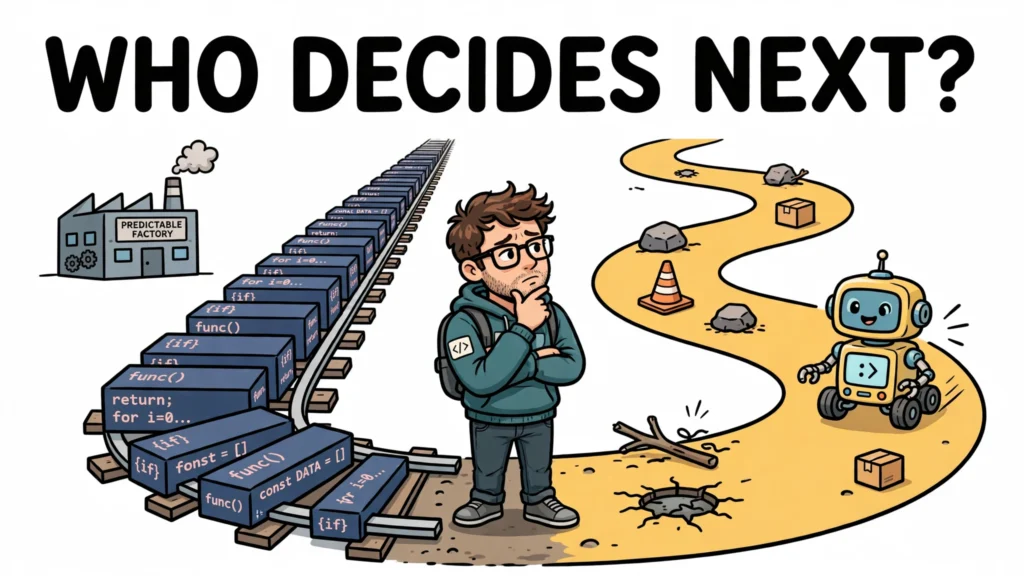


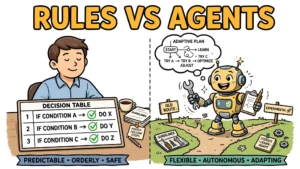
Every team building with a large language model faces the same fork: should this be an agent, or ordinary software? The ai agent vs application question is about who decides what happens next, what that decision costs, and what happens when it is wrong. An agent hands the next step to the model. A traditional application keeps it in code a person wrote and can read. This article sets out the conditions favouring each choice, what changes in cost, reliability and testing when the model decides, and the hybrid pattern vendor guidance converges on.
AI agent vs application: the short answer
Build an AI agent when the inputs vary from case to case, the steps cannot be listed in advance, and the task needs judgement over unstructured material such as free-text requests, documents or conversations. Build a traditional application when the steps are known, the inputs are structured, and a wrong or varying outcome is expensive. When the work is deterministic, repeatable, or can be expressed as a clear function or workflow, Microsoft’s AI Decision Framework is blunt: do not use an agent; use a workflow, an API integration, or traditional code.
The pattern both Anthropic’s and OpenAI’s guidance points to is a hybrid: deterministic code for validation, routing and anything irreversible, and a bounded agent step only for the part needing judgement. Start simple, and add complexity only when it demonstrably improves the outcome.
What counts as an AI agent, and what counts as a traditional application
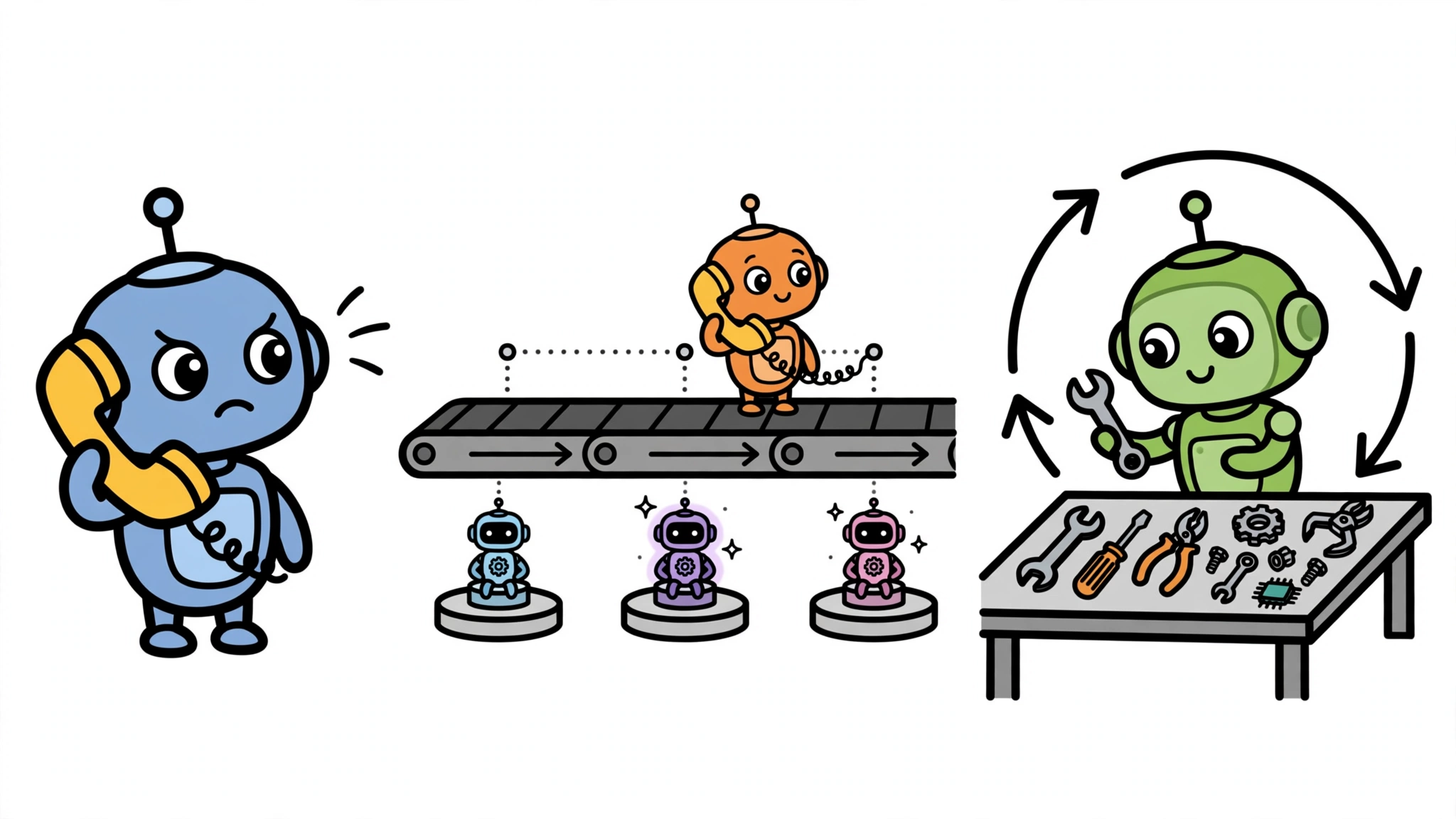
A traditional application is fixed code: rules, data operations and control flow defined in advance by a person. Given the same inputs and state, a deterministic workflow is designed to follow the same path, which makes runs easier to replay and inspect step by step. That predictability, under controlled inputs and state, is its strength. Its limit is that fixed orchestration constrains how execution is directed: a fixed set of branches does not by itself hand direction to the model, although general logic or an embedded model call within the fixed design can handle previously unseen inputs. A design change is needed only when the required behaviour falls outside the capabilities of the existing logic, tools and embedded model calls.
Anthropic draws the line on who directs the work: in a workflow, LLMs and tools are orchestrated through predefined code paths, while in an agent, the LLM dynamically directs its own process and tool usage. An agent is a model in a loop: it receives a goal, plans its steps, calls tools, reads the results and adapts. OpenAI puts it similarly: an agent uses a language model to manage workflow execution, recognises when a workflow is complete, can correct its own actions, and can halt and hand control back to a person.
Between the two sits a spectrum: a single model call, perhaps with retrieval; a fixed workflow calling a model at set points along a defined path; and, at the far end, a full agent choosing its own tools and order of operations. Anthropic advises finding the simplest solution possible and only increasing complexity when needed, noting that optimising single LLM calls is usually enough. The question is where on that spectrum a task belongs.
The Future of Privacy Forum’s 2026 survey adds a useful test, summarising the US Center for AI Standards and Innovation, housed at NIST, as characterising agentic AI as capable of planning and taking autonomous actions that impact real-world systems. A scripted bot following predetermined steps is not agentic: it only does what it was configured to do.
The conditions that favour building an AI agent
An agent earns its place when the goal is clear but the route cannot be enumerated before the run starts. Anthropic describes agents as suited to open-ended problems where it is difficult or impossible to predict the required number of steps and no fixed path can be hardcoded. Three task properties point that way.
First, variable and unstructured inputs. OpenAI’s guide prioritises workflows that rely heavily on unstructured data: interpreting natural language, extracting meaning from documents, or interacting with users conversationally. When inputs differ from case to case in ways a fixed set of branches does not cover, maintaining those branches becomes a burden rather than a design.
Second, discovery during the run. Some tasks only reveal their next step once an earlier step returns a result: a search that turns up an unexpected source, a tool call that fails and needs a different approach, a customer record that changes the question. An agent can revise its plan from what it finds. A fixed workflow revises its route only through paths its design provides, so a variation whose required behaviour falls outside the capabilities of its existing logic, tools and embedded model calls needs a design change rather than a run-time decision.
Third, judgement and exceptions. OpenAI’s first criterion for an agent is complex decision-making involving nuanced judgement and exceptions. A second criterion is a rule set that has grown so extensive and intricate that updates have become costly or error-prone.
The distinction, then, is what the work asks for. When the work is defined by nuanced judgement, exceptions, unwieldy rules or unstructured material, model-directed steps are worth considering. When the work is already written down as criteria a fixed design can apply, model-directed steps add a decision layer the task does not need.
The conditions that favour a traditional application
Build a traditional application when the steps are known and stable, the inputs are structured, and the outcome should be repeatable: validating fields, applying a rule, transforming structured data, syncing records, running fixed approval chains. Deterministic code is reliable and observable for that work, and needs no model to interpret anything.
The cost of being wrong is the second deciding factor. When a wrong step moves money, writes a record, cancels an order, authorises a refund or takes a safety-relevant action, variation is not a feature. It is a defect. A traditional application can be tested against a known expected result, audited after the fact, and reasoned about in advance. An agent’s behaviour, by contrast, depends on the model, the tools and the state of the task at run time, and the same input need not produce the same path twice.
Latency, cost and simplicity form the third factor. Anthropic notes that agentic systems often trade latency and cost for better task performance. Every turn of a loop adds model and tool calls, and with them time and cost a deterministic path does not incur. If a rule, a search, a query or a single model call already solves the problem, a loop buys flexibility the task does not need and pays for it on every run. OpenAI’s version: validate that the use case clearly meets the agent criteria, because otherwise, a deterministic solution may suffice.
Cost, reliability and testing: what changes when the model decides
The most consequential difference is in how the system is tested and trusted. A traditional application can often be checked against fixed expectations for defined inputs. For an agent, variable, path-dependent behaviour means fixed assertions on their own are not enough for the model-directed parts: behavioural evals are needed in addition, to establish a performance baseline, as OpenAI recommends as the first principle of model selection, and then to measure whether changes improve or degrade it. Fixed assertions still have a place for components, constraints and known expected results.
Cost follows the same logic: it grows with turns, model size and tool calls, and no single number captures it. On the vendor guidance consulted, the statement is qualitative only. No verified dollar or percentage range for agent runs against deterministic runs was found in that guidance, and quoting one without a source would invent it. What the guidance does say is directional: prototype with the most capable model to establish the baseline, then try smaller models, optimising for cost and latency only after accuracy is established.
Reliability changes shape too. Anthropic warns of higher costs and compounding errors, and recommends extensive testing in sandboxed environments alongside guardrails. An early mistake becomes context for the next step, which can build on a wrong tool result or misread document. Hence stopping conditions, such as a maximum number of iterations, and checkpoints for human feedback. Keeping a record of what the agent did — the steps taken, the tool results received and the outcomes reached — lets a team inspect a run, trace where it went wrong, and see a failure forming.
The hybrid pattern: a deterministic shell with a bounded agent step
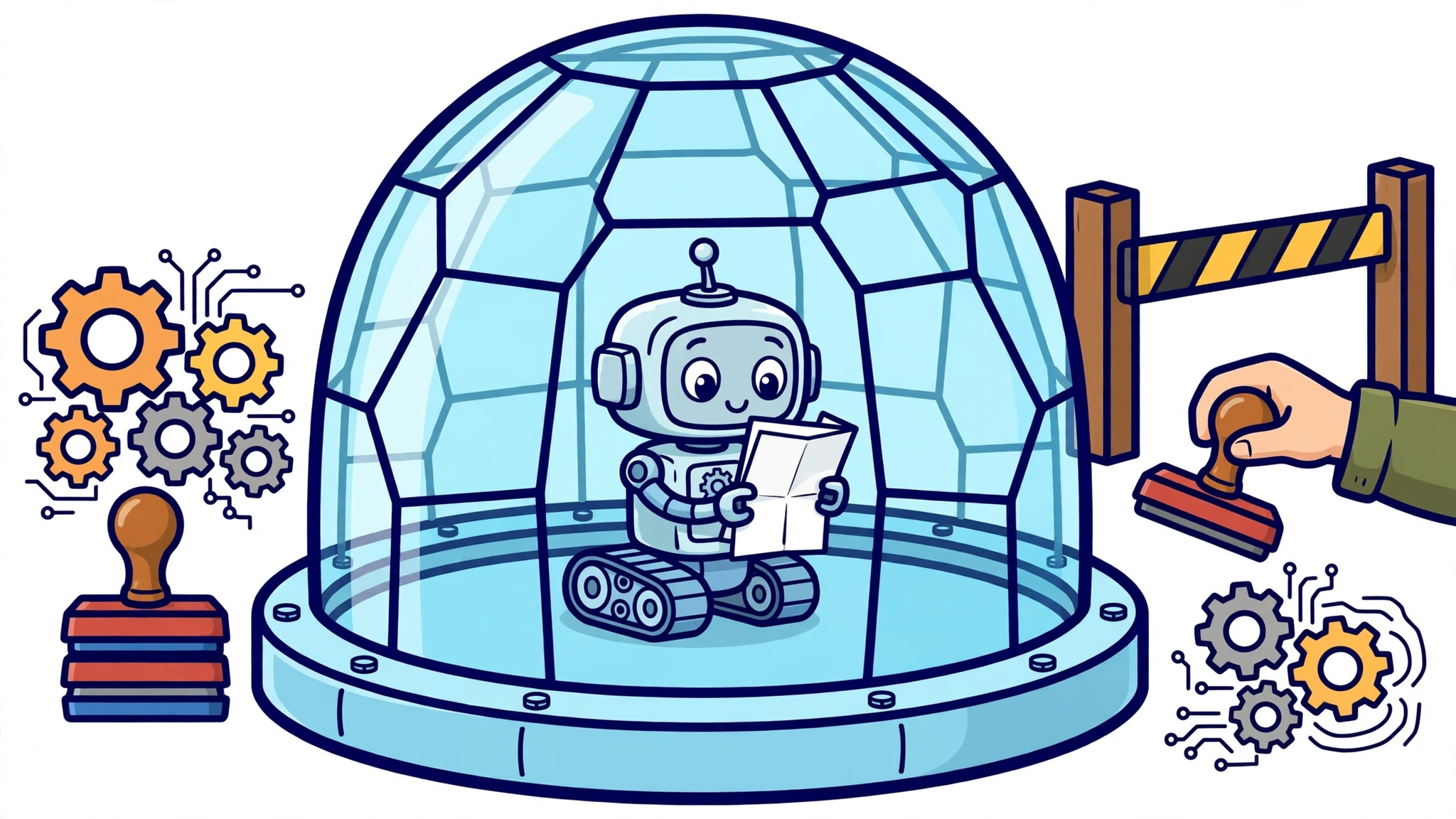
The practical answer is a deterministic shell with a bounded agent step inside it. Ordinary code owns everything that must not vary: validation, routing, transformation, every irreversible action. The agent owns only the part needing judgement: recognising intent, resolving ambiguity, or planning a route that cannot be written down. The shell checks the output, enforces limits, and hands the task to a person when a proposal crosses a risk threshold.
The sketch below shows the shape, as a fragment rather than runnable code. Take a clearly hypothetical task: a request arrives, its contents must be checked against a record, and only an ambiguous case needs further investigation. In a fixed workflow, the check and the routing are written down in advance, and the ambiguous case follows a pre-defined escalation path. The circumstance that would justify model-directed steps is a case whose next step depends on what the investigation itself uncovers, with no fixed path covering it. Even then, the checks around those steps stay fixed: the record is read and written by deterministic code, and any consequential action waits for the shell’s checks or a person.
# Sketch of the hybrid shape, not runnable code.
# Deterministic code validates, routes and commits.
# The agent is called only where judgement is needed.
def handle_request(request):
    validated = validate(request)
    if needs_judgement(validated):
        proposal = agent_step(validated)
        return apply_with_checks(proposal)
    return apply_rules(validated)
Guardrails make the shell trustworthy. OpenAI treats them as a layered defence: one guardrail is unlikely to suffice, while several specialised ones together create more resilient agents. Its seven types run from relevance and safety classifiers and a PII filter, through tool safeguards and rules-based protections, to output validation. Tool safeguards sit at the boundary with the world: each tool is rated low, medium or high risk on read-versus-write access, reversibility, permissions and financial impact, and high-risk calls pause or escalate to a human. Guardrails must sit alongside ordinary controls — authentication, authorisation, access control, standard software security. The agent operates inside them, not instead of them.
Human intervention is the last layer. OpenAI names two triggers: exceeding a failure threshold, such as failing to understand intent after multiple attempts, and any sensitive, irreversible or high-stakes action, such as cancelling orders, authorising large refunds or making payments. Those triggers are implemented in deterministic code. The agent proposes; the shell, and where necessary a person, disposes.
A decision checklist and a migration path
Five questions settle most cases. How variable are the inputs? If every input looks like the last, code can process it directly; if the task depends on free-form language or documents, a model may help. Is the right path known in advance? A fixed sequence fits ordinary orchestration; a system deciding its next step from what it discovers may justify model-directed planning. Does the task need dynamic tool choice? Use an agent when choosing tools is part of solving an ambiguous request; call the known operation directly when every run uses the same one. What does a wrong step cost? The higher the cost, the stronger the case for deterministic code and human approval. Has a simpler approach been tried and found wanting? If not, try it first.
A practical order to try is: rules and code, a single model call with retrieval, a fixed workflow, and then an agent — selecting and prototyping each option against the task requirements rather than treating the order as mandatory stages. Add complexity only when it demonstrably improves the outcome, and measure each option with evals before committing. Reuse depends on how the boundaries were drawn: deterministic parts may be kept if an agent step is added later, and moving back from an agent to fixed steps can mean removing a loop, tool set and testing regime, a trade-off to weigh before committing either way.
Three mistakes waste the most effort: reaching for an agent for a fixed workflow, paying loop and testing costs for unused flexibility; giving an agent irreversible tools before its reliability is proven, so a compounding error becomes a real-world action; and skipping evaluation while loosening oversight on a few impressive demonstrations, rather than widening autonomy only when the numbers support it. Avoid those three, keep the deterministic shell, and the ai agent vs application decision becomes a judgement about the task in front of you, made with the costs in plain sight.