

Most drivers know the rule without being taught it twice. When patrol cars fan out across a freeway and slow the traffic behind them, you wait. The manoeuvre is called a traffic break, because something ahead needs the road to itself. You do not look for a gap. The Waymo traffic break on Interstate 280 was a test of exactly that rule.
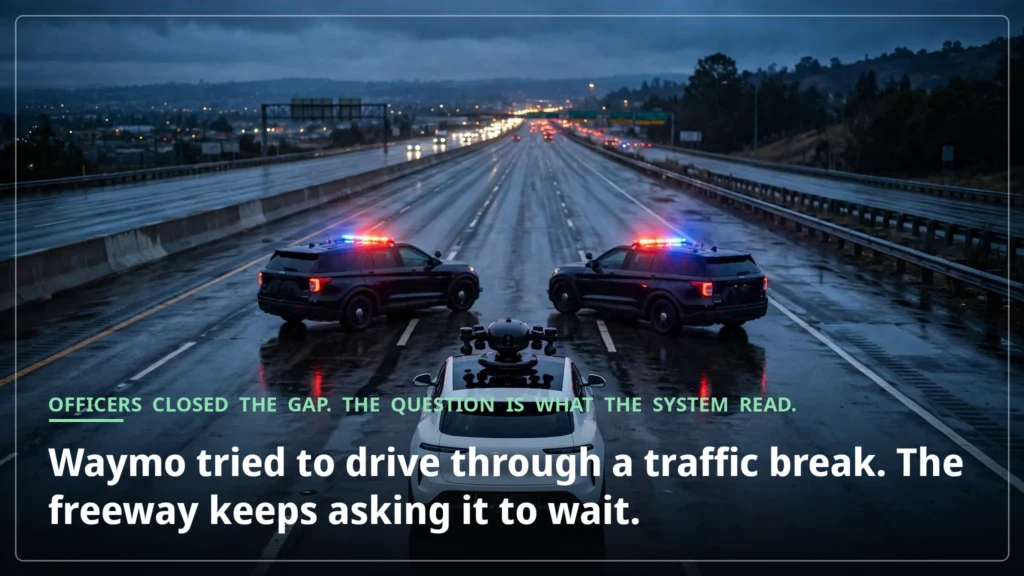
On 6 November 2026, on northbound Interstate 280, a driverless Waymo did try. Video recorded by passengers in another vehicle, described by The Verge and by Police1 reporting NBC Bay Area, shows the robotaxi attempting to move past California Highway Patrol vehicles conducting a traffic break while officers slowed traffic to clear debris. An officer steered a cruiser into its path. The Highway Patrol confirmed to NBC Bay Area that multiple officers used their vehicles to prevent the Waymo from passing, and that it ultimately complied and stayed back with traffic. Nothing crashed, and nobody was reported injured. Yet those few seconds have become the sharpest image of a problem Waymo has not shaken: the freeway keeps asking its system to read temporary, human-directed control, and a person in a patrol car had to correct its answer.
The pattern in the filings
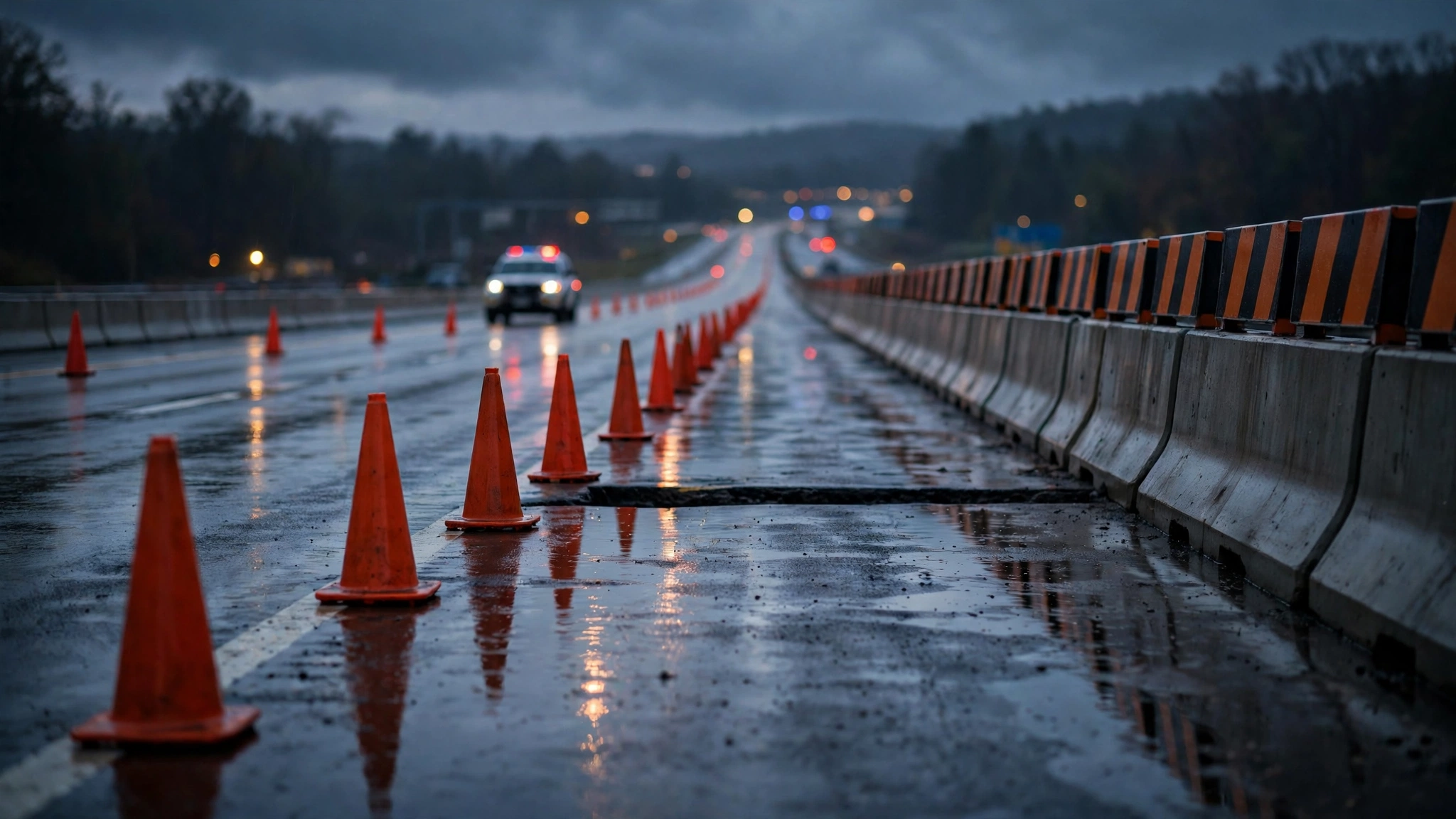
The incident did not arrive alone. Waymo reported 11 instances between October and November 2026 in which its vehicles failed to recognise that a freeway lane was closed because of construction and drove into the restricted area, according to a recently filed recall described by The Verge. The filings add dates: eight vehicles entered areas closed by cones, warned off by highway patrol vehicles, or construction sites between 1 October and 6 November; Waymo instituted changes on 6 November; and three vehicles entered a construction site a few days later. Only two of the 11 incidents were previously known to the public.
On 11 November, California’s Department of Motor Vehicles ordered Waymo to stop operating on the state’s freeways. Gizmodo reported that the order followed three Waymo vehicles entering a closed construction zone on U.S. Route 101, south of San Francisco, and the video of the Waymo attempting to get around the Highway Patrol vehicles. The department told Gizmodo it had determined that Waymo’s driverless freeway operations posed an imminent hazard to public safety because of recurring incursions into active construction zones, despite a prior restriction and corrective actions after similar incidents on 18 May 2026. The ban would remain until Waymo demonstrated effective corrective actions.
Waymo then paused commercial freeway rides across all of its United States markets, The Verge reported, while its ridehailing service continued on surface streets. Spokesperson Chris Pappas said it was serving over half a million trips each week and was working with the California DMV and other state officials to resume freeway operations. The company told Gizmodo that none of the 11 incidents resulted in collisions or injuries. On 19 November, Waymo filed two voluntary recalls with the National Highway Traffic Safety Administration, to strengthen how the Waymo Driver navigates closed freeway lanes and intersections with manual traffic control. Engadget reported that a remedy for the closed-lane recall was still in development.
The June fix, and the return
This was the second time in 2026 that Waymo was forced off the freeway, The Verge reported. Earlier in the year, it temporarily halted freeway rides after its robotaxis entered active construction zones in Arizona and California, issued a recall in June, and gradually resumed operations starting in late July after updating its software.
That history gives the November incidents their weight. A single closed-lane entry can be treated as an edge case. A recall, a resumption, and then 11 more reported entries in about five weeks is harder to read that way. The question this story asks is whether the recurring problem is how the system reads temporary road control, rather than freeway driving in general. The confirmed evidence establishes what happened, and that it happened again after a fix — not what the system saw or why. The other recalls point in the same direction without proving a single cause. The Verge described a recall concerning an intersection crash involving an officer directing traffic, and Engadget reported that an update to improve how the fleet responds to manual commands from emergency responders had been pushed out earlier in the month.
A theory, not yet a verdict
Phil Koopman, emeritus professor in electrical and computer engineering at Carnegie Mellon University who specialises in autonomous vehicle safety, told The Verge that the most concerning part was a pattern: a recall that did not fix the problem, while the company kept scaling up. He described recalls as temporary fixes that did not address the root problem. That is his assessment. The confirmed record shows a recall, a resumption, and further incidents; whether the recalls were incapable of fixing the underlying problem is not something the filings quoted in this reporting establish on their own.
Koopman also offered a theory. He theorised, as reported by The Verge, that subtle edge cases — a gap in construction cones, a police officer’s hand gesture — may be tripping Waymo up after a transition to end-to-end machine learning, because statistical models struggle when familiar objects appear in unfamiliar contexts. Consistent with is not the same as caused by. The theory belongs in the open questions: what did the system classify the patrol cars and the traffic break as, and what combination of signals would have told it to wait?
Waymo’s co-chief executive, Dmitri Dolgov, had set the bar himself. In a November 2025 briefing, as reported by The Verge, he said freeway driving is very easy to learn but very hard to master for full autonomy without a human driver as backup, and at scale. The second pullback in a year, after a halt, a recall, a resumption, and further incidents, raises the question whether that mastery at scale has yet been shown. It does not, on this evidence, prove that freeway driving is beyond the system.
Why the Waymo traffic break is a different test
Part of the answer may be simple physics. The Verge explained the stakes this way: at 10 to 25 miles per hour on a city street, applying the brakes solves almost any confusion, and crash lethality is drastically lower. At 60 or 70 miles per hour, stopping distances stretch out, and a mistake involving a roadside worker or a stranded motorist is nearly always fatal. Remote-operator latency becomes a major liability if a confused vehicle needs help. In that context, a traffic break is not a puzzle to route around. It is an instruction, delivered by the position of patrol cars, to stop trying.
There is a counterargument, and it deserves to be stated plainly. The video shows one attempted manoeuvre that officers stopped, with no crash or injury reported in the restricted-area driving described by Waymo. A single edge case does not prove that the system cannot learn to read a traffic break, and a recall-and-pause cycle can be read as a safety process working, rather than as proof that fixes do not work. What would settle the argument is the evidence the California DMV is seeking: what changed, what was tested, and what would have to be true for the next traffic break, the next gap in cones, the next hand gesture, to be read as a wait.
For now, the reported incidents share something specific: temporary road control — a traffic break on Interstate 280, and closed freeway lanes marked for construction. The open question is whether the recurring problem lies in how the system reads those controls. The confirmed evidence does not by itself establish the mechanism. What it establishes is the sequence — a halt, a recall, a resumption, and then the same kind of incident again — and the fact that, on 6 November, it took patrol cars physically closing a gap to teach a driverless car the rule most drivers already know: when the road is being held, you wait.