

Big Tech defeat: introduction to the 2026 election results
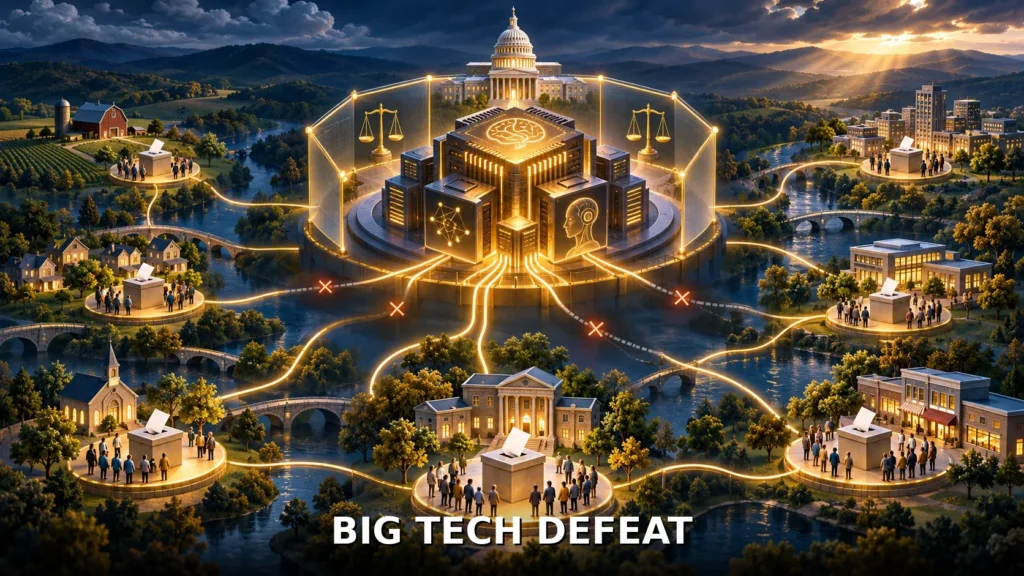
The Big Tech defeat in the 2026 US midterms points to a less welcoming political environment, according to The Verge’s assessment of the election. Its account connects Democratic gains and opposition to AI with the prospect of renewed scrutiny of technology companies. For the AI industry, the central question is whether that political backlash will translate into enforceable restrictions while businesses are already reconsidering how much value AI delivers.
In a November 6 article introducing an episode of The Vergecast, David Pierce characterizes the result as a major defeat for Big Tech. The episode’s discussion links the election to congressional attention toward technology executives, AI regulation and resistance to data center construction. That places the industry’s political influence, infrastructure ambitions and commercial performance within the same debate. The Verge’s election assessment is the source for the developments examined here.
The scope of that evidence matters. The article is a podcast introduction offering an editorial interpretation of the election. It supplies no seat totals, individual race results, polling breakdowns or measures of how strongly AI affected voting decisions. Its description supports an account of a perceived backlash; it does not establish how much AI contributed to the outcome relative to other issues.
Even within those limits, the argument raises a consequential distinction: an industry can face political resistance before the practical consequences of an election become clear. Pierce anticipates a renewed confrontation with Big Tech, but also describes the hosts questioning whether meaningful action will follow over the next two years. The prospect of pressure and the delivery of policy are separate parts of the story.
The election therefore provides a starting point for assessing the industry’s position, rather than a complete explanation of its future. The most useful reading of the available account is that political permission for AI expansion appears more contested, while the substance and effectiveness of the response remain unresolved.
Impact of voter sentiment on Big Tech and AI

The Verge interprets the election as a vote against AI as well as a favorable result for Democrats. That is a strong editorial conclusion. Without voter surveys or constituency-level evidence in the supplied account, however, it should remain attributed to the publication rather than treated as a measured national judgment about every use of the technology.
There is also a difference between opposition to large technology companies and opposition to AI itself. The article places both within its explanation of the election, but does not quantify their relationship. It does not show whether voters objected principally to corporate influence, AI deployment, data center construction or some combination. Those possibilities cannot be separated confidently from this source alone.
Data centers give the discussion a concrete point of contact with the industry’s expansion plans. Pierce expects the struggle over their construction to become more difficult. The significance of that observation is that resistance to AI need not be confined to arguments about software: in this account, it also reaches the facilities associated with the industry’s growth. The article does not identify particular projects, communities or decisions, so the extent of that resistance remains unspecified.
The episode also examines X as an environment that can isolate its participants from outside views. In the context of the election discussion, that raises a question about whether the political conversation within a technology platform reflects the wider electorate. The source does not provide a study of X users or evidence linking the platform to specific electoral outcomes. Its relevance here is the hosts’ concern about the industry’s perception of public opinion.
For AI companies, the analytical implication is a potential gap between confidence within the sector and acceptance beyond it. That is an interpretation of the themes Pierce brings together, not a separately established finding about company behavior. The evidence supports examining that gap, while leaving its size, causes and commercial consequences open.
Anticipated regulatory changes and challenges

The Verge expects renewed political confrontation with Big Tech and describes congressional attention likely to focus on technology executives and AI regulation. Its account offers a broad forecast of scrutiny rather than details of an antitrust case, enforcement program or legislative proposal.
That distinction prevents an election narrative from becoming an unsupported policy forecast. More attention from lawmakers would not, by itself, establish that a particular rule will pass, that an agency will bring a case or that a company will face a specific remedy. None of those outcomes is documented in the available material. The strongest supported conclusion is that the publication anticipates a more adversarial political environment.
The article itself preserves uncertainty about results. Pierce says the hosts consider whether anything is likely to be accomplished over the next two years. This qualification belongs alongside the prediction of renewed pressure: the expected intensity of the debate does not resolve the question of what it will produce. Any account that presented a regulatory crackdown as settled would go beyond the source.
The discussion of data centers adds another unresolved dimension. A harder fight over construction is an anticipated obstacle, but the source provides no proposed restrictions, permitting decisions or timetable. It therefore cannot support estimates of delayed capacity, increased costs or changes to AI deployment. What it does support is the narrower observation that the political debate includes the industry’s physical expansion as well as oversight of its executives and products.
For readers following AI regulation, the next distinction to watch is between expressed political intent and documented action. A named proposal, a formal decision or an identified enforcement step would make the implications more concrete. Those are standards for evaluating subsequent developments, not claims that any such measures have already occurred. On the present evidence, direction is clearer than mechanism, scope or timing.
Current state of the AI industry
The election discussion arrives alongside doubts about the AI industry’s commercial momentum. Pierce describes businesses reducing their commitments and agents failing to achieve the pervasive role suggested by expectations around them. The episode also questions whether companies have established a convincing way to earn money from AI. These are the publication’s assessments; the article supplies no adoption survey, financial dataset or agent performance benchmark with which to measure them independently.
The source supports reporting signs of retrenchment and skepticism about commercialization. It does not establish the size of a decline, identify which businesses are scaling back or show whether the pattern applies evenly across the industry. An account of widespread uncertainty is better supported than a numerical or comprehensive diagnosis of contraction.
AI search illustrates the tension. Pierce describes rapid growth in OpenAI’s web search while questioning its commercial significance, and presents Google’s AI search monetization as another unresolved problem. No growth figures, revenue totals or comparative margins are supplied. The example therefore supports a distinction between increased use and demonstrated earning power, without establishing how either company’s search business is performing financially.
Agents present a related but separate question. The source’s skepticism concerns whether they are becoming dominant, not whether a named system succeeds or fails at a specified task. There is no technical evaluation, implementation description or evidence about particular workflows. For readers in the AI-agents sector, the supported takeaway is that broad commercial expectations are being questioned; the article cannot settle the usefulness of any individual deployment.
Funding adds a further layer. Pierce asks whether enough money is entering the AI sector to sustain it, despite substantial sums moving within it. This raises a question about the durability of the business model, rather than documenting an imminent financing failure. The source offers no cash-flow statements, funding totals or dates by which companies must become self-sustaining.
Taken together, these observations suggest a sector being asked to substantiate several different propositions: that people want its products, that businesses will continue adopting them, and that use can support a durable business.
Future outlook for Big Tech and AI
The immediate outlook in The Verge’s account combines political resistance with commercial uncertainty. Big Tech is portrayed as losing electoral ground just as AI companies face questions about adoption, agents and monetization. The analytical significance is their overlap: the industry’s expansion is being challenged from more than one direction. The source does not establish that the election caused the commercial difficulties, or that those difficulties caused the election result.
Three unresolved questions follow from the account. The first is whether congressional interest becomes a concrete policy response. The second is whether resistance to data centers produces identifiable effects on construction. The third is whether AI businesses can turn growth and investment activity into sufficient income.
For agents specifically, the next useful evidence would connect claims of adoption to documented use and commercial results. The current source offers a skeptical assessment of their reach, but no basis for declaring either a universal failure or an eventual breakthrough. Expectations about agents should therefore be evaluated separately from claims about the political standing of Big Tech as a whole.
The same restraint applies to the election’s meaning. The Verge presents it as a backlash against AI, but the absence of detailed voting evidence leaves the strength and composition of that backlash uncertain. Stronger regulation may be anticipated without being enacted; public resistance may be visible in the discussion without its national scale being measured. Preserving those distinctions makes the political signal more useful, because it identifies what remains to be demonstrated.
The central implication is a demand for proof on two fronts. In this reading of The Verge’s account, the industry faces questions about both public acceptance and commercial sustainability. Electoral defeat may change the conditions in which technology companies make their case, but it does not decide which policies will follow or which AI businesses will endure.