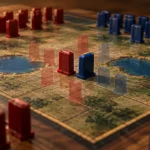



Google launched Playground on October 7, 2026, as an experimental platform for creating, playing and sharing browser-based games through text prompts. It is initially available to users aged 18 and older in the United States, with creation access rolling out in tiers tied to Google One membership. Google’s pitch is that people can turn an idea into a playable game without coding experience, then revise it through conversation. Google’s announcement describes both the creation workflow and the launch restrictions.
The launch combines game generation with a place to distribute and discover the results. Creators can keep games private, share links or publish to a community gallery; players can use leaderboards and, in select genres, multiplayer. A Unity Spark integration is also planned, but its advertised mechanics and higher-fidelity 3D capabilities belong to the roadmap rather than the initial release.
From a prompt to a playable game
Playground’s interface lets users describe what they want to build, test the result and request changes. Google offers three starting points: a blank canvas, starter prompts that can be remixed, and guided support to help shape a concept. That gives creators an entry point whether they already have a specific idea or need help defining one.
The prompts are intended to affect gameplay as well as appearance. Google says users can adjust physics, change rules, customize characters and reshape environments. Engadget’s reporting adds that creators can choose 2D or 3D and select single-player or multiplayer for supported genres.
These controls explain the significance of the conversational workflow: the initial generation is a starting point for further direction. A creator can play the result and request a change to a mechanic, rather than limiting the interaction to the game’s initial description. This makes Playground relevant to people who want to explore game ideas through iteration. It does not establish how reliably the system follows every request or how complex a finished game can become.
The available evidence describes controls and workflows, rather than a measured evaluation of their performance. There are no supplied benchmarks for generation time, prompt adherence or game quality. Google’s assertion that users retain control of creative direction should therefore be read as a product claim, not an independently demonstrated guarantee.
What is known about the AI behind it
9to5Google reports that Playground uses Gemini, Nano Banana and Lyria models with a custom harness. That is the only source in the supplied evidence supporting this model combination, so the architecture description remains an attributed report.
The evidence does not specify model versions, assign individual models to particular tasks or explain how the harness coordinates them. It also supplies no API documentation or configuration examples. The supported technical picture is consequently clearer at the interface level—prompt, generate, test and revise—than at the implementation level.
For developers assessing the platform, that distinction matters. A reported combination of models does not by itself explain the system’s execution architecture, debugging facilities or ability to integrate with an existing development workflow. Those questions remain open in the available evidence.
Sharing, discovery and community controls
Google says Playground games run in a browser and can be played on phones or laptops. Creators have three distribution options: retain a private game, send a shareable link to friends and family, or publish it to the Playground Explore gallery.
These options give the platform a role beyond generating a game. A link provides a way to invite others to play, while the gallery provides a route to the broader Playground community. Publishing to that gallery is the documented public distribution mechanism; the evidence does not establish an app-store publishing workflow.
The social features include in-game leaderboards and multiplayer in select genres. With a Play Games profile, users can claim a custom handle, like games, compete for leaderboard positions and follow creators. Google’s narrower qualification on genre support remains relevant: multiplayer is not documented as universal across every kind of game.
Google says the gallery uses player ratings and play activity to highlight games. This connects discovery to community response, although the announcement does not disclose ranking weights or establish how much visibility a particular game will receive.
Every published game also undergoes safety screening aligned with Playground’s Community Guidelines, according to Google, and users can report games. These are documented moderation mechanisms. The evidence provides no measured screening effectiveness, review turnaround times or reporting outcomes, so their presence should not be treated as proof that every problematic game will be caught.
Unity Spark is the next stage, not a launch feature
Google and Unity describe Spark as an expanded creation experience intended to retain an accessible interface while adding more advanced mechanics, high-fidelity 3D and the flexibility of the Unity runtime. These are the companies’ stated goals for the integration, rather than independently tested results.
The timing is more specific than a general promise of integration: Google says Spark is in testing and a closed beta is coming soon. Unity says the expanded experience will arrive later in 2026. Mobilegamer.biz likewise reports a closed beta ahead of a full launch later in the year. No exact beta or launch date is supplied.
The proposed progression is significant: creators would start with an accessible prompt interface and gain access to a richer Unity-based creation experience. However, the evidence does not establish project migration steps, source-code export, compatibility requirements or commercial-use terms. Developers cannot infer those capabilities merely from the reference to the Unity runtime.
Who can access Playground
Google directs eligible U.S. adults to playground.google. Google’s own launch announcement is the direct source for its stated entry point and eligibility requirements.
Google says tiered creation access is rolling out according to Google One membership. The evidence does not supply exact quotas, subscription prices or a complete tier comparison. Mobilegamer.biz also reports that Google provided no details about launches outside the United States.
Playground’s immediate proposition is a connected workflow for describing, revising, playing and sharing a game. Its value for more demanding development will depend on questions the launch evidence leaves unanswered: the reliability of generated mechanics, the limits of creation access and the capabilities delivered by Unity Spark when it becomes available.