


The bundle, not the chatbot
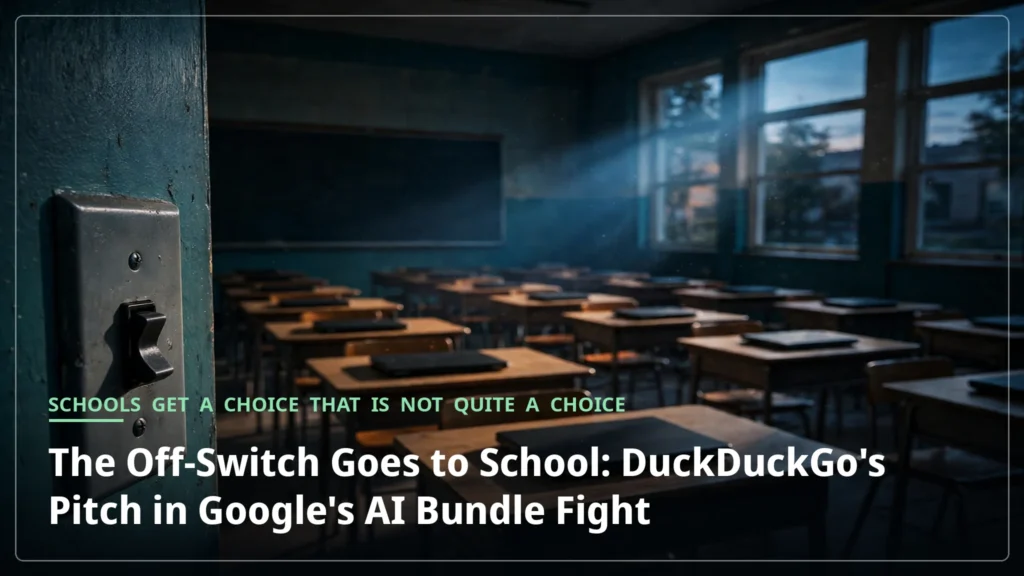
On Tuesday, Google gave schools a choice that was not quite a choice. Administrators could turn off Gemini, the company’s chatbot. They could, Google later clarified, turn Gemini, Gemini Notebook, and Search on or off individually. But if a school wanted Google Search without Google’s other AI features, the answer, in effect, was no: switching those features off would also mean losing Search. That is the sentence that turned a settings announcement into a fight, and it is the sentence DuckDuckGo answered.
DuckDuckGo did not announce a new product. Its founder and chief executive, Gabriel Weinberg, pointed schools on X to the company’s documentation for switching a default search engine to DuckDuckGo, adding, “get in touch for help.” Its chief public affairs officer, Kamyl Bazbaz, went further: “Forcing AI on school children: how a monopolist behaves when they think people are powerless. Prove Google wrong.” The pitch was not, at its core, “our search results are better.” It was “here is a search engine where the AI can be switched off.”
What Google actually announced
Google’s announcement on 3 November 2026 concerned K-12 student accounts. Gemini, Gemini Notebook, Gemini in Classroom, and Google Search would be entirely off by default until a school administrator explicitly turned them on. Google said the change was based on K-12 schools asking for more control, and that schools had told it they wanted control over AI in the classroom. The broader rollout is expected early in 2027.
Alongside the new defaults came Guided Learning, Google’s step-by-step study mode. In Google Classroom, Guided Learning became globally available on 3 November. In Search, Guided Learning is piloting in select US schools later in November, walking students through problems step by step rather than handing over a direct answer. Google’s stated aim is to stop AI shortcutting schoolwork.
That is a real concession, and it matters to the story. Google announced AI tools off by default, with administrators holding the switch. It is also, crucially, not the same as offering a Search without AI. Google’s education chief, Chris Phillips, has said Search and AI are deeply integrated. EdWeek quotes him putting the consequence plainly: “If a school is not comfortable with that and simply wants AI off, then they have the choice to not have Search on at all.”
Why Google Search is the sticking point

Gemini can be switched off separately. Search cannot be separated in the same way, because Google Search generally now heavily uses AI through AI Overviews and a conversational AI Mode that answers users’ queries. A school that turns Search on, under Google’s arrangement, gets Search with AI features it cannot switch off separately. A school that turns AI off entirely loses Search.
That distinction is why the backlash focused less on Gemini itself and more on the bundle. Educators have, as TechCrunch reported, been asking for tools that let them remove AI from the learning process altogether, not merely toggle individual products. Google’s answer gives them a toggle for Gemini, for Notebook, and for Search as a whole, but not a toggle for the AI inside Search. For a district with a strict policy against AI use, the practical options are therefore stark: accept Search with its AI, or go without Google Search for students.
Google’s clarification, posted on X after the backlash, insisted the announcement gave schools more choice, not less. Gemini, Gemini Notebook, and Search would be off by default, it said, and schools could choose to enable them individually. That is accurate as far as it goes. It does not resolve the question critics seized on: whether a school can switch Search on without its AI. On the evidence published so far, it cannot, and Google has not said otherwise.
DuckDuckGo’s counter-offer
DuckDuckGo’s pitch exploits that exact gap, and it does so with a deliberately modest product claim. The company, known for its privacy-focused positioning, is pitching schools a familiar action: change the default search engine. Weinberg’s documentation shows schools how to make that switch, and the company has offered to help schools that want to do it. Changing a default search engine does not require a school to abandon other services, and DuckDuckGo has not claimed that it does.
The second half of the pitch is the off-switch itself. DuckDuckGo offers its own AI features, including a chat interface called Duck.ai and an AI search assistant, so it is not arguing that AI should disappear from search. What it offers, unlike Google’s school arrangement as described, is the ability to disable those features in both search and browser settings. It also operates a dedicated site, noai.duckduckgo.com, where AI-assisted answers, AI-generated images, and AI feature suggestions are all turned off. The message to a school administrator is therefore concrete rather than rhetorical: here is a destination where search works and the AI features listed are off.
DuckDuckGo has also argued, via TechCrunch, that Google could easily turn off Search’s AI features for schools if it wanted to. That is DuckDuckGo’s argument, not an established technical fact, and Google’s position is the opposite: that Search and AI are deeply integrated and cannot simply be separated. The disagreement itself is the story. One company says the AI is an inseparable part of Search; the other says it is a layer that could be removed. Schools, caught between those two accounts, are being asked to choose a default and live with the consequences.
The scale of the hill

That choice is not happening on neutral ground. Google has historically dominated education. Figures Google published in previous years put around 50 million Chromebooks in schools, used by students and educators, and its Google Classroom platform serves over 150 million users globally. A default search engine is one setting inside a much larger classroom ecosystem of devices, accounts, and classwork tools.
This is the strongest counterargument to DuckDuckGo’s pitch, and it deserves to be stated plainly. Switching a default search engine does not displace Google from a classroom built on Chromebooks and Classroom, and no school adoption, signup, or switch figures for DuckDuckGo have been reported in the sources for this story. What has been reported is a pitch, two posts, and documentation. A pitch is not a migration. DuckDuckGo’s own reported momentum is of a different kind: the company reported earlier in 2026 that its app installs were up 30% as users rejected being force-fed Google’s AI Search. That is a company-reported figure about app installs in general, not evidence that schools are switching.
What remains unknown
Several questions will decide whether this moment amounts to more than a well-timed post. First, have any schools or districts actually switched, and at what scale? Second, what exactly would a school lose in practice if it switched off Google’s other AI features: access to Search entirely, or specific Search functions? Third, does DuckDuckGo’s no-AI offering meet the procurement, safeguarding, and device-management requirements that Google’s education bundle currently satisfies? Fourth, how does Google define “off by default” for Search, given that AI Overviews and AI Mode are part of Search itself?
The answers will arrive slowly, through administrator decisions ahead of the early-2027 rollout, through the Search pilot in select US schools later in November, and through whatever schools actually do with the defaults Google has handed them. Until then, the honest description of this story is a standoff over a switch, not a settled verdict about who won it.
That is why the off-switch is the right place to watch. Google’s announcement gave schools control over whether Gemini, Notebook, and Search are on at all. It did not give them control over the AI inside Search. DuckDuckGo, sensing the gap, offered schools a search engine where that control exists. The fight in education search is no longer only about which engine finds the best answer. It is about who gets to decide when the answer comes with AI attached, and what a school must give up to say no.