
Introduction to Medium’s TK app and AI writing assistance
Medium has launched TK, a writing app that brings AI writing assistance into the editor and pairs it with tools for human feedback and disclosure of AI use. The central proposition is straightforward: writers should be able to ask for help while developing a draft, without moving the task into a separate interface. Whether that assistance preserves the author’s judgment and improves the finished work remains an open question.
According to TechCrunch’s November 9 report, users invoke the assistant by typing @TK followed by a request or prompt. Medium presents the app as a way to make turning ideas into written words easier. The launch combines assistance with drafting, editorial and headline feedback, organization of earlier writing, and a social layer for sharing unfinished work.
The name comes from publishing shorthand. Editors and writers use “TK,” meaning “to come,” to mark information that needs to be filled in later. As TechCrunch explains, the unusual letter combination makes the placeholder easier to spot during proofreading. Medium’s app extends that idea into a product intended to help writers work through gaps in a draft.
TK is available on the web at launch. Medium says it will be free for people with a Medium account, with a desktop app on the roadmap. That establishes an immediate route to using the product, while leaving the desktop version as a future plan. The report does not provide a desktop release date.
The launch matters less as proof that AI improves writing than as a concrete proposal for how writers might incorporate it. TK brings assistance, collaboration, and an explanation of AI involvement into the same writing environment. Its usefulness will depend on the quality of those interactions, something the launch account does not independently establish.
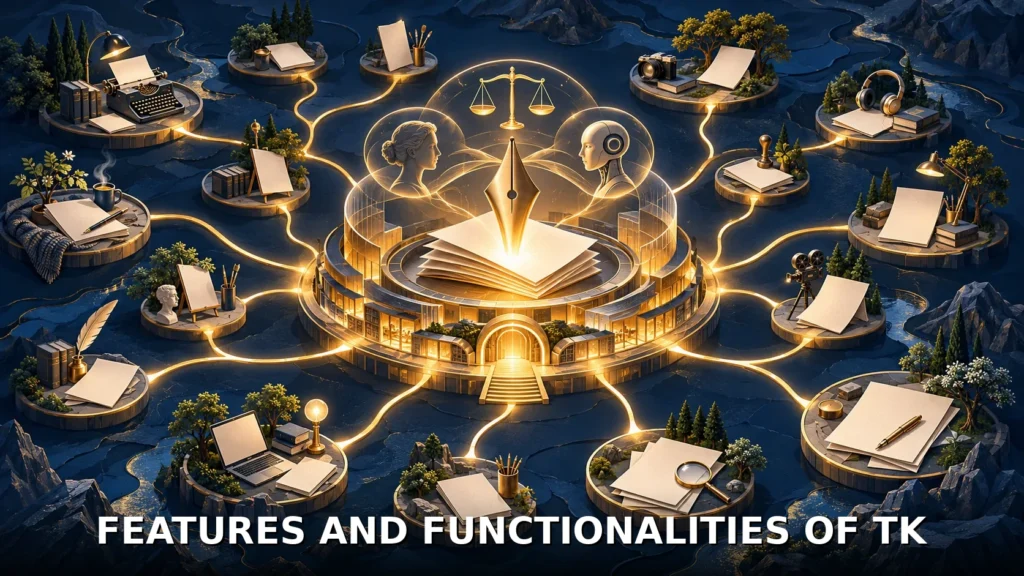
Features and functionalities of TK

The assistant’s position inside the editor is TK’s defining interaction. A writer can address it with @TK and a prompt at the point where help is needed. Medium suggests it could answer a question that would otherwise require switching tabs, such as how many days are in a particular month. This is an example of the company’s intended use, rather than evidence of the assistant’s accuracy across factual questions.
The distinction matters because convenience and verification are separate concerns. An answer delivered inside a draft can reduce the interruption involved in seeking information. It does not, on the evidence available, establish that the answer is correct or adequately sourced. The launch report supplies no accuracy benchmark or description of a source-verification mechanism.
TK also connects new writing with material already saved in the app. TechCrunch reports that it can pull in pieces of writing stored while an author was developing ideas, help users remember and organize previous writing, and suggest writing prompts. These functions extend the product beyond feedback on a finished paragraph: they address the earlier work of collecting material and deciding what to write.
Editorial assistance is another part of the proposal. Medium says TK will ship with skills for editorial feedback, headline feedback, and matching drafts to style guides for Medium publications. Those are related but distinct tasks. Feedback on a headline concerns how a piece is presented; matching a publication’s style guide concerns its editorial requirements. Neither, by itself, demonstrates the quality or originality of the underlying argument.
There is a qualification in the reporting worth preserving. Although the app has launched, the description of these particular skills uses Medium’s forward-looking wording that TK “will ship” with them. The report does not provide a feature-by-feature availability checklist or independent testing of those skills. Writers should read the description as Medium’s account of the intended capabilities, without assuming every detail has been separately verified.
For writers already using an AI agent, TK offers an optional connection through its MCP server or a Claude skill. According to the report, the purpose is to let the app better understand projects, positions, and ideas that may be stored in that agent’s memory. This makes external context part of the proposed writing workflow. The evidence does not describe setup steps, the scope of information exchanged, or the behavior of particular connected agents, so it supports no detailed implementation guidance.
Human collaboration sits alongside the AI assistance. Medium says writers can share early drafts with others and receive feedback through a social layer. That gives the product two routes to editorial input: responses from the assistant and responses from other people. The presence of both is significant because a writer can seek human reactions while the work is still taking shape, although the report does not evaluate how effective that collaboration is in practice.
TK can import and export Markdown, but TechCrunch explicitly notes that it is not itself a Markdown app. The distinction is useful for anyone considering how the tool fits into an existing writing process: support for moving Markdown in and out does not establish that the editor behaves like a dedicated Markdown editor. The report does not document conversion fidelity or more detailed export behavior.
The account also identifies an important limitation: writing in TK is not encrypted. It says users will be able to set access control permissions on their work, while describing the app as designed for collaboration. Permissions and encryption address different questions; control over who can access a draft should not be read as a claim that its contents are encrypted. The supplied reporting provides no further security architecture or data-retention details.
Implications for authorship and content quality

TK’s authorship question begins with the breadth of assistance it offers. Looking up a small factual detail, retrieving an author’s saved writing, recommending a headline, and providing editorial feedback can all influence a draft in different ways. Treating those activities as one undifferentiated use of AI would obscure how much of the finished piece reflects the writer’s own choices.
TechCrunch places the launch within a publishing debate about the boundary between assistance and authorship. Its report describes concerns that editorial suggestions can become the writing itself, rather than reflect what the author intended to say. It also notes uncertainty about whether AI detection tools can reliably distinguish writing produced with AI from writing developed with assistance or without it. Those concerns are context for the product, not an independent assessment of TK’s output.
Medium’s response includes allowing authors to publish notes explaining how they used AI. The company frames transparency about the provenance of writing as part of what publishing in the AI era requires, extending its stated ambition to prompts and source material. The concrete feature described is the ability to publish explanatory notes. The report does not establish a comprehensive audit trail, automatic verification of those notes, or a requirement that every writer disclose every interaction.
That boundary is important when assessing the value of disclosure. An account of AI involvement can help a reader understand the process behind a piece. It cannot, on its own, show that the argument is sound, the sources are reliable, or the final wording accurately represents the author’s thinking. Disclosure offers context for evaluating the work; editorial quality still requires an assessment of the work itself.
The usefulness of a note would therefore depend on its specificity. As an editorial principle, an explanation of which tasks involved AI would tell a reader more than a general acknowledgment that AI was present. This is an implication of the product’s transparency approach, not a claim that TK enforces a particular disclosure format or verifies the explanation.
The same distinction applies to style feedback. Matching a publication’s style guide may help a draft satisfy that publication’s expectations. It does not establish factual accuracy, reporting depth, or a distinctive point of view. The reported feature addresses one dimension of editorial work; the launch evidence does not show that it can stand in for the others.
Human feedback could provide another perspective on these questions. Sharing an unfinished draft gives other readers an opportunity to respond to the developing piece. However, the existence of a social layer does not demonstrate that people will receive expert review or that every suggestion will be useful. The writer still faces the editorial decision of which feedback to accept and what the piece should ultimately say.
Medium acknowledges the possibility of low-quality content and blurred boundaries between human-written and AI-written work. That acknowledgment makes the disclosure feature relevant, but it does not resolve those risks. The supplied report contains no comparative study of writing quality, time savings, or reader trust. It supports describing the product’s approach and its trade-offs, rather than declaring that the approach has succeeded.
Conclusion on the future of AI in writing
TK puts forward a model in which AI participates throughout the development of a piece: answering questions, resurfacing saved material, offering feedback, and connecting with context held by an external agent. Human responses and author disclosure are included in the same product concept. Taken together, those features suggest that Medium sees the writing process itself as the place to integrate AI assistance.
The strongest case for that approach is continuity. If the tools work as described, an author could work with earlier ideas, request assistance, and seek feedback within a shared writing environment. That is a reason to examine the product, not evidence that it improves every writer’s process.
The unresolved questions are practical as well as editorial. The quality of suggestions, the usefulness of disclosure notes, and the handling of context from connected agents will shape what writers can reasonably rely on. The lack of encryption is already a documented consideration for deciding which drafts belong in the app. The planned desktop version adds another future development, without a reported delivery date.
Medium’s launch therefore offers a specific direction for AI-assisted writing rather than a settled answer about its future. It combines easier access to assistance with mechanisms for collaboration and explaining AI use. The consequential test is whether that combination helps authors make clearer decisions about their work—and gives readers enough information to judge the result.