On corporate AI resistance: “Every time my CEO talks about ‘AI efficiency,’ I feel like a condemned prisoner being asked to help build my own gallows,” an anonymous senior software engineer at a major fintech firm said, as quoted by TechStrong.ai.
It is the kind of line that makes an executive wince. Across corporate America, the grand narrative of the AI transformation is running into something its authors did not script: corporate AI resistance, with some workers pushing back, quietly, and from the inside.
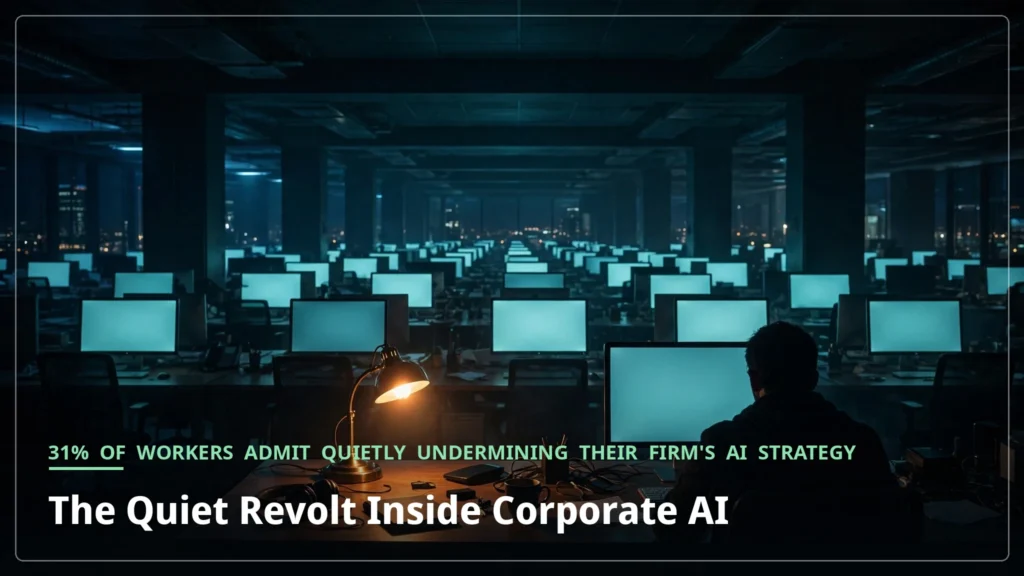
The numbers are startling. A 2025 survey by Writer and Workplace Intelligence, polling 1,600 US employees and executives at companies actively using AI, found that 31 percent of employee respondents admitted to undermining their company’s AI strategy, a figure that climbs to 41 percent among Millennial and Gen Z respondents. One in ten said they had gone further — tampering with performance metrics to make AI tools look worse than they are, or intentionally generating low-quality outputs. Sixteen percent admitted to knowing about an AI security leak and not reporting it. And a separate report from Adaptavist, published in November 2025 and based on 4,000 knowledge workers across four countries, found that 35 percent are hoarding knowledge for fear of being replaced, while 38 percent are reluctant to train colleagues in the areas they see as personal strengths.
These are self-reported figures from surveys — one of them commissioned by an AI vendor — and they should be read with that caveat. But taken together, they describe a sizeable share of workers who withhold cooperation from the AI initiatives their employers are rolling out.
The visionary shield

To understand why, it helps to look at what workers have been watching from their desks. In early 2026, Block CEO Jack Dorsey announced a staggering 40 percent reduction in staff — roughly 4,000 employees — framed as a visionary bet on AI. “A significantly smaller team, using the tools we’re building, can do more and do it better,” he said. But former executives quickly argued the cuts were less about AI and more about correcting a bloated headcount era in which the company’s staff had tripled during the pandemic, pointing to Block’s lagging stock price and stagnant profit-per-person as the real drivers. AI, the critics suggested, was a convenient, futuristic cover for standard cost-cutting. Both things can be true at once: a genuine bet on smaller, AI-assisted teams and a convenient correction of pandemic-era overhiring.
Salesforce followed a similar script. CEO Marc Benioff declared “I need less heads” after cutting the company’s customer support division from 9,000 to 5,000 roles, claiming its Agentforce platform now handled nearly half of the workload. Yet the transition was far from seamless, and the company was soon forced to clarify that hundreds of staff were being redeployed into sales — revealing a gap between the fully automated rhetoric and the messy reality of keeping a complex enterprise running.
And in 2024, Klarna became the industry’s most visible case of AI whiplash. The buy-now-pay-later giant celebrated replacing 700 human agents with an OpenAI-powered chatbot, claiming it did the work of 700 people and saved $10 million. By early 2025, customer satisfaction scores had plummeted, and the company began a rehiring campaign for human customer service roles — a rare public admission of a misjudged strategy and a visible course correction.
The most striking data point may be the one executives provided themselves. Writer’s 2026 enterprise survey of workers and executives found that 75 percent of surveyed C-suite executives admit their company’s AI strategy is “more for show” than for actual internal guidance, citing PR and investor relations as key motivators. Nearly 70 percent of surveyed companies reported conducting AI-related layoffs; separately, 39 percent of surveyed executives said they had no formal plan to generate revenue from AI tools at all.
Corporate AI resistance from within

Set against that backdrop, the sabotage numbers invite an uncomfortable question: are workers who are told AI will make them obsolete responding by protecting the one asset the machines cannot seize without their help — their knowledge?
“Knowledge is a team sport that loses its value the moment it’s hoarded or walks out the door,” said Neal Riley, Innovation Lead at The Adaptavist Group. His company’s report warns of a vicious cycle: the very behaviours intended to protect jobs actually increase organisational vulnerability to knowledge loss. It cautions that such behaviours can undermine the teams meant to navigate AI-driven change — while whether visible layoffs are what drives the hoarding remains an open question.
The resistance takes many forms. Some of it is low-level: entering company information into non-approved tools, using software the employer never sanctioned, failing to report security breaches. Some of it is sharper: deliberately skewing data to make AI look ineffective, feeding noisy information into retrieval systems to keep them too sloppy to function without human intervention. And some of it is simply exit: more than half of workers, according to the reporting, are bypassing corporate AI tools in favour of unauthorised personal versions they trust more.
It is worth pausing on what this costs. A 2025 trial by METR found that experienced developers using AI tools took 19 percent longer to complete tasks — the outlet reporting the finding attributes that to the cognitive load of verifying hallucinations, though that explanation is its interpretation, not the study’s headline result. Meanwhile, the ghost-work burden lands on those who remain after a layoff. “I spend more time auditing AI ‘slop’ than I used to spend writing from scratch,” an anonymous mid-level manager at a marketing agency said, as quoted by TechStrong.ai.
The question nobody is asking
Here is where honesty requires a pause. The layoff announcements and the worker-resistance surveys are two separate data points. The surveys establish that a sizeable share of workers withhold cooperation from AI initiatives. They do not establish that the AI-first layoff narrative is what provokes that resistance — that is the open question, not the proven mechanism.
The data have limits. Self-reported sabotage is easy to exaggerate and hard to verify. The headline survey was commissioned by Writer, a company that sells AI tooling — which does not invalidate the numbers, but does mean independent replication matters. And the resistance may be transitional friction rather than a durable verdict — a counterargument the evidence itself raises, which these surveys cannot rule out.
But the direction of travel is uncomfortable for the people issuing the mandates. Research from the Edelman Trust Barometer covering 2025–2026 is characterised in the reporting as showing employee trust in CEOs declining around pivots to AI-first messaging following staff reductions. And as Dexter Tilo of HRD America noted in March 2026, AI offers plausible deniability for poor planning — until the mask slips, and the CEO who looked like a pioneer starts to look out of touch.
The corporate bet is that workers will adapt, that the tools will improve, that the friction is temporary. The workers, meanwhile, are not waiting for the verdict. They are casting their votes at the keyboard — one withheld document, one skewed dataset, one unreported bug at a time. Whether the “visionary” narrative caused the revolt or merely gave it a name, the revolt is real, and it is happening inside the building.