

The religious accommodation nobody had to ask for — yet
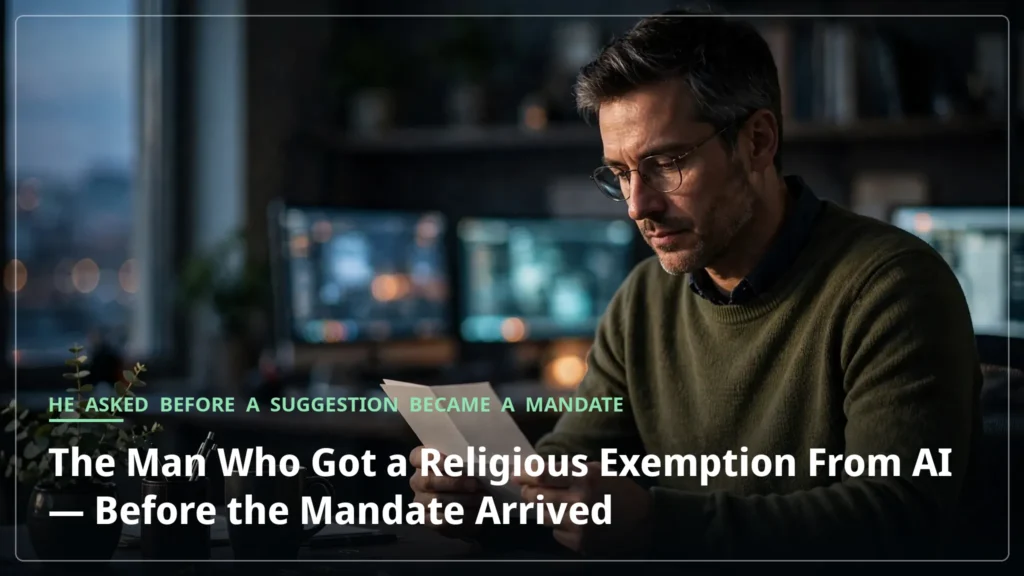
David Durman did not wait to be told what to do. He works at the University of Kentucky as a research administrator, supporting researchers as they apply for grants, and in that job nobody had required him to use artificial intelligence. Some colleagues and university leadership had recommended that employees try out the tools. That recommendation was enough. Durman, a nontheistic Humanist, asked for a religious accommodation excusing him from personally using AI at work — before the suggestion could become a mandate.
On September 25, the university’s Office of Equal Opportunity approved his request, determining that it posed no undue burden on his department. Durman continues to perform all of his job duties without using AI. He is, according to the American Humanist Association, the first Humanist to secure workplace accommodations of this kind, and one of the first people to publicly discuss pursuing them.
The case is small in its facts and large in its implications, and the gap between those two things is exactly what makes it worth paying attention to. AI was not required in his role, and he continues to perform his duties without personally using it. What changed was the paper trail: a worker with a conscience objection to AI now has a documented answer from an employer, and other workers with similar concerns have a precedent to point to.
Thinking as a moral act

Durman’s stated objection is about what using AI does to the person using it.
“The way we become moral actors for ourselves and for others is through the active application of our minds,” he said, “and the diminishing of that [through AI use] is going to necessarily have a negative impact on our ability to do so.” Offloading the labor of thinking through a situation — regardless of whether that labor is taxing — undercuts, in his view, his ability to be a moral actor.
He put it plainly: “I cannot, in good conscience, partake in the use and proliferation of this technology.”
What he hopes, he has said, is that his case encourages people with similar concerns to pursue a resolution of their own.
The letter, the meeting, and the yes

The paper trail itself is instructive, because it shows how un-dramatic a precedent can look at birth. With the support of the American Humanist Association, Durman sent a letter to the university’s Office of Equal Opportunity in late August, requesting reasonable accommodations on the basis of his “sincerely held beliefs as a Humanist.” After meeting with the office in mid-September, his request was approved on September 25.
The documented process ran through the university’s accommodation procedure: a letter, a meeting, and an approval. The university’s spokesperson, Jay Blanton, told TechCrunch that the institution reviews requests for religious accommodations on an individual basis, considering the employee’s job responsibilities and the circumstances of the request. “In this case, the university determined that an accommodation could be provided while allowing the employee to continue performing the essential functions of their position,” Blanton said.
That sentence is the load-bearing wall of the whole case, and it is worth reading twice. The accommodation works because Durman’s job, as currently constituted, does not require AI use. He continues to perform all of his job duties without using AI, and still works with colleagues who may use AI tools. The university did not agree to become an AI-free workplace. It agreed that one employee, in one role, need not personally use the technology.
Why a Humanist counts
The part of the story that travels furthest is the identity of the person who won it. Durman does not believe in a god. Humanism, as the American Humanist Association presents it, is a comprehensive non-theistic belief system — and, in the words of the association’s staff attorney Alexandria Huiskens, such systems “are entitled to the same religious protection under Title VII and the United States Constitution as traditional religions.”
Huiskens has said that Humanists and nontheists fall into the protected categories, and that they are also protected by the law at work.
Durman was not the first person to test this ground. He was inspired by Erin Maus, a Unitarian Universalist software engineer who secured similar protections from her employer. Durman’s case extends the pattern from the engineering desk to the administrator’s office, and from a faith tradition to a non-theistic one. Two cases do not make a movement. Whether they mark the start of a wider pattern, or remain two individual accommodations, is an open question.
The catch: individual, conditional, reviewable
Here is where the honest version of this story resists the triumphant one. The accommodation is individual and conditional. The university reviews each request on its own facts, and Blanton added that “as technology and job responsibilities evolve, accommodations may be reviewed to ensure they remain reasonable and workable.” If AI use becomes an essential function of Durman’s role, the accommodation that fits his job today may not fit his job tomorrow.
Nor does one university’s decision bind anyone else. This was an employer’s accommodation, not a court ruling, and it does not automatically establish the same entitlement for other employees — at Kentucky or anywhere else. A private employer could contest a similar request, and whether a court would treat an objection to AI as a sincerely held belief remains unresolved.
That is not a reason to dismiss the case. It is the reason the case matters in the form it actually took. The strongest version of Durman’s story is not “workers can now refuse AI.” It is narrower and more interesting: a worker who saw where the wind was blowing moved before the weather changed, and found that the law, as his employer read it, had room for him.
The question other offices may face
Step back and the shape of a coming argument is visible. In Durman’s workplace, AI tools such as ChatGPT, Claude and Microsoft Copilot were recommended to employees, and his concern was that a recommendation could one day become a mandate. A worker who objects on grounds of conscience might then look for a legal shelter. Durman found his shelter early, while the tools were still only recommended.
His case leaves open questions that other workers may ask. Would the same request succeed for someone whose job already requires AI use? Would a private employer answer the way a public university did? And what happens when the essential functions of a role change underneath an accommodation that was granted for the role as it was?
Durman himself framed the hope modestly: he hopes his case encourages people with similar concerns to pursue a resolution of their own. Not a revolution, not a refusal movement — a resolution, pursued by each person in the way that fits them best. AI use is not required in his role. Thanks to a letter written in August and approved in September, he has an accommodation in place if that changes — though whether it would remain workable if his role changes is still an open question.