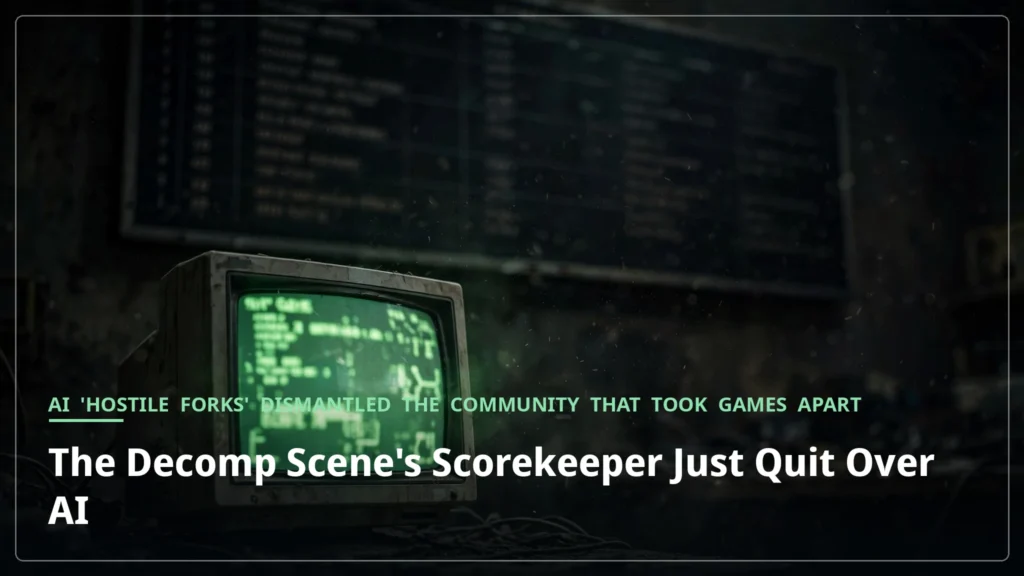

The community hub that tracked the retro-game decompilation scene is gone — at least, the part that made it feel like a community. decomp.dev, launched in 2024 as an index of decompilation projects with gamified progress percentages and a leaderboard, has sunset its public layer: the main index is gone, new submissions are closed, and the central leaderboard is retired. The existing project pages — landmarks like the Super Smash Bros. Melee and GameCube Animal Crossing decomps — stay online. The social scaffolding around them has been dismantled.
The reason, stated plainly by the site’s administrator @encounter, writing as Encounter, is artificial intelligence. “The community aspect of decompilation has been broken,” the “Sunsetting decomp.dev” statement reads — and it lays the breakage at the feet of AI-assisted hostile forks.
The complaint, in the site’s own words
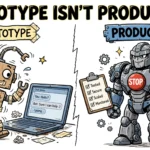
Encounter’s diagnosis is specific. The hostile forks, the statement says, “put little to no effort into meaningfully contributing to existing projects, tearing apart our community fabric.” The behavior is described in equally concrete terms: “while community members put in the effort to decompile a game, opportunists have frequently raced to release a half-baked, barely-functional port from it.”
“We love these games and want to understand how they work, and to uncover the mysteries that the original developers left behind.” — Encounter, “Sunsetting decomp.dev”
That last line matters, because it names what decompilation was for in this telling: understanding, mystery, the slow unwrapping of how the original developers built these worlds. AI, the statement concedes, “can expedite the decompilation process in a significant way” when guided with human input and code reviews. The objection is not to acceleration as such. It is to people who took the community’s years-long work, ran it through an AI-assisted sprint to the finish line, and shipped ports of games they never helped take apart — while the people doing the taking apart were still in the middle of it.
The technical context, for those outside the scene: decompilation projects are, technically speaking, legal. They contain no leaked content or copyrighted assets; players supply their own legally-sourced ROMs, and the decompiled code powers ports that run at higher frame rates, in widescreen and ultrawide, with modern dual-stick controls and user mods. A group spent years manually decompiling the original GameCube Animal Crossing by hand. That is the kind of work being finished — or “finished” — by people the statement calls opportunists.
The speed of retro-game decompilation is genuinely exhilarating
Let us not pretend the acceleration isn’t thrilling. The viral AI ports read like a wish list: a browser-based Halo, Wind Waker running on an iPhone, Super Smash Bros in mixed reality. Chris Sotraidis, an AI consultant working as a hobbyist, built a mobile port of The Legend of Zelda: Ocarina of Time from a community-built decomp — and he is candid that AI accelerated him, while noting that some of his ports “would have been possible with minimal AI assistance if I’d had significantly more time.”

The momentum is not confined to hobbyists. Xbox Labs, announced October 13, 2026 by Xbox CEO Asha Sharma and led by CTO Scott Van Vliet, exists to test AI against old games — WebAssembly and WebGPU ports, Apple Silicon builds, an engineer who decompiled N64 Snowboard Kids with AI assistance in 84 days, another who used Claude Fable to port Command & Conquer Generals Zero Hour to Mac, iPhone, and iPad. Sharma also cited AI “Skyrim x Tarkov” mashup mods — mods that have drawn anger from mod creators over the practice.
Then there is Tim Sweeney, who on October 17, 2026 posted on X that Epic is “moving developers around to retool for maximum AI acceleration,” adding: “The games we’ve long wanted, which didn’t exist because they’d cost several times more to make than they’d earn back, will soon become possible… It’ll be a new golden age of gaming.” Epic’s new launcher in preview was “vibe coded”; reports describe Fortnite NPC AI conversations, “no more hand-written code” ambitions, AI prioritization of the Disney partnership — alongside backlash and rumored Fortnite-collab refusals.
“The games we’ve long wanted, which didn’t exist because they’d cost several times more to make than they’d earn back, will soon become possible… It’ll be a new golden age of gaming.” — Tim Sweeney on X, October 17, 2026
Play anything, anywhere, on anything. That is the visible story. And the sheer delight of it — a GameCube classic in your pocket, a decades-old shooter in a browser tab — is exactly what makes the discomfort so hard to hold. You love the ports, and you cannot un-know what the delight costs.
The case for the other side
Now the counterarguments, fairly stated. Sotraidis is the clearest counter-example: he built on community groundwork and says so, and his argument is that “thoughtful creators and builders will be able to make even more amazing things, faster.” The finishing of a stalled project, in this light, could be framed as contribution rather than theft.
The hostile-fork framing, moreover, hinges on intent and credit. A port of a completed decomp with clear attribution to the original team reads as legitimate continuation; a rushed, barely-functional fork dropped over an unfinished project to claim the glory reads as the thing Encounter describes. The statement’s own examples distinguish between projects that “put little to no effort into meaningfully contributing” and what AI could do “with the right guidance, human input, and code reviews.” Speed with stewardship is not the enemy here.
And decomp.dev’s shutdown is one site’s decision, not the death of the scene. The decomps themselves remain legal, and the existing project pages remain online. Corporate legitimization — Xbox Labs, Sweeney’s golden age — suggests institutionalization rather than extinction. Over 90% of classic games are estimated critically endangered, per figures cited in syndicated coverage — which is why the counterargument runs that decompilation can be a form of rescue, even if the reporting leaves open how much preservation any given port actually achieves.
What exactly was broken?

But linger on Encounter’s charge a moment longer: that opportunists have “frequently raced to release a half-baked, barely-functional port” while community members were still decompiling the game. Note the word raced. The offense is competitive. Someone else’s finished line becomes your starting gun, and the people who ran the whole race watch you sprint the last hundred meters and take the photo.
“While community members put in the effort to decompile a game, opportunists have frequently raced to release a half-baked, barely-functional port from it.” — Encounter, “Sunsetting decomp.dev”
Is that a breakage of the community, or a disagreement about what the community owes? In the account Encounter gives, the scene’s purpose was that the understanding was the work — slow, collaborative, communal, the leaderboard tracking progress toward comprehension. In Encounter’s telling, AI-assisted ports keep the output (playable games everywhere) while, in the hostile-fork cases the statement documents, discarding the process (years of shared forensic labor) — though whether that trade-off describes a corner of the scene or the scene more broadly is precisely what the reporting leaves open. What the shutdown mourns is not lost code. The code survives. What was dismantled was the social ritual around it: percentages, leaderboards, submissions, the sense that the work belonged to the people doing it.
The question the reporting leaves open is whether that amounts to a broader hollowing-out of the craft culture, or one hub’s rational retreat from moderating a contest it can no longer adjudicate. Sotraidis’s optimism and Sweeney’s golden age point to a future where the craft is everywhere — decompiled, ported, remastered, mashed up — but nowhere in particular. Encounter’s eulogy points to the feared cost: a scene where nobody quite remembers who took the game apart first.
“The community aspect of decompilation has been broken.” — Encounter, “Sunsetting decomp.dev”
Perhaps the affair here is not really about AI, or even about games. It is about what happens to a gift economy when a shortcut appears — when the loving, slow, communal act of understanding something gets outcompeted by the efficient act of using it. The ports are wonderful. The delight is real. And so, it seems, is the guilt. The only honest question left is what the scene becomes now: whether the builders keep building, knowing the racers are behind them, or whether — like decomp.dev’s leaderboard — the community simply retires from the contest and goes quiet.