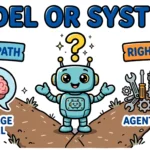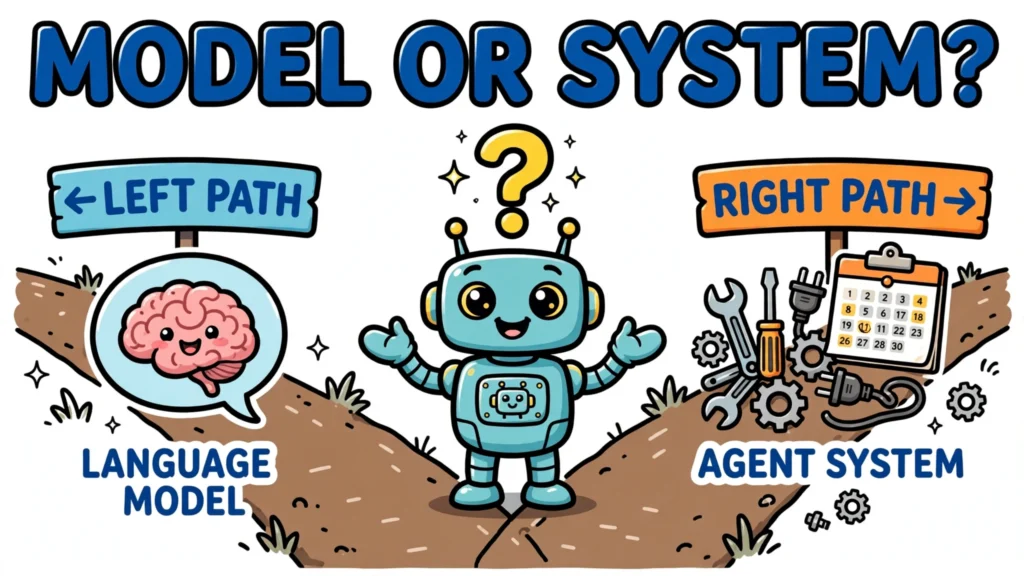


LLMs and AI agents are often talked about as if they were the same thing. They are not. An LLM is a model; an AI agent is a system built around a decision-making mechanism, and in the LLM-powered case that mechanism is an LLM. Understanding that one distinction clears up most of the confusion about what agents can do, what they cannot do, and when you actually need one.
What an LLM actually is
An LLM, a large language model, is a model that works with language: it understands text, generates text, and reasons in text, step by step, when given a prompt and context. In its basic form it is stateless between calls. It has no memory of past conversations unless a surrounding system stores and resupplies that history, no access to live data unless a tool or retrieval step provides it, and no ability to change anything in the world on its own. Its strengths are language tasks: drafting, summarising, translating, explaining, and working through a problem in words.
That limitation is not a flaw. It is the definition of the component. A model takes text in and returns text out. Everything else an agent appears to do — remembering, looking things up, sending a message, running code — comes from the system wrapped around the model.
What an AI agent actually is
An AI agent is a system, not a model. It is given a goal and works toward it on a user’s behalf, with some degree of autonomy over how it gets there. For goal-directed agents, the defining feature is not the size of the model or the cleverness of a single answer, but the loop: the system takes in context, decides a next step, executes it, reads the result, and adjusts. Simple reactive agents are a different, simpler case: they act on the current percept alone, without that loop.
Not every agent is LLM-powered. An agent’s decision-making may use an LLM, a rules engine, a planner, or another mechanism. The LLM-powered agent is a major subclass, not the whole category. Classical agent types show the range: simple reflex agents act on condition-action rules, model-based reflex agents keep an internal state, goal-based agents use search and planning, and utility-based agents optimise against a utility function. None of those requires an LLM.
Autonomy is a spectrum. A scripted assistant that follows fixed steps, a single agent with tool access that chooses its own next step, and a multi-agent system in which several agents cooperate all sit on that spectrum. What the goal-directed ones share is action toward a goal over multiple steps, not a particular model underneath; reactive agents sit at the simple end of the spectrum and act on rules or the current percept alone.
LLMs and AI agents: the core relationship
In an LLM-powered agent, the LLM is the reasoning engine. It interprets the goal, breaks it into steps, decides which tool to call and with what arguments, and interprets the results those tools return. OpenAI describes agents as systems that independently accomplish tasks on behalf of users, and its agent design foundations are exactly three things: model, tools, and instructions. The model drives reasoning; the tools are external functions or APIs; the instructions define behaviour and constraints.
The relationship, for LLM-powered agents, is one of composition. Such an agent contains an LLM, or several, but an LLM on its own is not an agent, just as an engine on its own is not a car. Agents that do not use an LLM are still agents, just not LLM-powered ones. And the layers are separable: the same LLM can power many different LLM-powered agents, and the same LLM-powered agent design can swap in different LLMs.
This is why the word “agent” causes so much argument. People use it for the model, for the system, and for the whole paradigm at once. Keeping the layers apart — model, system, paradigm — makes every later question easier to answer.
A worked example: the agentic loop in action
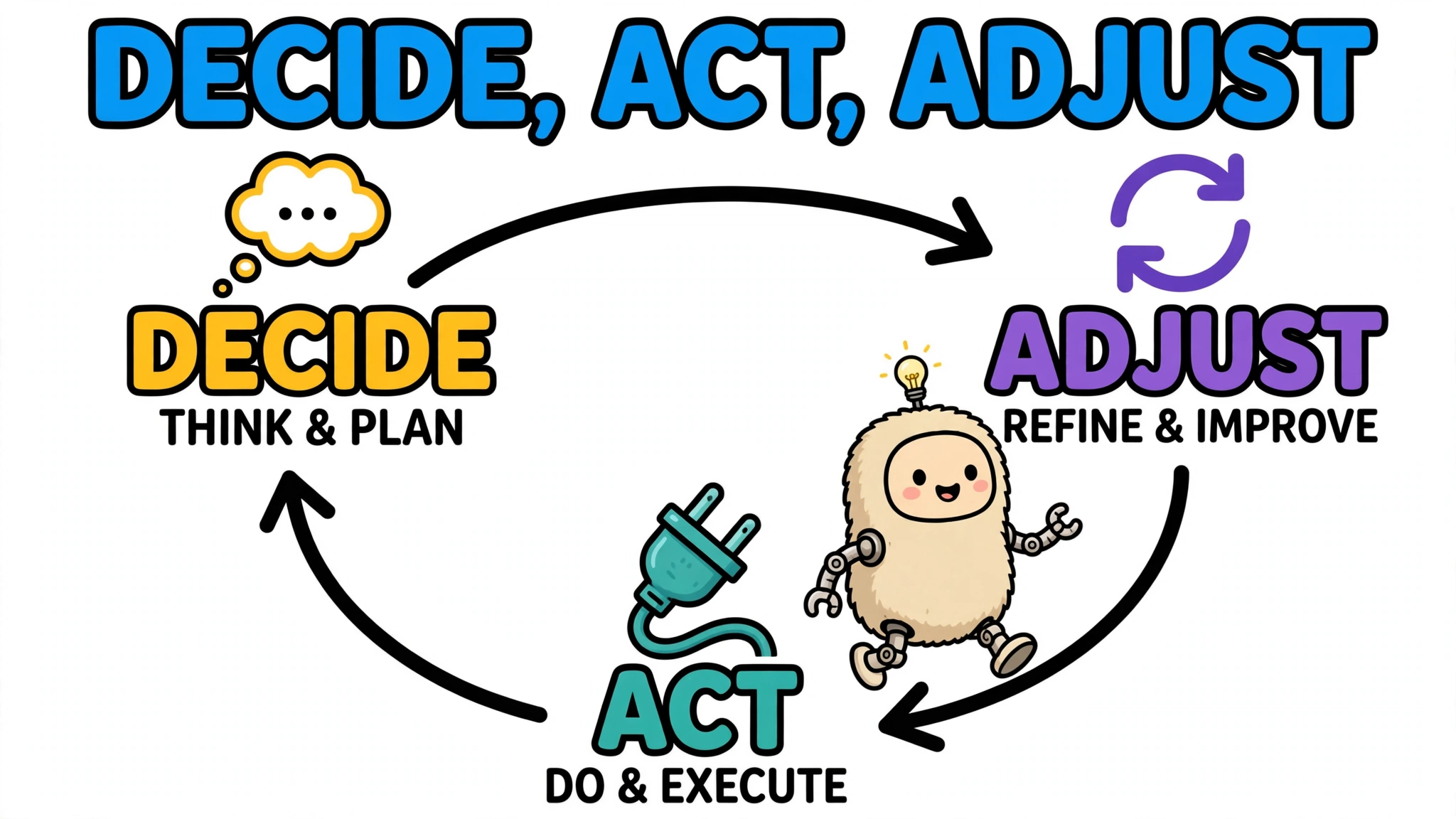
Take a concrete task for an LLM-powered agent: research the best time to hold a team meeting next week and draft the invitations. A single LLM call cannot do this, because the draft must reflect live calendar data that a single pass cannot check. An agent can, by looping.
First, the agent receives the goal and the relevant context. The LLM reasons about the first step and decides to check calendars, so the system calls a calendar tool. The tool result comes back as new context. The LLM reads it, notices a conflict, and decides to check an alternative. When a workable slot emerges, it drafts the invitation text and stops with the draft ready for the user to approve and send. At each step, the LLM contributed the decision, phrased as text or as a tool call; the surrounding system contributed the tool call itself, the stored result, and the loop that kept going until the goal was met.
The loop below is a schematic fragment, not runnable code, showing that shape:
while not done:
    response = call_llm(messages)
    if response has tool_calls:
        results = execute_tools(response.tool_calls)
        messages.append(results)
    else:
        done = True
        return response
The loop stops when the goal is achieved, when a step limit is reached, or when a human approval step is required. Those stopping conditions matter as much as the loop itself: without them, an agent can keep acting long after it should have stopped.
What the LLM does not give an agent
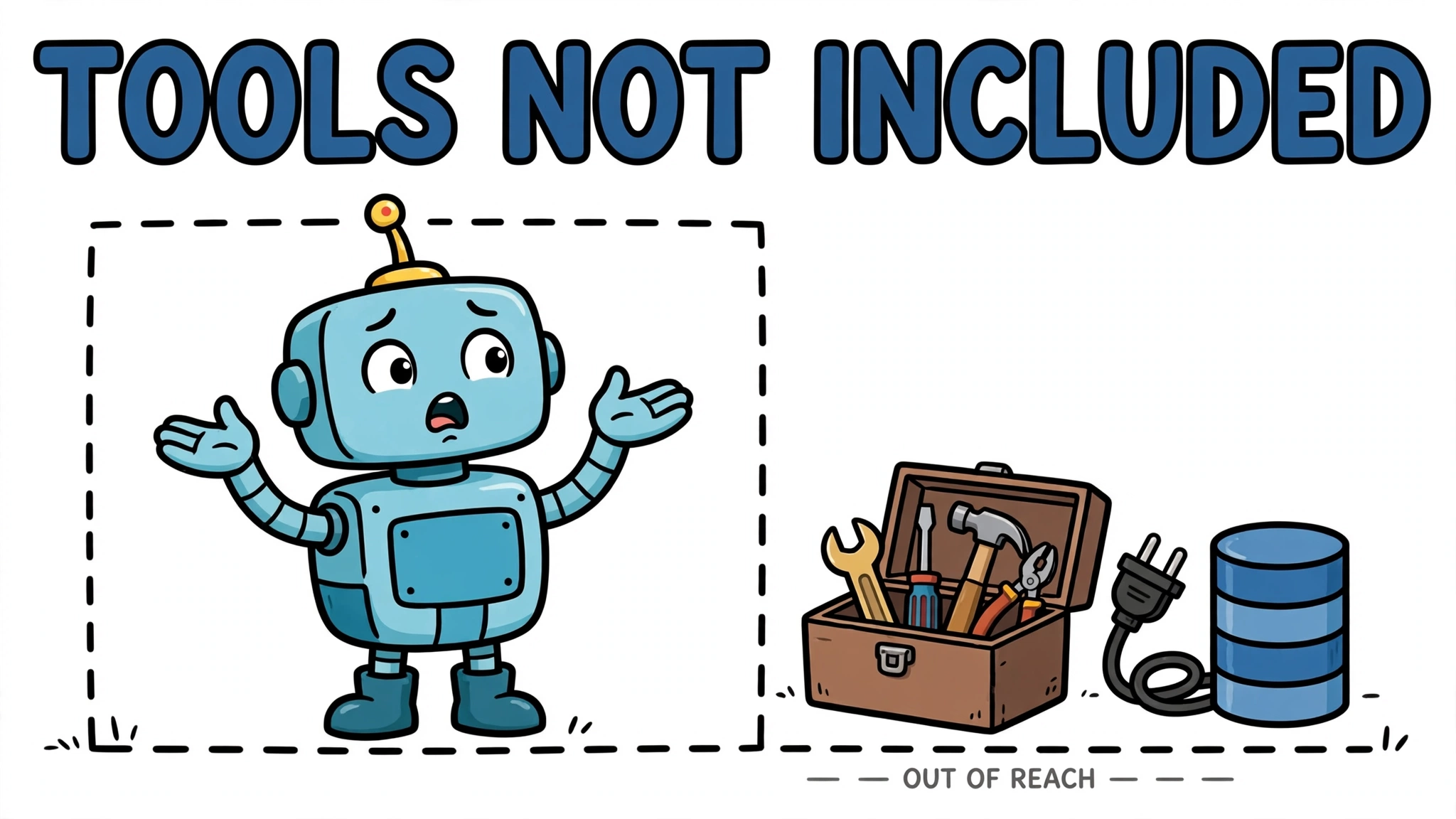
Four things people commonly assume come with the model do not. First, tools: APIs, databases, browsers, and code execution must be wired in. The LLM can only propose a call; the harness executes it. Second, memory and state: conversation history, long-term memory, and task progress live outside the model and must be managed by the system. Third, permissions and guardrails: what the agent may touch, spend, or change is set by the surrounding system, not by the model. Fourth, fresh information: anything after training, or inside private systems, reaches the model only through retrieval or tools.
This is the practical meaning of the composition claim. Buying or accessing a capable model is not the same as having an agent. The model is one component, and the components around it — tools, memory, state, permissions, stopping conditions — are where most of the engineering actually lives.
LLM, agent, and agentic AI: clearing up the terms
Three terms, three levels. LLM: the model. Agent: a system that acts toward a goal, using some decision mechanism; an LLM-powered agent is the subclass whose decision mechanism is an LLM. Agentic AI: the broader paradigm of systems that perceive, reason, and act with significant autonomy, often as multi-agent systems.
A chatbot powered by an LLM is not automatically an agent. In the LLM-system convention, tool use and goal-directed iteration are what cross the line: the system must decide its own next steps and act on them, not merely answer. That convention does not exclude rule-based or reactive agents, which count as agents in the broader taxonomy whether or not they run that loop. Multi-agent systems are agents composed of agents; in LLM-based architectures each agent typically has its own LLM calls, roles, and shared state, and they pass results to one another.
Keeping these levels distinct also prevents a common overclaim. Saying “we built an agent” when you built a chatbot with a good prompt, or saying “we use agentic AI” for a single scripted workflow, stretches the term in the LLM-system convention — even though scripted systems can be agents in the broader, rule-based sense — and misleads everyone who has to maintain, audit, or trust it.
When a plain LLM is enough, and when you need an agent
A plain LLM suffices when the task is producing or transforming text in one pass: drafting, summarising, explaining, brainstorming. There is no live data to fetch, no external action to take, and no result to adapt to. Adding a loop, tools, and autonomy to such a task usually adds latency, cost, and failure modes, and should be justified by the task requirements and expected benefit rather than assumed.
An agent is warranted when the task requires live data, multiple steps, external actions, or adapting to results along the way. Even then, the agent is not the only option. Anthropic’s engineering guidance draws a useful line: workflows orchestrate LLMs and tools through predefined code paths, while agents let the LLM dynamically direct its own process and tool usage. If you can draw every branch of the process in advance, a fixed workflow is usually the simpler, more predictable choice. Reach for an agent when the next step genuinely depends on what the system finds — the content of a free-text message, the result of a search, an unexpected error — and cannot be hardcoded.
The costs of an agent are real: latency across many model calls, token spend, a wider failure surface, and an oversight burden. The simpler option should be the default until the task demands more.
Common mistakes and limits
The first mistake is treating the LLM’s confident text as verified fact, especially when it reports tool results it has not actually checked. The model phrases its answer fluently whether or not the underlying data supports it, and fluency is not evidence.
The second is giving an agent broad permissions because the model seems reliable, rather than bounding what it can do. An agent’s permissions bound the operations it can access, which shapes its worst case — what it can read, change, send, or spend if it misunderstands the goal or acts on manipulated tool output — though permissions alone do not determine every consequence. Least privilege, approval gates for irreversible actions, and step limits are measures that reduce particular risks, with their use depending on the system and its permitted actions; they do not by themselves establish that an agent is safe to run.
The third is assuming the agent remembers, learns, or understands consequences the way a person would. Its memory is stored context managed by the system, its learning is whatever its designers built in, and its judgement is pattern-based reasoning over text. The relationship between LLMs and AI agents is powerful precisely because the two layers are different — and it breaks down exactly when people forget which layer they are dealing with.