


The voluntary exit offer on the table
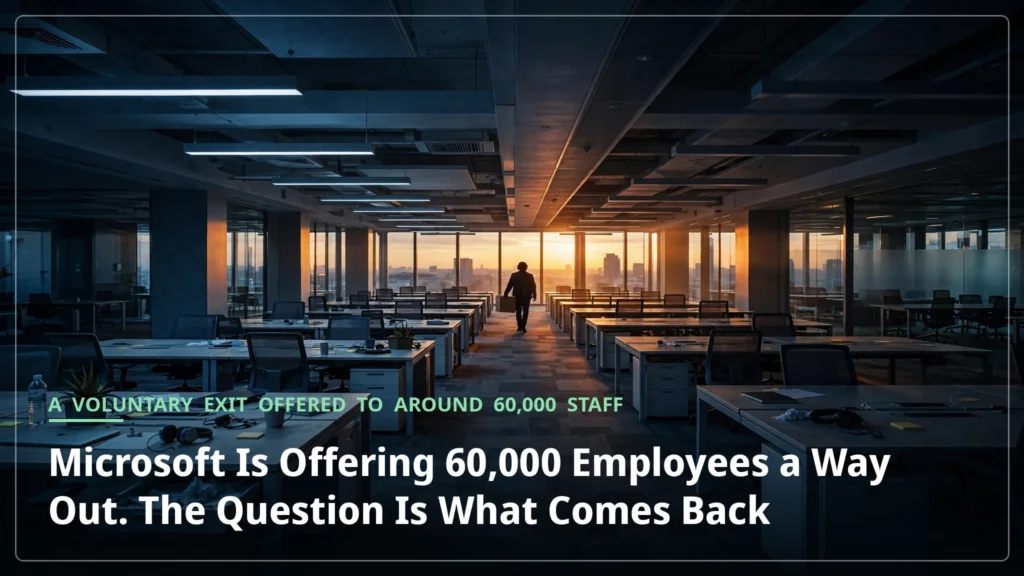
On 26 October 2026, Microsoft gave a large group of its employees a choice: leave, with support, rather than wait to see what happens next. Chief People Officer Amy Coleman announced a time-limited Voluntary Exit Offer for eligible employees at level 70 and below in participating teams in the United States, Canada, the United Kingdom and India. In Coleman’s words, as reproduced in coverage of the memo, the offer gives eligible employees “who may be considering a future outside the company a new choice to make that transition now with support”, and gives participating organisations “another way to adapt their workforce to changing needs”.
The reporting around the offer is striking in its scale. Around 60,000 employees are reported eligible — roughly 27% of Microsoft’s workforce of about 223,000 full-time employees as of 30 June 2026. One important qualification belongs in the same breath as that number: Microsoft’s own announcement does not give a headcount figure, and coverage describes the 60,000 figure inconsistently, as coming from company statements to reporters rather than from the blog post itself. The eligibility pool is not the outcome. Microsoft has set no target for how many employees will accept, and the eventual number of departures is not yet known.
What is known about the mechanics is narrow. Eligible employees were reported to decide in early December, with departures for those who accept expected on 31 December 2026. The package is described as financial support and career-planning resources, similar to standard severance — but Microsoft has not published the exact terms, so the details by country, level and tenure remain undisclosed. That gap matters, because it is exactly the kind of detail that decides whether an offer like this feels generous, merely adequate, or beside the point for the people weighing it.
Not a layoff, and not company-wide

The first thing to get right about this story is what it is not. A voluntary offer is genuinely different from a layoff: employees choose whether to leave, and the company has put no acceptance target on the table. If few people take it, the headline eligibility figure will greatly overstate the outcome. That is not a footnote; it is the central uncertainty of the whole announcement.
It is also not company-wide. Participation is decided by business priorities, customer commitments and workforce needs, and some organisations are not taking part. Reported participating teams include AI experiences, Copilot, CoreAI, Windows + Devices, Xbox, finance and human resources. Marketing, the commercial business, discovery and quantum, and security were reported as not participating. The shape of the offer is therefore uneven by design — a reshaping of selected teams, not a uniform cull of a quarter of the company.
And headcount alone will not settle the story even after the decisions come in. Microsoft could still hire in other roles, so a fall in one set of teams need not mean a permanently smaller company. Acceptances alone cannot answer the question of how much smaller Microsoft will be — and only if Microsoft discloses them. Further layoffs could deepen the reduction; hiring could offset it. The announcement, on its own, does not say how much smaller Microsoft will be.
The context: a year of shrinking, in steps
The offer does not arrive out of nowhere. It follows a 4,800-person layoff round in July 2026 and an earlier 2026 retirement offer reported at around 9,000 eligible US employees, of whom about 30% accepted. Overall headcount fell year over year, from about 228,000 in June 2025 to about 223,000 in June 2026 — a fall, for the first time in a decade, according to the reporting.
That sequence is part of why the voluntary offer reads differently from a routine benefits notice. A company that has already cut in July, and already tried a retirement offer, is now asking tens of thousands of employees, in selected teams, whether they want to leave. The question is not whether Microsoft is changing the shape of its workforce — the July round and the headcount figures already show movement in that direction. The question is what shape it is moving toward, and whether this offer is a step in a deliberate direction or simply another way of lowering costs.
The model from almost two years ago

This is where The Verge’s reading of the story enters, and it deserves to be labelled as a reading, not as Microsoft’s explanation. The Verge frames the move as an effort to lower operating costs and headcount without reducing investment in AI infrastructure, and it reaches back to a podcast from almost two years ago in which chief executive Satya Nadella said total people costs would fall while cost per head and GPU per researcher rose. The Verge reads that as fewer people, higher pay, and more AI tools for those who remain.
Two cautions keep that reading honest. First, Nadella’s podcast remark was made almost two years before this offer and was not a statement about it, so linking the offer to that model is interpretive, not a confirmed company explanation for this programme. Second, Microsoft’s memo itself did not attribute the offer to AI spending; any link between the offer and AI investment is reporters’ context, not a company statement. The Verge’s framing is a hypothesis to test against what happens next, not a fact about Microsoft’s intentions.
And yet the hypothesis is worth testing, because it makes a prediction that can actually be checked. If the workforce that remains after this offer looks more like the model Nadella described — fewer people, paid more per head, with more AI tools each — then the reading gains weight. If, instead, Microsoft hires back into the same kinds of roles, or the departures cluster in teams with no connection to that model, the reading weakens. The test is in the composition of the workforce that remains, not in the size of the eligibility pool.
There is a further wrinkle that cuts against any simple version of the story. Reported participating teams include AI-related groups such as Copilot and CoreAI. If this were a straightforward story of AI replacing jobs, one would not expect the teams building AI products to be among those offered the exit. Their presence in the participating list weakens a direct AI-replaces-these-jobs mechanism, and it is one reason to reject the thesis that AI spending is simply forcing Microsoft to cut jobs. The mechanism, whatever it is, is not that tidy.
What to watch
Three unknowns will decide how this story is remembered. The first is take-up: how many of the roughly 60,000 eligible employees accept, and whether Microsoft discloses the figure. A small acceptance rate would make this a footnote about an offer few took; a large one would make it one of the biggest workforce events in the company’s recent history. The second is distribution: which participating teams see the highest take-up, and whether take-up differs between AI-related teams and other teams. That pattern would say more about the company’s direction than any single total. The third is what happens afterwards: whether Microsoft hires into the same kinds of roles, or uses layoffs in addition to the voluntary offer.
Until those answers arrive, the honest summary is a narrow one. Microsoft has offered around 60,000 employees in selected teams a supported way out, with no target and no published exact terms, following a year in which its headcount already fell. Whether that offer moves the company toward the workforce model Nadella described almost two years ago — fewer people, paid more per head, with more AI tools each — is the distinctive question this announcement raises. It is a question, not an answer. The decisions in early December, and whatever Microsoft discloses about them, will be the first real evidence either way.