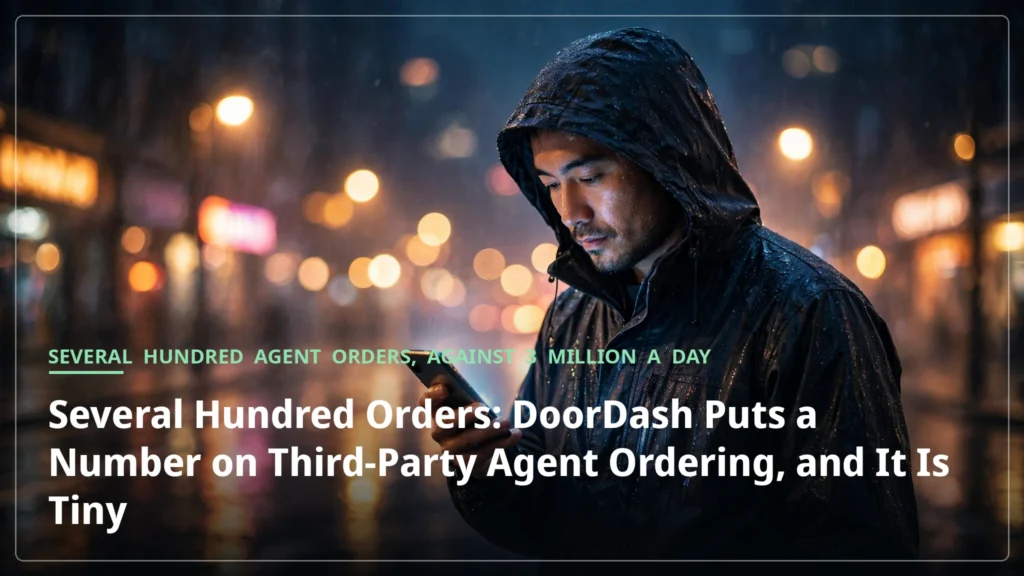



There is a particular kind of earnings-call answer that lands harder than any prepared remark. On DoorDash’s third-quarter earnings call, an analyst asked chief executive Tony Xu about DoorDash agent orders, and Xu gave a number so small it rearranges the conversation.
DoorDash, Xu said, has seen only several hundred orders in total from third-party agents. He named Muse, Instinct and Fo among them, and added the qualifier that matters: this is where AI agents are today, not where they might end up. Users, he said, are still predominantly placing orders through DoorDash’s own app.
DoorDash agent orders: several hundred, against three million a day
The contrast is doing most of the work in this story, and it is worth stating it exactly as DoorDash stated it. The several hundred figure is a total, accumulated across the time third-party agents have been placing orders. The comparison figure, from DoorDash’s 2025 report, is an average of 3 million deliveries a day. Those are different kinds of numbers, a running total against a daily rate, and the counting period for the several hundred is not specified in the reporting. Even allowing for that imprecision, the gap is enormous. A channel measured in hundreds, set against a business measured in millions per day, is not a takeover. At DoorDash, at least, it is a footnote so far.
Xu’s own framing was deliberately un-dramatic. “You never want to fight gravity,” he said. “But at the same time, you don’t want to be delusional.” The first half of that sentence is a concession: technology habits change, and a delivery company cannot simply wish a new way of ordering away. The second half is a warning against mistaking a lively debate for a large business. Both halves can be true at once, and at DoorDash right now, the numbers side with the second.
DoorDash is not standing still

It would be a mistake to read Xu’s answer as indifference, because DoorDash has been building in this exact area all year. In June it launched Ask DoorDash, a chatbot that lets users place orders through prompts and photos. In July it introduced a command-line ordering agent. In September it launched a text-to-order agent. It has also released a model context protocol, or MCP, connector to enable ordering from other chatbots for corporate ordering.
That timeline matters, because it changes what the several hundred figure means. DoorDash is not a bystander watching agents arrive from outside. It has its own agents, in its own app and interfaces, and it is simultaneously keeping the door open to agents built by other companies. Xu said DoorDash wants to learn more about agentic use cases and develop what he called a healthy relationship with third-party agent makers. He also said that, in the future, there could be an opportunity for DoorDash to advertise within these agents.
Put those facts together and an inference suggests itself: DoorDash may be trying to set the terms of the agent channel rather than be bypassed by it. That inference is worth stating, but it is only an inference, and it should be labelled as one. The disclosed facts establish a tiny third-party total, a set of internal agent products, and an expressed interest in working with outside agent makers. They do not establish a decision to set access terms, a mechanism for controlling the channel, or an outcome in which DoorDash keeps control of future agent-mediated ordering.
The question the evidence does not settle
There is a second, equally plausible reading of exactly the same behaviour, and a fair article has to give it its full weight. Low third-party volume, new internal products and friendly words about outside makers could simply be early experimentation. A company trying a new channel looks a lot like a company preparing to dominate it, at least in the early months, when the volumes are too small to distinguish the two. The evidence available does not resolve who will control agent-mediated customer relationships at DoorDash in the future, and pretending otherwise would repeat the very overreach this story warns against.
That unresolved question is the real story here, more interesting than the headline number alone. If agent ordering grows, does the customer relationship stay with DoorDash, move to the agent maker, or split somewhere in between? Does DoorDash’s own agent suite become the main way people order through agents, with third-party agents as a marginal side channel? Or do outside agents eventually place a meaningful share of orders, with DoorDash supplying the logistics underneath someone else’s interface? Nothing in the earnings-call disclosure answers those questions. It only tells us where things stand today, and today is very small.
A wider split over who lets agents in

DoorDash’s measured posture sits between two much sharper positions taken by other large retailers in recent weeks. Walmart announced on 21 October that it will let AI shopping agents buy on a customer’s behalf through dedicated Agent Profiles, with purchase approval or a spending cap set by the customer, via its Agent Gateway, an MCP server. Amazon, by contrast, blocked Meta’s Muse agent in September. The same knock on the door has produced opposite answers, and that split is the context in which DoorDash’s answer should be read.
DoorDash’s documented position is narrower. It has disclosed a tiny total, built its own tools, and said it wants to learn and to keep relationships healthy, and the supplied evidence does not describe a blocking policy or a formal gateway comparable to Walmart’s. That is a holding position, and holding positions are often described, unfairly, as indecision. In this case it may be the most honest position available, given how little ordering agents have actually done on the platform so far.
What to watch next
Three things would change this story, and each is worth watching for rather than assuming. The first is the counting itself: over what period were the several hundred orders counted, what counts as an order from a third-party agent, and is that total growing, flat, or concentrated in one or two agent makers? A total without a period is a snapshot without a scale, and the next disclosure should be judged on whether it supplies one.
The second is DoorDash’s own agents. Ask DoorDash, the command-line agent and the text-to-order agent are the instruments through which DoorDash could shape agent ordering on its own terms, without waiting for outside agents to grow. If those tools become a significant ordering route, the story becomes one about a platform absorbing a new channel. If they stay marginal too, the whole agentic question at DoorDash stays theoretical a while longer.
The third is advertising. Xu’s remark that there could be an opportunity to advertise within agents is, for now, only a remark about the future, and the supplied evidence establishes no advertising launch or revenue figure. It is nevertheless revealing, because it shows where DoorDash sees value if agents do become a real channel: not only in fulfilling orders placed elsewhere, but in being present, and paid for, inside the agent itself. That is a future to watch, not a present to report as fact.
For now, the honest summary is narrow, and its narrowness is the point. At DoorDash, third-party agent ordering is tiny: several hundred orders in total, over an unspecified period, next to an average of 3 million deliveries a day. Whether DoorDash’s combination of its own agents and openness to outside makers will leave it in control of agent ordering, or whether it is simply early experimentation in a channel that has barely begun, remains an open question. The hype about agents taking over commerce may yet prove right, somewhere, someday. On DoorDash’s own numbers, it has not happened there yet.