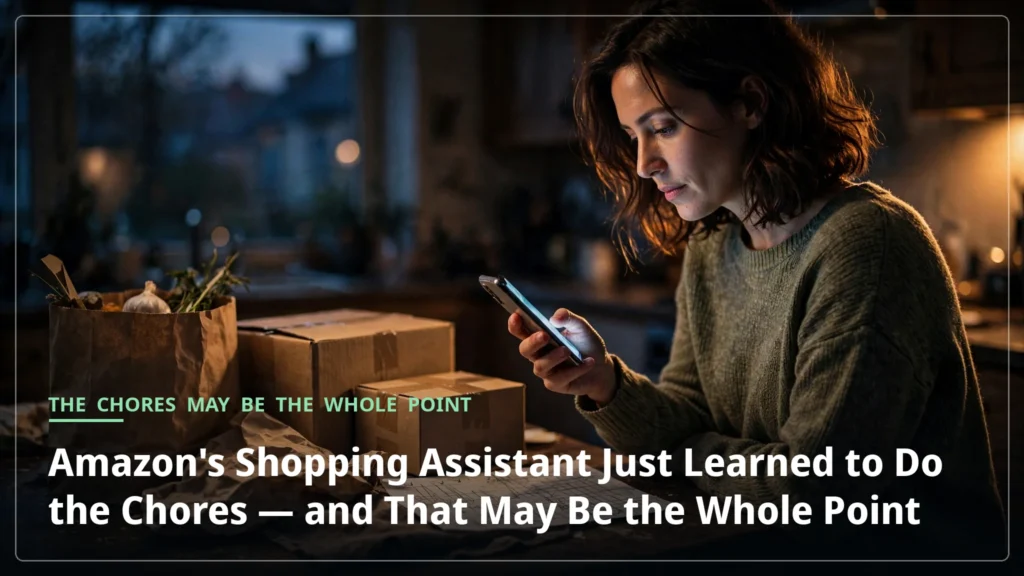



The least glamorous announcement of the year
What Amazon announced on 29 October 2026 was smaller than a robot or a frontier model: its shopping assistant can now edit a grocery list.
That is, on the face of it, not much of a story. Lists are the dullest corner of online shopping: the half-remembered milk, the wedding registry with three items left on it, the subscription you meant to pause three months ago. Amazon’s Alexa for Shopping can now create, edit, and move items between those lists and registries, in conversation. Ask it to “Create a new shopping list” or “Show me what’s left on my wedding registry,” and it does. It can also skip or pause a Subscribe & Save delivery, change a delivery to every three months, update your delivery instructions, answer a question about an unrecognized charge, tell you where your refund is, and explain what your Prime benefits actually are.
More than 100 new actions in total, according to Amazon, available now to customers in the United States through the Alexa icon in the Shopping app or at the top of the desktop screen. The Verge, which covered the update, describes the features as rolling out to US customers.
It is worth pausing on how boring all of this sounds. Then it is worth asking why Amazon bothered.
What the shopping assistant already did

Alexa for Shopping sits next to the search bar across Amazon’s app and website. Before this update it already helped customers research products, compare options, check price history, surface tailored gift recommendations, and set price alerts — and, with auto-buy switched on, purchase an item when it hit a target price. The new actions do not add a new kind of shopping. They absorb the chores around shopping: the list-making, the subscription-tending, the delivery-instruction fiddling, and billing questions.
“Our vision for Alexa for Shopping is to make every part of shopping as convenient as possible,” said Rajiv Mehta, Amazon’s vice president of Conversational Shopping, in the company’s announcement. “Alexa for Shopping can now help with more than 100 brand-new shopping actions, giving customers the ability to handle everything from building a holiday gift list to resolving a billing question just by asking.”
That is the mechanism, stated plainly by Amazon itself: one conversation instead of a dozen small tasks scattered across an account. The question is what that consolidation is worth.
The bet, stated as a bet

Here is the thesis, with its uncertainty attached rather than hidden: by pulling lists, registries, recurring deliveries, and refunds into one conversation, Amazon appears to be betting that the assistant which handles the chores becomes the place shoppers return to for the next purchase. That is an inference, not a fact the announcement establishes. The usage figures suggest it, but they do not prove it.
The figures, all Amazon’s own, are these: more than 400 million customers have used Alexa for Shopping in the last 12 months, and the number using its agentic features has grown more than eight times since the start of the year. Those numbers describe adoption of an assistant, not control of a purchase. With this announcement, Amazon published no figure showing that handling a grocery list changes conversion or basket size, and whether shoppers still shop elsewhere is left unanswered by the supplied evidence. That absence matters, because the leap from “used the assistant” to “owned the purchase” is the entire argument — and it is, for now, unproven.
There is also a steelmanned objection that deserves to be stated in full. This may be a feature dump, not a strategy. Lists and billing answers are table stakes for any competent shopping assistant, and “100+ actions” is a marketing count, not a moat. Shoppers still compare prices elsewhere and buy wherever is cheapest, and a rival agent can still find a product and send the shopper to Amazon to buy it. Convenience is not the same as control, and counting actions is not the same as changing behaviour.
The context Amazon did not state
The Verge places the announcement in the context of Amazon resisting third-party AI shopping agents from companies such as Meta and Perplexity. That is the article’s context, not a confirmed statement of Amazon’s motive, and it should be read that way. Whether keeping third-party agents out is a deliberate defensive choice, or simply how a first-party assistant is built, is a question the sources do not answer. It is, however, the question that gives an otherwise administrative update its edge: the chores are moving inside one company’s assistant at precisely the moment when several other companies would like to be the assistant instead.
TechCrunch, covering the same update, notes its timing ahead of the holiday season — gift lists and registries front and centre, exactly when shoppers are making lists for other people. That timing is suggestive, not conclusive. It is consistent with a company that wants its assistant in the room when shoppers are making lists for other people, and equally consistent with a company shipping a backlog of useful features before the holiday season.
What to watch
The honest version of this story ends with a short list of unknowns. How many of the 100+ actions do customers actually use, versus the headline list and registry features? Does list, registry, or subscription handling inside the assistant change conversion or basket size? Will these capabilities expand beyond US customers, and when? And does the assistant that answers your refund question become the assistant you ask first next time — or just the fastest way to get a chore done and move on?
What the sources support is narrower, and it is still interesting: Amazon has consolidated lists, deliveries, refunds, and subscriptions into a single conversation. Whether handling the chores means owning the purchase is unproven. Hundreds of millions already use the assistant, but the competitive payoff is still a question, not a conclusion.
And that may be the real story behind the shopping list. The future of shopping, if this bet pays off, will not arrive as a robot buying things on your behalf. It will arrive as a chatbot, patiently managing your wedding registry, one unglamorous chore at a time.