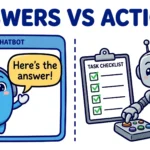

Prompt engineering AI agents is the practice of writing the instructions that let a language model do useful work through tools, rather than simply answering a question in one turn. Where a chatbot prompt asks for a good answer, an agent prompt asks for a good outcome: the right tool, used in the right order, checked against the result, and stopped at the right moment. That difference is the whole subject of this article.
An agent is a model that can read instructions, decide on an action, see what happened, and decide again. The prompt is where you tell it what it is for, what it may touch, what it must never do on its own, and what a finished job looks like. Get that right, and the same model becomes noticeably more reliable; get it wrong, and it will confidently take the wrong tool, repeat a failed step, or declare a half-finished job complete.
What prompt engineering for AI agents actually means
Prompt engineering for agents means designing the complete working instruction set for a system that acts. A one-shot chatbot prompt is judged by the quality of a single reply. An agent prompt is judged by the quality of a whole trajectory: every reasoning step, every tool call, every observation it reads, and the final answer it gives when it stops.
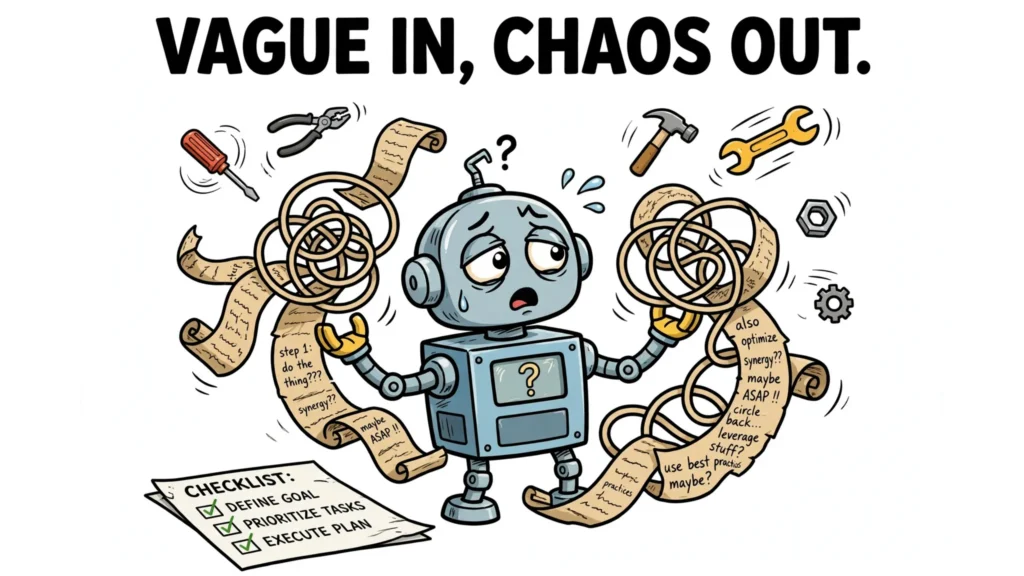
That instruction set usually has several parts working together. The role tells the agent what kind of helper it is. The goal states the task in one clear sentence. The tool definitions describe what the agent can actually do. The constraints set the boundaries: what needs approval, what must be verified, and what is out of scope. The output format tells the agent how to hand its work back so that other software, or a human, can use it. Leave any of those parts vague, and the agent will fill the gap with a guess. Guesses are where agent failures start.
How an agent prompt works inside the loop
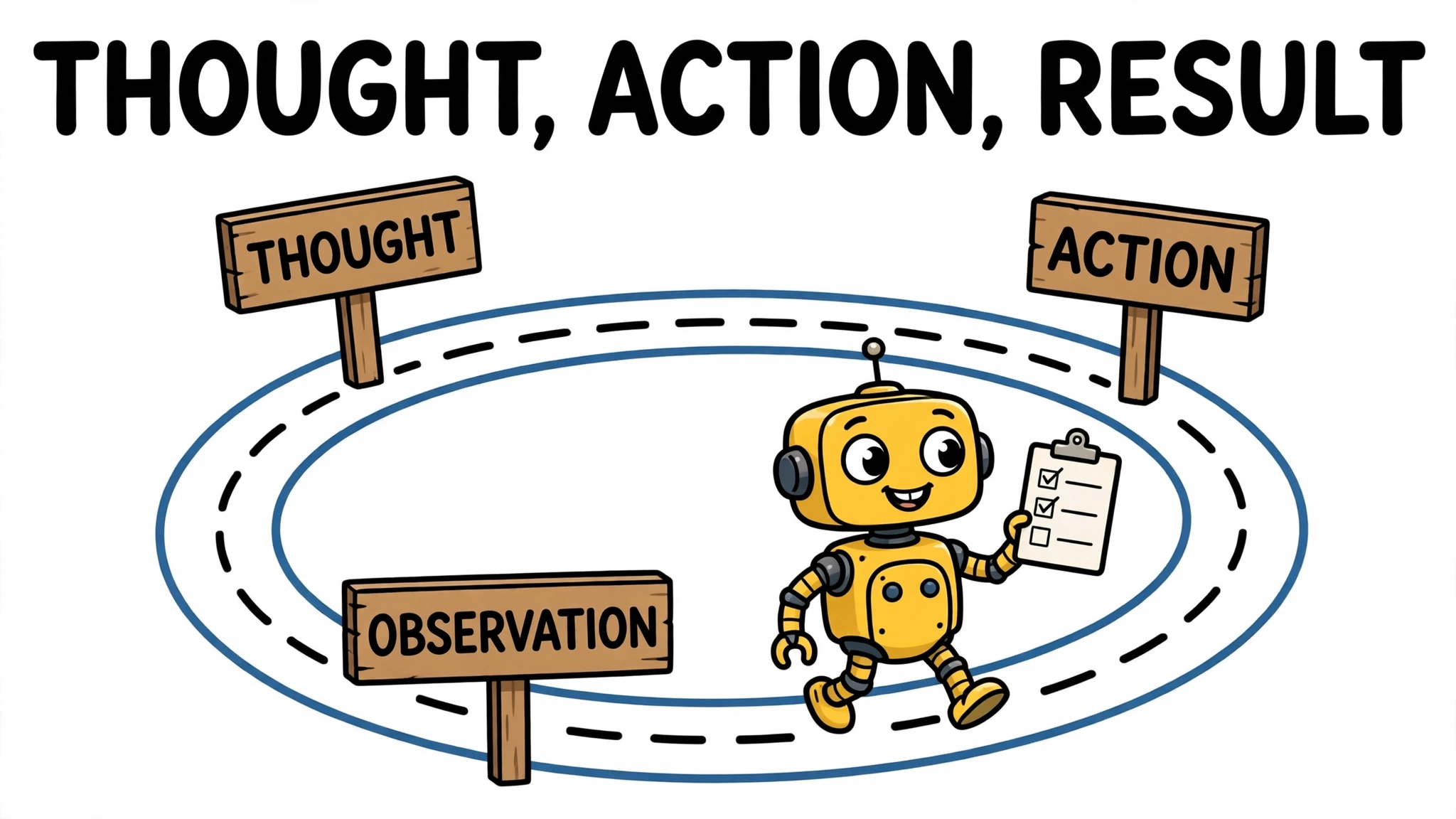
An agent works in a loop. It reads its system prompt, the user task, the descriptions of the tools available to it, the results of tools it has already called, and any memory or context it has been given. Then it decides what to do next: call a tool, ask for more information, or give a final answer. When a tool returns a result, that result is added to the context, and the loop runs again.
Researchers describe this pattern as reasoning interleaved with acting. In the ReAct pattern, the agent alternates between a reasoning trace and an action, then reads the observation that the action produces. Thought, Action, Observation, repeat. The reasoning trace helps the agent keep track of its plan and handle exceptions; the action lets it gather information from an external source instead of relying only on what it already knows.
The anatomy of a good agent prompt
A good agent prompt is built from parts that each do one job. Start with role and goal, each in one clear sentence. “You are a support agent for an online store” is a role. “Resolve the customer’s delivery question using the order tools, and do not change an order without approval” is a goal with a boundary built in.
Next, describe the tools in the terms the agent will actually use to choose between them. A tool description should say what the tool does, when to use it, what arguments it needs, and what a successful result looks like. Vague descriptions cause wrong calls, not clean errors: if two tools sound similar, their overlapping descriptions can make tool selection ambiguous and increase wrong calls, so the wording has to make the distinction obvious.
Then add constraints, output format, and failure handling. Constraints include what the agent must verify before acting, what it must never do without approval, and what to do when information is missing. The output format should be stated as a shape the rest of the system can consume, not as a vague request for a “nice summary”. Finally, tell the agent what to do when a tool fails: retry once with different arguments, try an alternative source, or report the failure and stop, rather than inventing a result.
Examples and counter-examples belong in the prompt too, for the exact task at hand. Show the agent a good trajectory, not just a good final answer: the reasoning, the tool call, the observation, and the conclusion. A counter-example is equally valuable: show the agent the tempting wrong move — for instance, answering from memory instead of checking the order tool — and label it as wrong.
Prompt techniques that matter most for agents
Several techniques earn their place specifically because agents act, not just answer. Few-shot examples are the first: give the agent worked examples of the whole trajectory, including tool use, so it learns the format before it faces a real task. The original ReAct work used exactly this approach, prompting with a small number of human-written task-solving trajectories and no additional training, in the original ReAct work.
Step-by-step reasoning is the second. Asking the agent to reason briefly before acting gives it a place to choose a tool for a stated reason, rather than jumping to the first plausible action. ReAct-style think-then-act patterns are the agent version of this: a short thought, a tool call, and then a reaction to what the tool returned.
Structured output is the third, and it is where prompt engineering meets software engineering. When code will consume the agent’s reply, the reply must arrive in a shape the code can parse. Schema-constrained output does this by forcing the model to follow a declared format: OpenAI exposes this through a response format with a JSON schema and a strict mode, while Anthropic’s structured data path runs through tool use, where the model calls a tool with arguments matching a declared input schema. The schema guarantees shape, not truth — it can require a field to be an integer, but it cannot prove the integer is the right one — so validation of the content still belongs in your own code.
Decomposition completes the set: break a larger task into subgoals with observable completion checks — in the support-agent example, find the order, check its status, and only then summarise — so the agent can verify each step instead of improvising one long plan.
A worked example: from vague request to agent-ready prompt
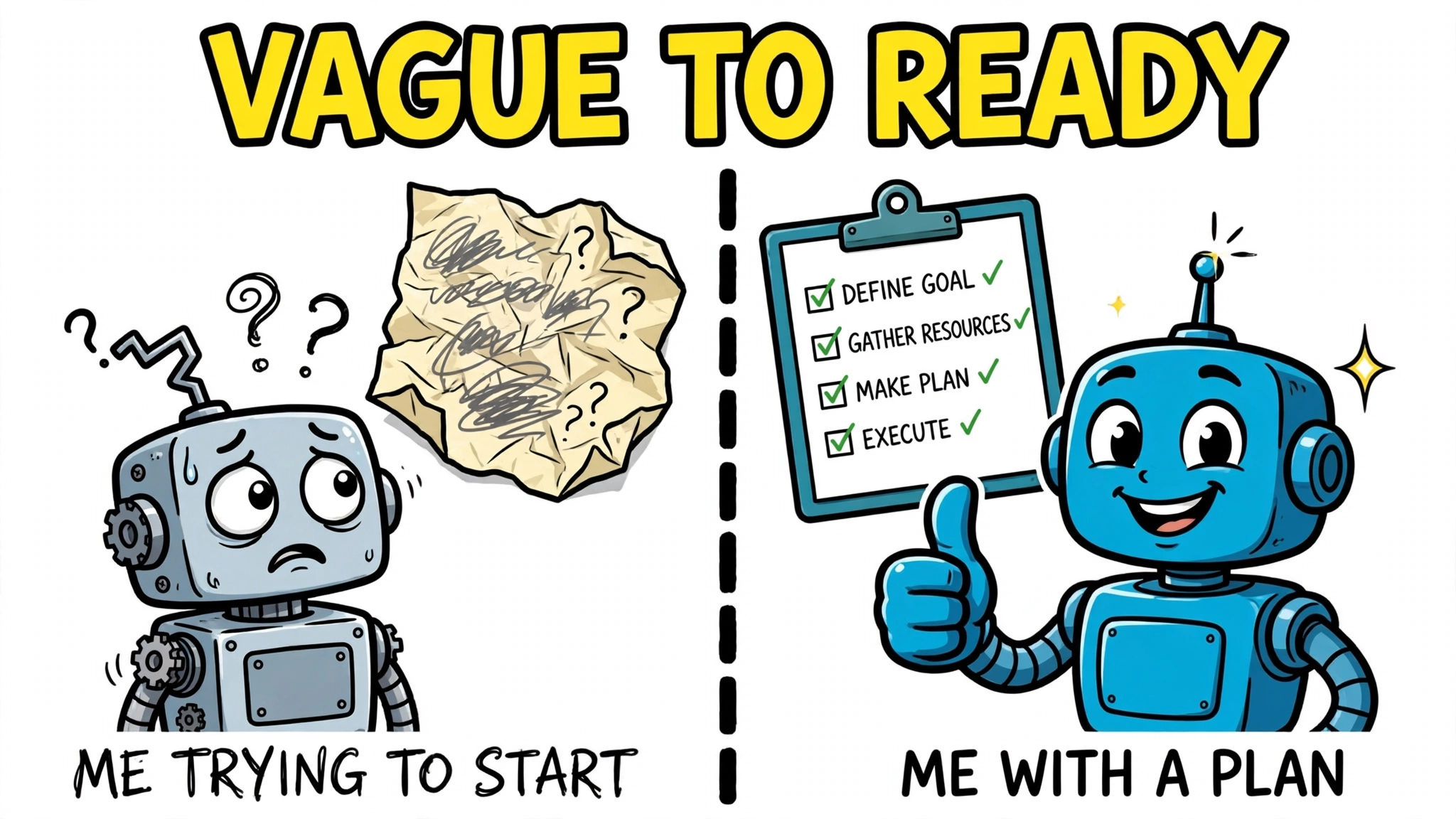
Consider a support agent. A vague prompt might read like this:
You are a helpful support agent. Help the customer with their order problem.That prompt invites failure. The agent has no instruction to check the order before answering, no boundary on changing orders, and no format for its final answer. Faced with a customer asking about a delayed delivery, it may answer from general knowledge, guess at a delivery date, or offer a refund it was never authorised to give.
An agent-ready version of the same prompt states the role, the tools, the checks, and the stopping conditions:
You are a support agent for an online store.
Goal: resolve the customer's delivery question using the order tools.
1. First call get_order_status with the order id the customer provides.
2. If the order id is missing, ask for it and do not guess.
3. Never change, cancel, or refund an order without a recorded approval.
4. If a tool returns an error, retry once with the same arguments, then report the failure and stop.
5. Reply with: order status, delivery estimate from the tool result, and the next step for the customer.
Every added line removes a decision the agent would otherwise have to guess at. Watch the first real run for three things: whether it picks the right tool first, whether it stops when it lacks an order id instead of guessing, and whether its final answer reports only what the tool actually returned.
Prompt Engineering AI Agents in Practice
The worked example also shows why tool definitions deserve as much care as the main prompt. A tool definition is itself a small prompt: a name, a description, and a schema for its arguments. The model reads that description when deciding what to call, so a description that says only “gets order info” leaves the agent to guess what “info” includes, while a description that says “returns the current status, delivery estimate, and tracking id for one order id” gives it a precise contract.
A minimal tool definition, in JSON, looks like this:
{
  "name": "get_order_status",
  "description": "Returns the current status, delivery estimate, and tracking id for one order id.",
  "parameters": {
    "type": "object",
    "properties": {
      "order_id": {"type": "string"}
    },
    "required": ["order_id"],
    "additionalProperties": false
  }
}
A call that matches that schema is simply a request for one order id, for example:
{"order_id": "ORD-12345"}That payload satisfies the schema: it is an object, it carries the one required string field, and it adds no extra properties. Keeping schemas flat, explicit, and fully described is a prompt-engineering decision with direct reliability consequences, because the schema is what the model reads when it decides how to act.
Testing, evaluating, and iterating agent prompts
Prompt engineering for agents is an engineering loop, not a single clever sentence. Start with a small set of realistic tasks, including edge cases: a missing order id, a tool that returns an error, a customer request that is outside what the agent may do. Run the prompt against that set and record what actually happened, not just whether the final answer sounded good.
Measure the things that matter for an agent: task success, tool errors, unnecessary steps, and cases where the agent acted without the required check. A fluent final answer that skipped the verification step is a failure, even if the customer would not notice it on that occasion. Change one element at a time — a tool description, a constraint, an example — and keep the version that wins on the test set. Changing several things at once makes it harder, in a simple comparison, to isolate each change’s contribution.
Common mistakes and where prompting stops working
Common mistakes include overloaded prompts, contradictory instructions, and hidden assumptions. Overloaded prompts bury the important instruction among nice-to-haves. Contradictory instructions — “be fast” and “verify everything”, with no priority between them — create ambiguity and inconsistent behaviour. Hidden assumptions are the quietest failure of all: a prompt that assumes the agent already knows which system holds the truth, or that a tool result is always up to date, will fail the first time that assumption is wrong.
Prompt injection deserves a separate warning, because it is specific to agents that read untrusted data. A language model receives system instructions, user input, retrieved documents, and tool outputs as one stream of text, with no hard boundary between trusted instructions and data that happens to contain instructions. An instruction hidden in a web page, an email, or a tool result can therefore be followed as if it came from the developer — and for an agent, that can mean a real tool call, not just a wrong sentence. The defences are structural, not just verbal: treat tool output as data, never as instructions; give tools the least privilege they need; validate every tool-call argument against a schema and against business rules on your own side; and require human confirmation for high-impact actions such as sending mail, deleting data, or making a payment.
Finally, know where prompting stops working. No wording will fix a missing tool, a stale data source, or a task that genuinely needs a different capability. When the agent keeps failing on the same kind of task, the fix may be a better tool, a retrieval step that grounds it in current facts, a guardrail that checks its work, or training for that specific behaviour — rather than a longer prompt. Prompt engineering is powerful precisely because it is cheap to iterate, but that cheapness becomes a trap when it is used to paper over a capability the system does not have. The best agent prompts are honest about what the agent can do, precise about how it should do it, and explicit about where it must stop and ask.