

If you have followed AI news in the last two years, you have probably seen the phrase “agentic AI” everywhere, usually without a clear explanation of what it actually means. This article explains agentic vs traditional AI in plain terms: what an agentic system does that other systems do not, how the two approaches compare dimension by dimension, and when each one is the right choice for a real task.
What agentic AI is
Agentic AI is an artificial intelligence system that can accomplish a specific goal with limited supervision. That definition, used by IBM, captures the two qualities that matter most: a goal, and the freedom to work toward it without a human directing every step. An agentic system is not a single model type. It is a pattern built around a model, plus tools, memory, and a loop that keeps going until the job is done or a stopping condition is reached.
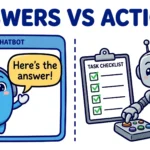
The core of the pattern is the sense-plan-act loop. The system collects data from its environment through sensors, APIs, databases, or user interactions. It interprets the request and the wider context, sets objectives based on the goal it was given, and develops a strategy to reach them. Then it acts, observes what happened, and revises its plan. That cycle repeats. A chatbot, in its standalone form, answers and waits. An agentic system answers, acts, checks the result, and decides what to do next.
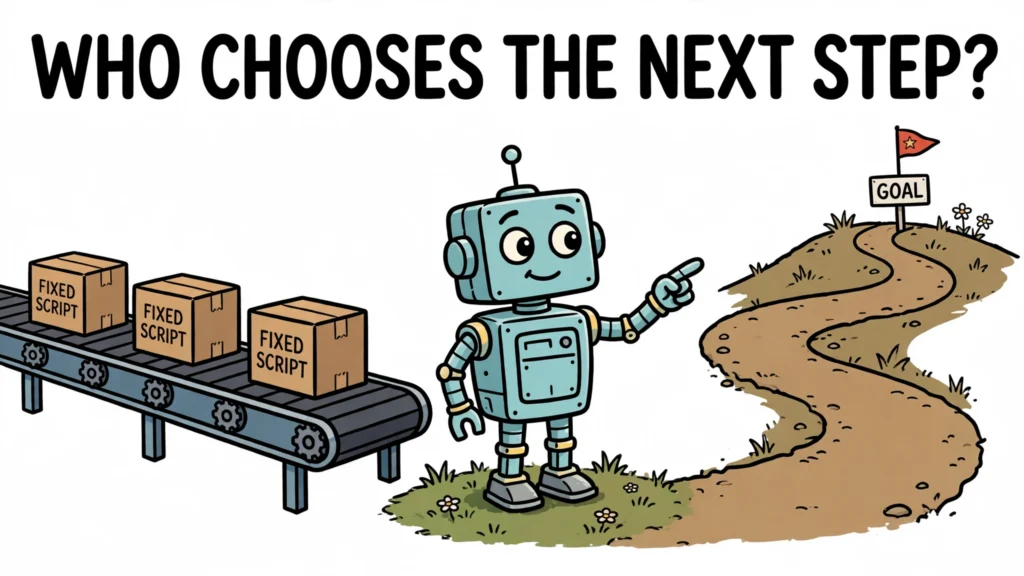
Three traits follow from that loop, and they are worth naming precisely because they are often confused with the loop itself. Autonomy means the system can choose its next step rather than waiting for the next prompt. Goal-driven behaviour means its steps are organised around an outcome, not around producing a single response. Adaptability means it can replan when new information arrives. Tool use, memory, and adaptation support the loop, but on their own they do not make a system agentic. A script that calls a tool in a fixed order is not agentic, however useful it is.
How agentic AI works in practice
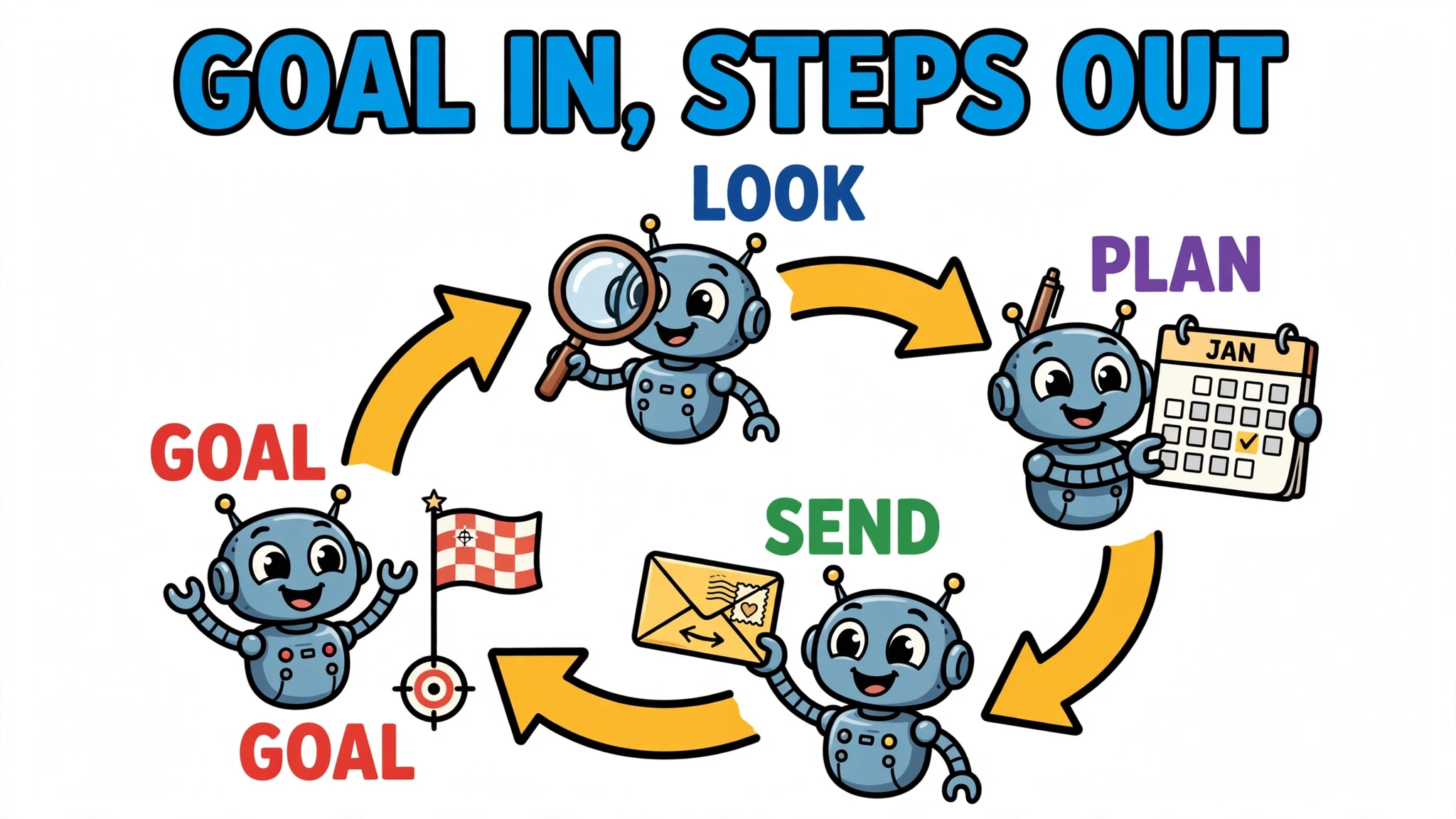
Consider a concrete, ordinary task: reconciling last month’s invoices. A standalone chatbot could explain how reconciliation works, or draft an email about it, but it could not finish the job. An agentic system given the goal “reconcile last month’s invoices” would work through a loop. First, it would gather the relevant data: invoices from one system, payments from another. Then it would compare them, flag mismatches, and decide what each mismatch needs: a corrected record, a follow-up message, or a human decision.
Tools support the data-gathering and action steps in this workflow. The agent searches records, calls application programming interfaces, and queries databases, then uses the results to decide the next action. Planning, interpretation, and revision can happen without a tool call. Memory and context across steps are what make this possible: the result of step two informs step three, and a decision made early in the task is still available late in it. When a step fails, the loop observes the failure and revises the plan, for example by trying a different source, asking for a missing piece of information, or escalating to a human when the failure cannot be resolved from the available data.
The same pattern appears in simpler settings. An agent asked to schedule a week’s meetings checks calendars, emails participants, and books rooms, without needing explicit instructions for each sub-task. The goal is stated once; the steps are chosen by the system. That is the practical difference the rest of this article keeps returning to: the human specifies the outcome, and the system figures out the sequence.
What traditional AI means in this comparison
Traditional AI is not one thing, and a fair comparison needs to say which baseline is meant at each point. In this article, “traditional” covers two baselines that predate the agent loop, and they work in quite different ways.
The first baseline is rule-based systems and classical machine learning. Rule-based systems encode knowledge that people write down, typically as if-then rules stored in a knowledge base. They behave predictably within those rules, which makes them easy to inspect and audit, and they cannot go beyond what they were written to do. Classical machine learning, by contrast, learns patterns from examples: a developer supplies data and a model structure, and training adjusts the model until its predictions fit the examples. A typical classical model is trained for one task, such as classifying emails as spam or predicting a price from structured data, and it produces one output per input.
The second baseline is the generative AI chatbot in its standalone form: one response per prompt, with no tools, memory, or persistence unless the surrounding system adds them. This is the form most people meet first, and it is genuinely powerful for explanation, drafting, and summarisation. But in its standalone form it reacts to a prompt rather than pursuing a goal over time. The comparison in this article is therefore about system design, not about model type. The same underlying model can be a chatbot in one system and the reasoning engine of an agent in another.
Agentic vs traditional AI: the key differences
The differences are clearest when they are laid out dimension by dimension, with the qualification that each one depends on how the system is designed.
- Goal orientation. An agentic system is designed around a goal: completing an outcome, such as reconciled invoices or a booked schedule. A traditional system is typically designed around an output: one prediction, one classification, or one response per input.
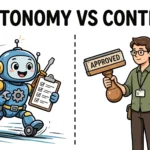
- Autonomy and initiative. An agentic system acts across steps on its own, under human-set guardrails, choosing what to do next. A standalone traditional system, by contrast, waits for the next input or prompt before doing anything further; a surrounding system may add orchestration, state, and adaptive control around it.
- Tool use and environment. An agentic system changes external systems through tools: it searches, calls APIs, queries databases, writes records, and sends messages. A standalone chatbot answers inside the model. Tool use alone, however, does not make a system agentic; a fixed workflow that calls tools in a set order is still a workflow.
- Adaptation. An agentic system replans on new information: a failed lookup, a changed record, or an unexpected result can change the next step. A standalone traditional system may adapt within fixed rules or retraining cycles, but replanning a multi-step task on its own is the agentic pattern, not a property of the standalone baseline.
- Memory and state. An agentic system carries context across steps, where the surrounding system provides it, so later steps build on earlier ones. A standalone model response starts fresh each time; anything it needs must be supplied again in the prompt.
Put together, the contrast, for the standalone baselines compared here, is between a system that pursues an outcome over time and a system that responds to an input. That single sentence is the most useful summary of the whole comparison, provided the qualifications above are kept with it: the boundaries are about design, and real systems mix both.
Where the boundary blurs
Many real systems sit between the two poles, and insisting on a clean binary would mislead more than it clarifies. A chatbot with tool calling can look agentic when it fetches a document or checks a calendar, yet still be following a narrow, single-turn pattern. A scripted workflow can call several tools in sequence and still not be agentic, because every step was fixed in advance. A partially autonomous agent with strong oversight may outperform a fully autonomous one with a vague goal.
A practical test helps. Ask: does the system choose its own next step toward a goal, or does it follow a fixed script? If the system itself selects or revises its next step toward its goal in light of what the previous step found, it is behaving agentically. Merely executing a prewritten branch, a conditional step fixed in advance, does not count: the choice of plan must come from the system, not from the script. If the sequence was decided before the task started and nothing observed along the way can change it, it is a workflow, even if a model is involved somewhere inside it. Agenticness is a spectrum, not a label, and most production systems will sit somewhere along it by design.
This also explains why the word “agent” is used so loosely in marketing. A product can contain a model, call a tool, and still not pursue a goal. The test above, applied to the actual behaviour of the system rather than its branding, is a more reliable guide than any product name.
When to use agentic AI and when not to
Agentic AI earns its complexity when the task is multi-step, tool-dependent, and open-ended, with a verifiable outcome. Reconciling records across systems, triaging a queue of support cases, or preparing a report from several sources are good fits: the goal is clear, the steps are many, and success can be checked at the end. In those cases, letting the system choose the sequence saves the human from orchestrating every step by hand.
It is a poor fit in several common situations. For a single-turn answer, a chatbot or a direct lookup is typically faster, cheaper, and easier to verify under comparable conditions, because it avoids the overhead of unnecessary additional steps. For high-stakes, irreversible actions without guardrails, such as deleting records or moving money, full autonomy is the wrong default; those actions should pause for human approval. And for any task with no clear success check, the system cannot reliably verify that the intended outcome was achieved; stopping still comes from limits, timeouts, or human intervention, not from the loop recognising success on its own.
The trade-offs follow from the loop itself. Each additional step can add time and model calls, so a task that a single response could answer may become slower and more expensive as an agent task, depending on the models, tools, and execution conditions. Oversight is also harder: the more steps the system takes on its own, the more important it becomes to log what it did, so a human can review the chain afterwards. Those costs are worth paying when the task genuinely needs many steps and many tools, and they are wasteful when it does not.
Limits and common mistakes
The most common mistake is calling any chatbot or workflow “agentic” because it uses a language model. The label should follow the behaviour: a goal-directed loop that chooses its own next steps. Without that, the word adds marketing, not meaning, and it hides the real question, which is how much autonomy a system actually has and what bounds it.
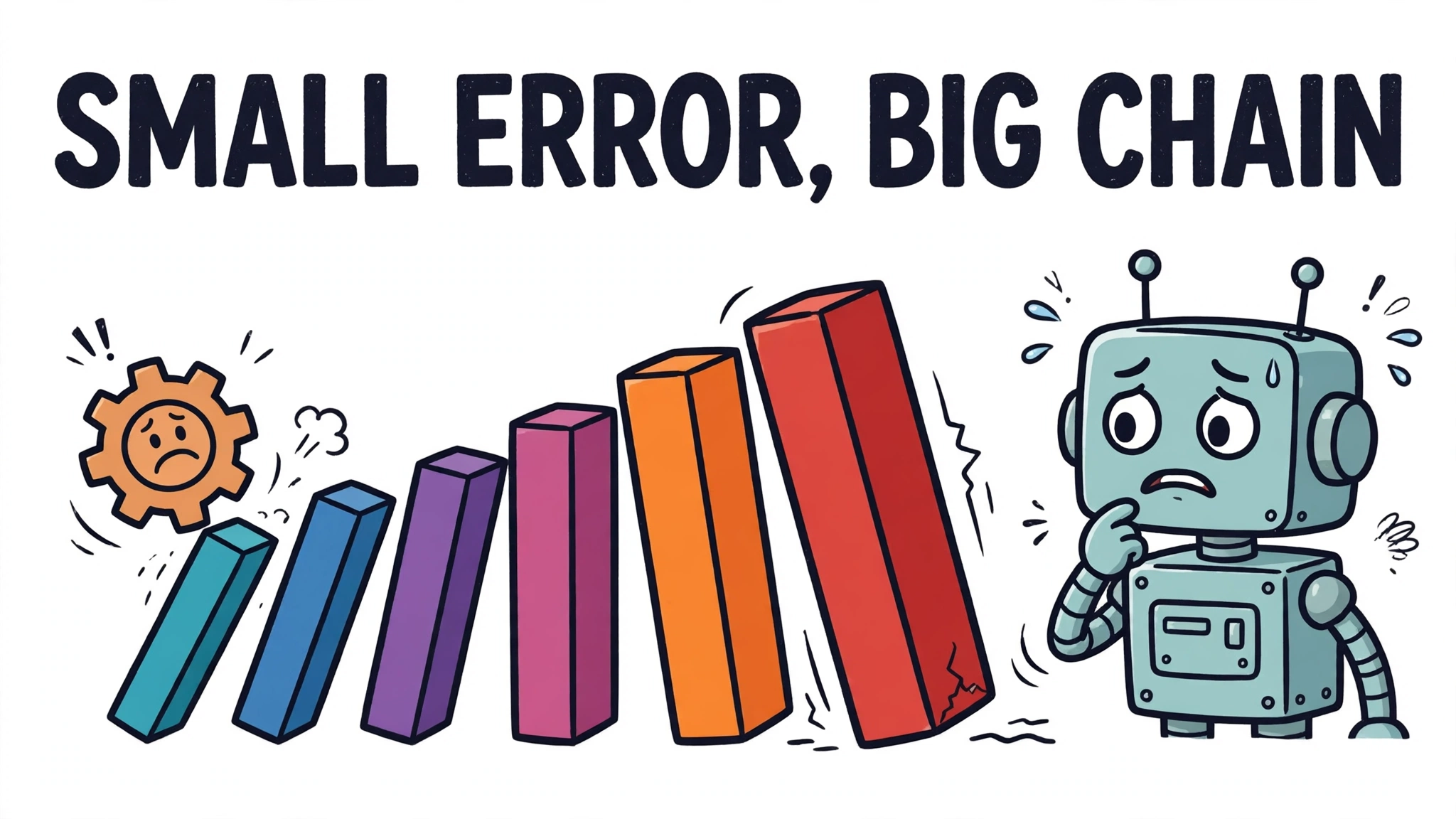
The failure modes of real agent loops are well documented and worth taking seriously before granting write access to anything important. Agents can fail silently: they hallucinate, loop, or produce plausible but wrong actions, and then reason on top of the messy result, compounding a single mistake into a chain of them. Chatbots can hallucinate too; what is distinctive here is that an agent acts on its outputs and feeds the results into later steps, so one error can compound across a chain of actions. The recurring patterns are looping on the same tool call, acting on bad or empty tool output, taking unapproved irreversible actions, and running up cost because nothing caps steps, tokens, or wall-clock time.
The guardrails that address these failures are straightforward, and they belong outside the model rather than inside a prompt. Cap iterations and add a stop condition, so an agent that cannot finish fails loudly instead of spinning forever. Give tools least-privilege permissions, and require human confirmation for anything destructive or public, approving the exact action rather than a vague summary of intent. Verify tool outputs before acting on them, and schema-check tool inputs and outputs at the boundary instead of letting the model self-correct in a loop. Finally, keep a record of every decision and action, so failures can be understood after the fact rather than guessed at.
Agentic AI is a genuinely useful pattern, and it is easy to over-claim for. Used where a goal, many steps, and verifiable success justify the loop, and bounded by caps, permissions, and approval gates, it lets systems finish work that a single response cannot. Used as a label for anything with a model inside it, or without those bounds, it creates risk faster than it creates value. The difference between those two outcomes is not the model. It is the design around it.