

Deciding when to build human-in-the-loop ai agents into a workflow is one of the first governance choices a team makes when agents start acting on real systems. An agent that only reads and summarises can be wrong in a chat window; an agent that sends messages, moves money, deletes records or changes production can be wrong in the world. The question is not whether oversight matters in general, but which actions deserve a person standing in the way before they happen, which deserve monitoring after the fact, and which should run untouched.
What human-in-the-loop actually means
Human-in-the-loop, human-on-the-loop and human-out-of-the-loop are three different oversight positions, and confusing them is the most common source of weak governance. In a human-in-the-loop setup, the agent pauses before a designated action and waits for a person to approve, edit or reject it; nothing happens until the person decides. In a human-on-the-loop setup, the agent acts and a person monitors, able to intervene when something looks wrong. In a human-out-of-the-loop setup, the agent acts without human involvement at all, and oversight, if it exists, is retrospective: logs, audits and incident reviews.
The distinction matters because only the first position stops a bad action before it lands. A review that happens after the agent has sent the email, executed the payment or run the database update is not human-in-the-loop at all; it is human-after-the-fact. Teams should also distinguish approval before action from review after action when they write their policy, because the two demand different tooling: approval needs a pause mechanism, while retrospective review needs logs good enough to reconstruct what happened.
The conditions that call for a human in the loop
Four conditions, alone or combined, argue for putting a person in the loop. The first is irreversibility. Framework documentation converges on the same examples: sending an email, deleting a record, executing a financial transaction, or any operation that cannot be cleanly undone. If the cost of being wrong cannot be refunded, recalled or rolled back, the action should wait for a person.
The second is regulated or high-stakes subject matter. The EU AI Act’s Article 14 requires high-risk AI systems to be designed so that they can be effectively overseen by natural persons while in use, with oversight measures commensurate with the risks, level of autonomy and context of use. For the strictest case the Act names, remote biometric identification, no action may be taken on an identification unless it has been separately verified and confirmed by at least two natural persons. Finance, health, legal and safety-critical work carry the same logic even outside that regulation: the consequences of error fall on people, not just on systems.
The third condition is low confidence or novelty: situations the agent has not been reliably tested on, inputs outside its tested range, or cases where its reasoning is uncertain. The fourth is external visibility: actions that reach customers or third parties, where a mistake becomes a reputational or contractual event rather than an internal one. When several of these conditions coincide — an irreversible, externally visible action in a regulated domain — the case for in-the-loop approval is at its strongest.
When a human in the loop hurts

More oversight is not always better, and a badly placed approval step can make a system less safe than no approval step at all. The most obvious cost is latency and throughput: a low-risk, high-volume, fully reversible action, such as classifying an internal ticket or drafting a summary nobody acts on without further review, may add little value from a human pause while still costing speed and money, and independent triggers such as novelty or external commitments still require assessment.
The subtler cost is that approval steps degrade. Human factors research describes automation bias: the tendency to over-rely on automated recommendations, accepting them without enough scrutiny (errors of commission) and gradually ceasing to monitor at all (errors of omission). Over-reliance grows under time pressure and distraction, exactly the conditions of a busy review queue. When reviewers face dozens of low-value checks per hour, review becomes a ritual: the person clicks approve, the action runs, and everyone believes a human reviewed it when no real review happened. Research summaries of AI coding-agent oversight put human intervention success at only 9 to 26% across oversight strategies tested, even when a problem actually surfaced in front of the reviewer. The supplied evidence does not settle whether that failure is mainly one of recognising the problem or of attending to it, so this article reports the range without assigning a single cause. Alert fatigue is the same pattern in another form: clinicians have been reported to dismiss between 49% and 96% of safety alerts. A human in the loop who is flooded, rushed or given no real authority to override is not a safeguard; they are a signature step.
A decision framework: risk, reversibility and confidence for human-in-the-loop ai agents
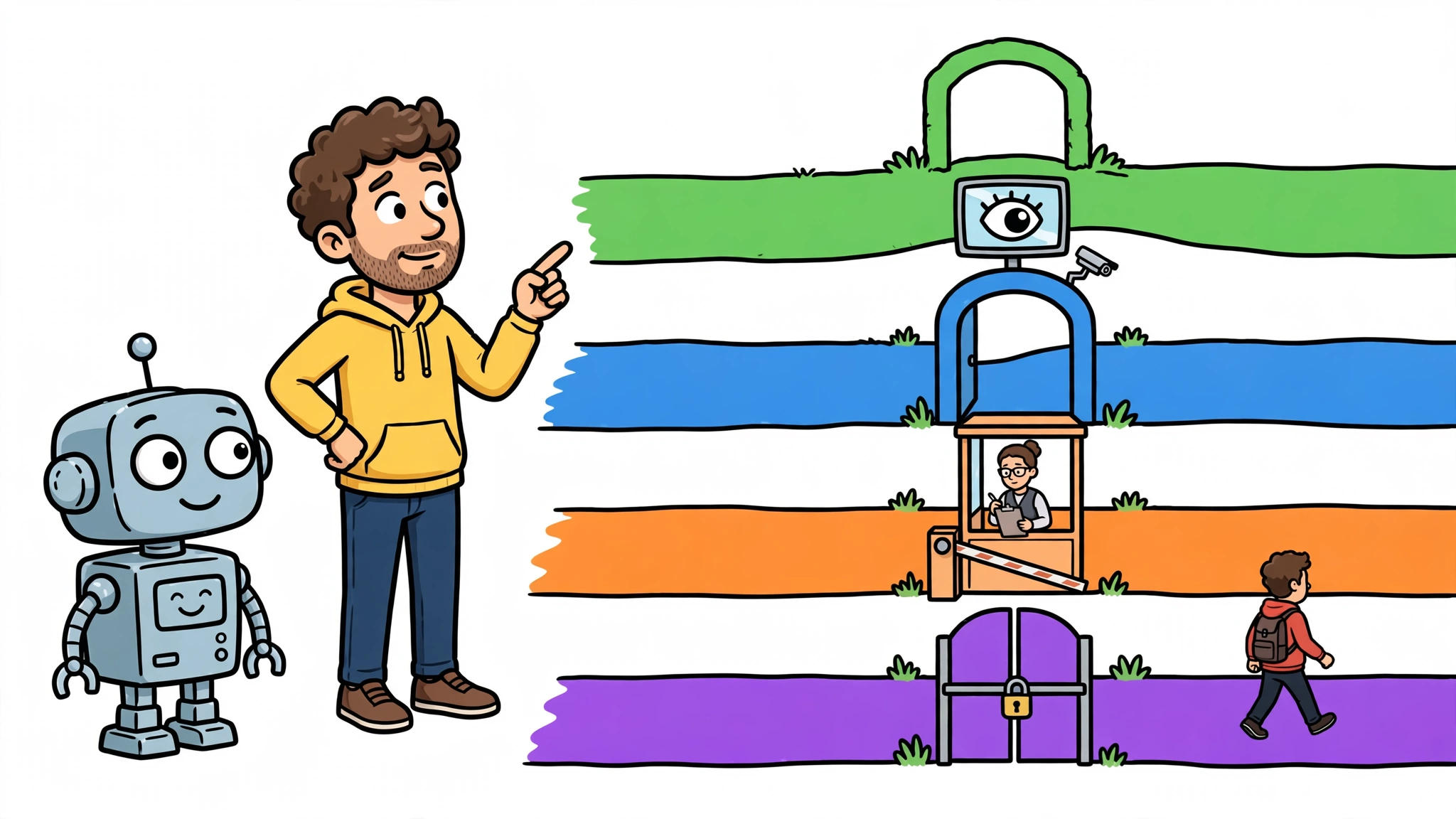
A workable method scores each action type on three axes and routes it to a tier. Impact asks what happens if the action is wrong, and who bears it. Reversibility asks whether the action can be undone, and at what cost. Confidence asks how reliably the agent performs this action type, measured on real tasks, not assumed from a demo.
From those three scores, four tiers follow in this proposed qualitative framework — a working proposal, not validated thresholds. Precedence matters: check approval triggers and any applicable human-decision requirements first; only actions that pass those checks may be routed to monitoring or autonomy. Autonomous: low impact, reversible, high measured confidence — the agent acts and logs. Monitored (human-on-the-loop): moderate impact and moderate-to-high confidence, with no approval trigger applying — the agent acts, a person watches, and exceptions escalate. Approval-gated (human-in-the-loop): high impact, irreversible, or low confidence — the agent pauses and a named person approves, edits or rejects before execution. Human-only: the decision and execution responsibility stays with a person, even where the agent may still prepare supporting material; any rule against agent-generated proposals is a separate policy choice, not a consequence of this framework.
Worked examples make the tiers concrete. A refund above a set threshold is approval-gated: money moves and cannot be quietly recalled. A bulk customer-record update is approval-gated for the same reason, plus its blast radius. A code deployment to production is approval-gated when it changes live behaviour, but a deployment to a staging environment can be merely monitored. A customer email that commits the company to a deadline or a price is approval-gated; an internal draft summary is autonomous. The point of the framework is that the tier attaches to the action type, not to the agent in general — the same agent can be autonomous for summaries and gated for payments.
How to design an approval step that works
An approval step works only if the reviewer can actually judge the action. That means showing exactly what will change: the tool, its arguments, the sources the agent used and a short statement of its reasoning — not just a recommendation and an approve button. The reviewer must be able to approve, edit or reject, and to answer on the agent’s behalf where that is the right move; agent frameworks such as LangChain’s human-in-the-loop pattern support exactly these four decisions, with the pause held durably so a reviewer can answer minutes later and the run resumes from the exact point where it stopped.
Three further design rules follow. First, as an implementation recommendation, runtime enforcement is recommended over a prompt request: the gate should be enforced by the runtime, and teams should verify that every protected execution path checks approval before acting, rather than assuming no path can bypass it. Second, escalation should be exception-based: the agent pauses on low confidence, novel inputs and high-impact actions, not on every action, so reviewers spend their attention where it matters. Third, everything must be logged: who approved what, who overrode what and why, and what the agent did next. The NIST AI Risk Management Framework’s GOVERN 3.2 principle calls for human-AI roles and oversight to be defined — who the human is, what they review, what authority they have. The further implementation advice in this paragraph, including treating an override rate near zero as a warning sign of automation bias rather than proof of a perfect model, comes from a practitioner guide to the framework, not from NIST text itself.
Common mistakes and limits
The first mistake is treating approval rate as a success metric. A dashboard built on output quietly rewards the behaviour it should prevent: a 100% approval rate is indistinguishable from rubber-stamping. Track override rates, time-to-decision and edit rates instead, and investigate when overrides fall to zero.
The second mistake is an accountability gap: nobody owns the approved action. If the reviewer lacks the competence, training, authority or support to judge the action — the deployer duty the EU AI Act states expressly — the approval is decorative, and the reviewer is left absorbing blame for a system that gave them little real control.
The third mistake is oversight that cannot intervene in time. A monitor who sees a problem only after the action has executed, or a stop control that merely pauses rather than bringing the system to a safe state, fails the test Article 14 sets: the overseer must be able to disregard, override or reverse the output, and to interrupt the system so it comes to a halt in a safe state. Design the intervention first, then the monitoring around it.
A practical checklist before you ship
Before an agent touches a live system, work through this list. Inventory every action type the agent can take and assign each one a tier under the risk, reversibility and confidence framework. Name the reviewer roles for gated actions, with response-time expectations and cover for absence — a gate with no available reviewer is a blocked workflow, and blocked workflows get bypassed. Define the metrics you will watch: approval rate, override rate, edit rate and time-to-decision, with a review cadence for each. Set the escalation triggers in the runtime: low confidence, novel inputs, high-impact actions and anything outside the tested range. And schedule a re-tiering review as measured reliability changes: promotion from gated to monitored is available only for actions whose gating reason was insufficient measured reliability and whose remaining impact, reversibility and applicable human-decision requirements permit monitoring; improved reliability alone never removes a gate that exists because the action is irreversible or a human decision is required. Actions that fail in production move back to a stricter tier. Oversight is not a setting you choose once; it is a control you tune as the agent proves itself — or fails to.