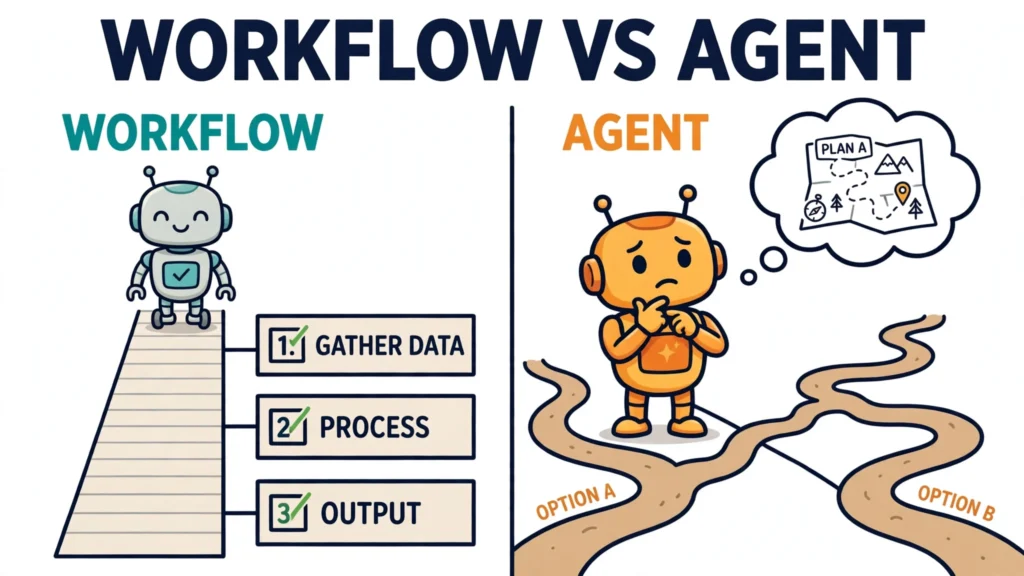

Reasoning in AI agents is the decision-making step between seeing the world and acting on it. A chatbot answers a question and stops; an agent takes a goal, looks at the current state, works out what to do next, does it through a tool, reads the result, and revises its plan. That middle step — turning a goal and a pile of observations into a next action — is reasoning, and it is what lets an agent determine its own path instead of following one someone else wrote in advance.
What Reasoning in AI Agents Actually Means
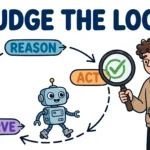
Start with the loop every agent runs: perceive, reason, act. The agent perceives the goal and the current state — the user’s request, the contents of a database, the result of the last tool call — then reasons over its options, acts through a tool, observes what happened, and goes around again. Anthropic puts it plainly: an agent is typically just a large language model using tools based on environmental feedback in a loop. Reasoning is the step in that loop where decisions happen.
Reasoning differs from plain text generation because of what it produces: plans, intermediate conclusions, tool calls, and self-corrections. Given the instruction “change my flight to Friday and refund the fare difference,” the agent does not write an answer — it decides to look the booking up first, check the change policy, compute the fare difference, then issue the refund. Each decision is checkable against the world: the booking either exists or it does not, the policy either allows the change or it does not. That grounding is the point: the loop makes reasoning iterative rather than one-shot.
Where Reasoning Sits in the Agent Loop
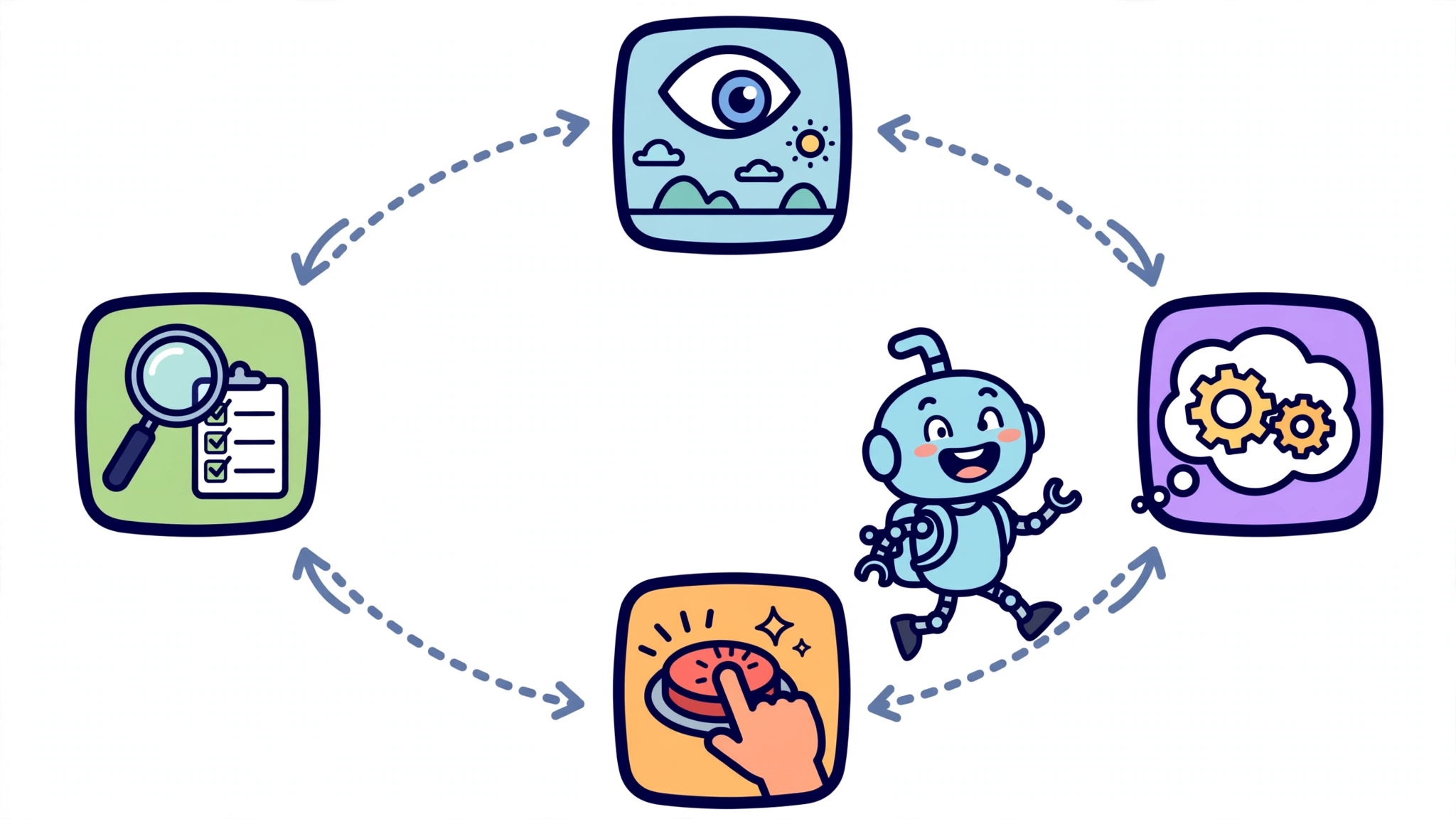
The loop runs once per turn, and reasoning is involved at every turn: decomposing the goal into smaller steps, picking the next action — which tool to call, with which arguments, or whether to ask a clarifying question — and interpreting the tool result: did the call succeed, does the result change the plan, is the goal complete?
Here is one request traced through the loop, in the ReAct style of alternating thoughts and actions. The trace is illustrative — invented booking details standing in for your own data:
{
  "request": "Change my flight to Friday and refund the fare difference.",
  "trace": [
    {"thought": "I need the booking before I can change anything. Look it up first.",
     "action": "lookup_booking(booking_id='BK-1042')",
     "observation": "Booking BK-1042: Tuesday flight, fare $320, changeable with a $25 fee."},
    {"thought": "The booking is changeable. I need Friday's fare before I can work out the refund.",
     "action": "get_fare_quote(booking_id='BK-1042', new_date='Friday')",
     "observation": "Friday's flight costs $280."},
    {"thought": "Friday's flight costs $280, so the fare difference is $40, minus the $25 fee — a $15 refund.",
     "action": "check_change_policy(booking_id='BK-1042', new_date='Friday')",
     "observation": "Policy allows the change. Refundable amount: $15 after the fee."},
    {"thought": "Policy allows it and the refund is $15. Change the flight, then refund.",
     "action": "change_flight(booking_id='BK-1042', new_date='Friday')",
     "observation": "Flight changed. New fare $280 confirmed."},
    {"thought": "Flight changed. Now issue the $15 refund for the fare difference.",
     "action": "issue_refund(booking_id='BK-1042', amount=15.00)",
     "observation": "Refund of $15.00 issued."},
    {"thought": "Flight changed and refund issued. The task is complete; confirm to the customer.",
     "action": "reply('Your flight is now Friday. A $15 refund for the fare difference is on its way.')"}
  ]
}
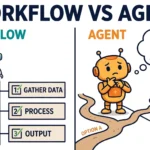
Notice what reasoning did at each step: it chose the order of operations, did the arithmetic that turned two fares and a fee into a refund amount, and decided when the task was done. A scripted workflow can do the same steps when its logic already covers them; the difference is who determines the process — predefined workflow logic, or the model’s own decisions informed by observations.
The Main Reasoning Patterns Agents Use
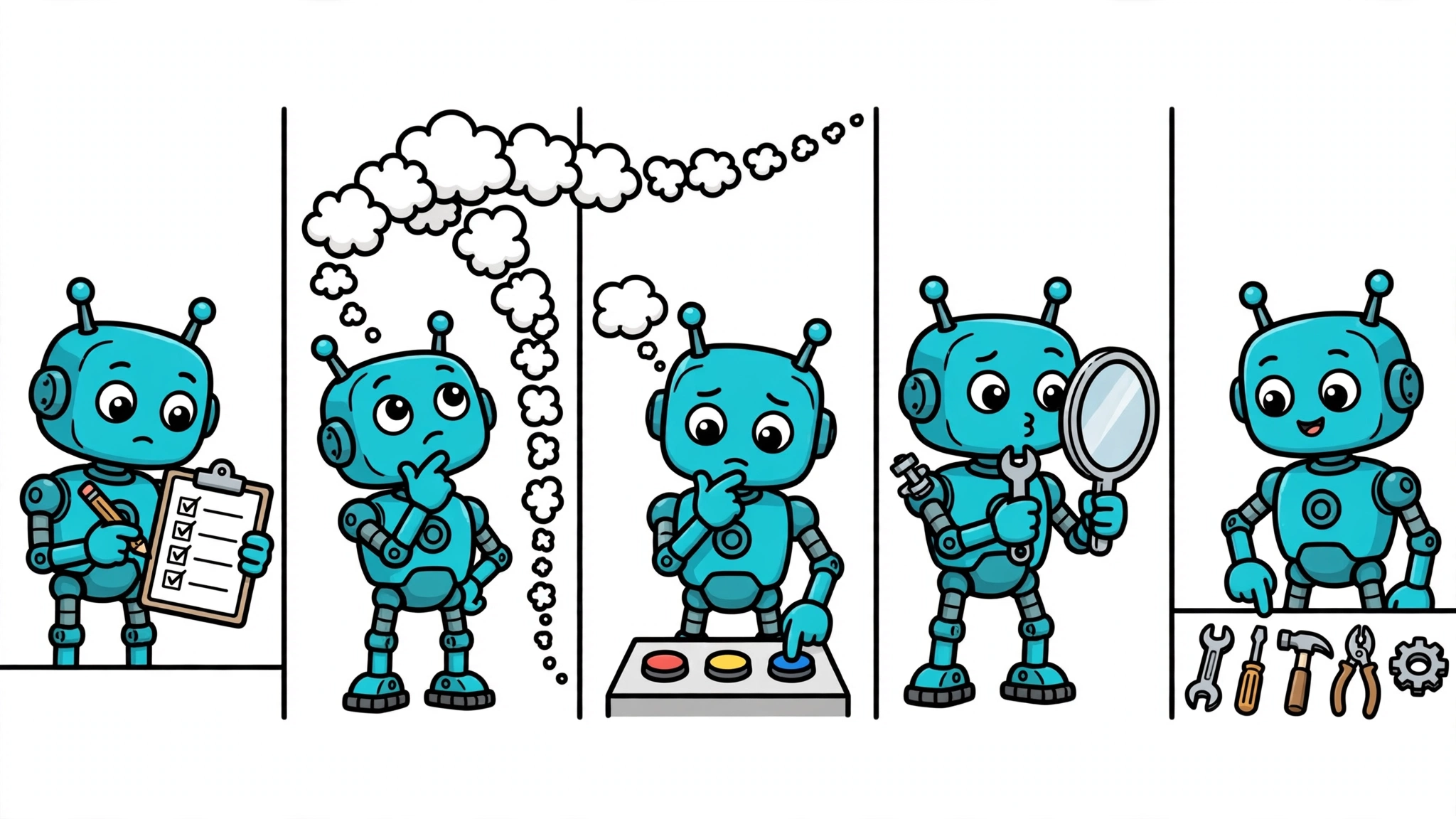
Agents reuse a small set of reasoning patterns, each fitting a different kind of problem at a different cost.
Step-by-step planning and task decomposition. The agent breaks a goal into sub-tasks before acting. It fits long-horizon goals with a clear structure; its cost is rigidity, since an early plan can be wrong in ways the agent only discovers halfway through.
Chain-of-thought and extended thinking before acting. The model writes out intermediate reasoning steps before committing to an answer. Chain-of-thought prompting — giving worked intermediate steps as exemplars — lifted PaLM 540B on GSM8K from 17.9% to 56.9% with just eight exemplars, with gains appearing reliably only in large models, onset around 100 billion parameters.
ReAct-style interleaving of reasoning traces and tool actions. The agent alternates a thought, an action, and an observation. The ReAct paper showed that reasoning traces help the model create, maintain, and adjust high-level plans as well as handle exceptions, while actions let it pull in information from the environment. On ALFWorld it beat imitation and reinforcement learning baselines by 34 points of success rate, and on WebShop by 10 points.
Reflection and self-correction after a failed or surprising step. The agent inspects its own output, identifies what went wrong, and tries again with the lesson attached. Reflexion turns feedback into self-reflective text stored in an episodic buffer and prepended on the next attempt; using GPT-4 it reached 91% pass@1 on HumanEval.
Tool-use decisions. Reasoning also covers the meta-decision: when to call a tool, which one, and with what arguments. A wrong argument to a state-changing tool can cause real consequences — a wrong refund, a deleted record — while a wrong argument to a read-only lookup returns an error or the wrong information without changing external state. So this pattern deserves deterministic, code-based checks wherever the expected result is machine-verifiable, with stronger validation and checkpoints on the actions that change state.
| Pattern | When it fits | What it costs |
|---|---|---|
| Step-by-step planning | Long-horizon goals with clear structure | Rigidity — a wrong early plan is expensive to abandon |
| Chain-of-thought / extended thinking | Multi-step problems with dependent steps | Tokens and latency — more thinking per answer |
| ReAct interleaving | Tasks where the next step depends on tool results | Iterative turns can add invocations and latency |
| Reflection / self-correction | Tasks where errors are diagnosable and fixable | Extra attempts — and retries can repeat the same mistake |
| Tool-use decisions | Every agent, every turn | A wrong call to a state-changing tool can have real consequences |
Reasoning Models Versus Reasoning Techniques
Two things are constantly conflated. A reasoning technique is a prompting pattern — chain-of-thought, ReAct, reflection — that elicits reasoning from a general model at inference time. A reasoning model is a model trained to reason: OpenAI’s o1 was trained with large-scale reinforcement learning to produce a long internal chain of thought before answering, and its performance improved with both more reinforcement-learning training compute and more test-time compute.
On AIME 2024, o1 scored 74.4% with a single attempt against about 12% for GPT-4o; with a 64-sample majority vote it reached 83.3%, and with 1,000 samples re-ranked by a learned scoring function it reached 93%.
DeepMind’s Snell et al. (2024) showed the other side: a small model with well-allocated test-time compute matched a model on the order of 14 times larger on curated math benchmarks — but the gains are roughly log-linear, so each doubling of thinking time buys a shrinking increment.
Use prompting techniques when the task is moderate and the model is already capable — prompting needs no new model training, but additional reasoning consumes tokens and inference time. Use a reasoning model when the task is hard, verifiable, and worth the latency: mathematics, coding, and multi-step planning where a wrong answer is expensive. And the two compose: a reasoning model running a ReAct loop with reflection may be a stronger agent than either alone — but that has to be established by task-specific evaluation against simpler alternatives, since additional reasoning can also hurt. It costs the price of both.
What Reasoning Makes Possible
Reasoning is what lets an agent work through multi-step tasks on its own, deriving the steps from the goal as it goes. A reasoning agent can change a flight, notice the fare difference, check the policy, and refund the balance. A scripted workflow can do the same sequence when its logic already covers each step and each check — the difference is who determines the process: predefined workflow logic, or the model’s own decisions informed by observations.
It is also what lets an agent handle ambiguous or incomplete requests — a customer who says “sort out my booking” has not specified what is wrong, so the agent has to infer intent, look at the booking, and clarify only what it cannot infer — and recover from errors: when a tool call fails or returns something unexpected, the agent re-plans instead of failing outright, and when the environment changes mid-task it adapts the plan rather than executing a stale one.
Where Reasoning Breaks Down
Reasoning is not magic, and its failure modes decide whether an agent is trustworthy. The traps are consistent enough to list, each with the guardrail that catches it.
| Failure mode | What happens | Guardrail that catches it |
|---|---|---|
| Hallucinated plans | Confident wrong steps — a plan that looks sound but rests on a misread tool result or an invented fact | Verification steps: check every load-bearing claim against a tool result before acting on it |
| Compounding errors | A small mistake early in a long chain propagates — each step builds on the last, so the final answer is far from the truth | Short chains and checkpoints: verify intermediate results, and keep reasoning traces visible so a wrong turn is spotted early |
| Overthinking simple tasks | Wasted tokens, latency, and sometimes worse answers — on easy problems extra thinking does not help and can actively hurt | Effort budgets: cap reasoning effort by task difficulty, and route simple tasks to a direct answer |
| Fluent but wrong reasoning | A plausible-looking chain of thought that does not guarantee a correct answer — the trace reads well and the conclusion is still wrong | Outcome grading: grade the final state of the environment, not the elegance of the trace |
| Reasoning that ignores the observation | The agent keeps executing its original plan after a tool result contradicted it | Human checkpoints and blast-radius limits for irreversible actions — refunds, deletions, external messages |
The common thread is that traces alone cannot establish correctness or reliability. A fluent chain of thought is not evidence of a correct answer — Wei et al. are explicit that producing a plausible-looking chain does not guarantee the answer at the end is correct. Qualitative trace inspection can still help diagnose planning and tool-use problems, but outcome grading and repeated trials are what establish task performance: did the booking change, was the refund right, did the database end in the required state?
How to Evaluate and Improve Agent Reasoning
Task-success benchmarks measure agent reasoning end to end, each on a different slice. SWE-bench grades real GitHub issue resolution by hidden tests across 2,294 instances; at publication the best model, Claude 2, resolved just 1.96%. GAIA tests general-assistant multi-tool reasoning with 466 questions; human annotators reached 92% while GPT-4 with plugins reached only 15% at publication. τ-bench simulates multi-turn user conversations with policy-following agents, scoring success by comparing the final database state to the annotated goal state, and adds the pass^k metric — the probability the agent succeeds on all k trials of the same task. GPT-4o with function calling solved about 61% of retail tasks once, but under 25% on pass^8: the same agent often succeeded on a task in one run and failed it in another.
Those numbers tell you what to measure. A single successful run proves almost nothing about a reasoning agent; only repeated trials show whether the reasoning is reliable. Anthropic’s eval vocabulary gives the structure: a task is a single test with defined inputs and success criteria, a trial is one attempt, a grader scores some aspect of performance, a transcript is the complete record of a trial, and the outcome is the final state in the environment.
Reading reasoning traces is the qualitative half of evaluation. A good trace shows the agent decomposing the goal, choosing tools for stated reasons, noticing when an observation contradicts the plan, and revising. A bad trace asserts without checking, repeats a failed call unchanged, or reaches the right answer for the wrong reason. The guardrails are verification steps before irreversible actions, human checkpoints where the stakes are high, and limits on blast radius.
When should you add more reasoning, and when should you simplify the task instead? Add reasoning when the task is open-ended, the steps are uncertain, and errors are costly. Simplify when the reasoning is doing work the system could do deterministically: if the refund amount is always fare difference minus fee, compute it in code and let the agent reason about the exceptions, not the arithmetic. Reasoning is the most expensive tool in the loop; spend it where only reasoning works.
The Bottom Line: When Reasoning Matters Most
Reasoning is what lets an agent determine its own path. A workflow follows a path someone wrote; an agent works out the path from the goal, the state, and what its tools return — and a workflow can handle the same multi-step task when its logic already covers the steps. That is the whole job: perceive, reason, act, observe, and reason again.
Simple, deterministic tasks need little reasoning — adding it can hurt. The decision rule is the same one Anthropic gives for agents generally: start with the simplest solution that works, and add reasoning only when it demonstrably improves outcomes. Reasoning is not the goal. The finished task is.