

Introduction to Perplexity’s Teammates: AI agents for work
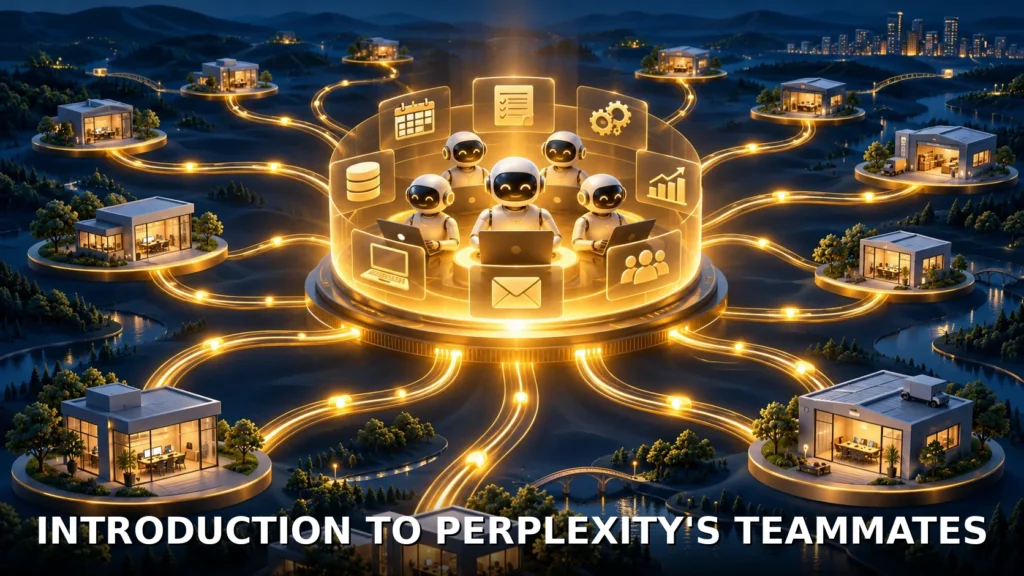
Perplexity has introduced Teammates, always-on AI agents for work that users can assign different jobs to run simultaneously. The system connects to Perplexity Computer and draws on existing projects, skills, and memory from Perplexity tools. Its central proposition is ongoing delegation: several agents can work on separate assignments while users follow their progress through individual threads.
The Verge’s November 5, 2026 report describes Teammates as Perplexity’s response to work-focused agents from OpenAI and Anthropic. Access requires Perplexity’s $200-per-month Max subscription, according to the report. That places the cost of entry alongside the functionality at the center of any assessment of the launch.
The distinction that matters is between completing a task and sustaining work. Perplexity says Teammates extend Computer through collaboration and support for ongoing, large-scale work. That is the company’s description of the intended capability; the supplied reporting does not include independent tests demonstrating how reliably the agents sustain such assignments or how much supervision they require.
For readers assessing AI agents for work, the launch therefore answers one question more clearly than another. It establishes what Perplexity is offering: continuously available agents, concurrent assignments, links to its existing tools, and interfaces for monitoring and interaction. It does not establish the resulting productivity gains. Those would depend on execution quality, the work assigned, and the effort needed to review results, none of which is measured in the available evidence.
The significance of Teammates is consequently a change in how Perplexity proposes users organize work. Instead of treating each assignment as an isolated exchange, the product offers multiple agents with distinct jobs and persistent places to follow their progress. Whether that arrangement delivers enough useful completed work to justify its subscription requirement remains an open question.
Functionality and capabilities of Teammates

The reported capabilities combine three ideas: continuous operation, different roles within a workspace, and simultaneous execution. Teammates can run around the clock and handle an array of tasks, according to The Verge. Users can give different jobs to separate Teammates, allowing those assignments to proceed concurrently.
These capabilities address different parts of workplace automation. Continuous operation describes when an agent can work. Role assignment describes how responsibilities can be divided. Concurrency describes the ability to pursue multiple assignments at once. Keeping those distinctions clear matters because none, by itself, establishes the quality of the completed work. An agent’s availability is a different property from its accuracy, and parallel activity is a different property from successful coordination.
Perplexity’s description adds collaboration and ongoing, large-scale work to that picture. However, the reporting does not explain the mechanism for collaboration. It does not establish how agents divide a shared objective, pass results between one another, or resolve conflicting outputs. The evidence supports reporting the company’s claim, while leaving those implementation questions unresolved.
The same caution applies to scope. The report says Teammates can perform various tasks, but the supplied material does not provide a detailed catalog of supported workplace workflows. It would therefore be premature to treat the announcement as confirmation that any particular department’s processes can be automated from beginning to end.
A practical interpretation is that Perplexity is offering a framework for delegating multiple streams of work. That interpretation follows from the documented combination of separate assignments and simultaneous operation. It is not evidence that every assignment is autonomous, that every task can continue indefinitely, or that users can dispense with review.
The missing performance evidence also limits the meaning of scale. No benchmark in the supplied reporting quantifies completion rates, execution speed, error rates, or the number of agents that can work effectively together. The launch establishes the proposed operating model; it leaves its demonstrated capacity unmeasured.
Integration with existing Perplexity tools

Teammates integrate with Perplexity Computer, which The Verge describes as an AI system capable of deploying agents on a user’s device to complete tasks. Perplexity says Teammates build on that system by adding collaboration and the ability to undertake ongoing, large-scale work. Computer is therefore the named connection to task execution in the launch account.
That relationship is more informative than viewing Teammates as a completely separate product. The reported design links the new agents to a system Perplexity already uses for completing tasks. Teammates also draw on existing projects, skills, and memory from the Perplexity tools a user already has. Together, these connections make continuity with an existing Perplexity workspace a central part of the offer.
The potential value of that continuity is contextual. If agents can use relevant existing material, users may have less context to restate when assigning work. That is an inference from the described integration, rather than a measured reduction in setup time. The reporting contains no comparison showing how much preparation Teammates require with or without those existing resources.
The integration claim also has boundaries. The supplied account does not explain which projects or memories are available to each agent, how access is selected, or how changes to that material affect work already underway. Nor does it provide technical documentation for the relationship between Teammates and Computer. Those omissions prevent a more detailed account of the underlying architecture.
For an existing Perplexity user, the relevant question is whether the material already held in those tools is sufficient and appropriate for the assignments being delegated. For someone evaluating the system afresh, the same integration means the assessment should encompass the surrounding Perplexity tools as well as the agents themselves. These are implications of the product’s stated dependencies, rather than evidence that a particular deployment will succeed.
The clearest supported differentiation here is the connection between Teammates, Computer, and existing Perplexity context. The evidence does not establish a broader list of integrations or document how external workplace systems participate in execution.
User experience and task management
Each Teammate gets an individual thread in the Perplexity app, where users can follow its progress. The report also says users can interact with Teammates in Slack. These are the two interaction surfaces identified in the available account: threads for monitoring within Perplexity, and Slack for interaction.
Individual threads give the product a concrete task-management structure. Separate agents have separate places where users can check their work. In a system designed for concurrent assignments, that arrangement offers a way to distinguish one agent’s activity from another’s. It does not, on its own, establish what information appears in each thread or how much detail users receive about execution.
That distinction matters when evaluating oversight. A progress view can show that work is advancing, but the supplied reporting does not explain whether it includes intermediate outputs, decisions, errors, or requests for intervention. The presence of a thread should not be interpreted as proof of a comprehensive audit trail or a particular approval process.
Slack interaction similarly broadens where users can engage with the agents, but the evidence stops short of describing the supported interactions. It does not specify whether every management action available in the Perplexity app is also available in Slack. A documented communication channel is useful information; a full account of its controls would require more detail than the supplied report provides.
The resulting management model places delegation and review together. Users assign different jobs, then have individual threads through which to monitor progress. As an editorial implication, the usefulness of this arrangement depends partly on whether users can understand the status of several assignments without spending excessive time checking them. No usability study or measurement of that monitoring burden appears in the evidence.
Perplexity CEO Aravind Srinivas also expressed a vision of organizations eventually having hundreds of Teammates working for each person, according to The Verge. That is an ambition attributed to the executive, rather than a documented current deployment scale. The distinction is especially relevant to task management: the report establishes individual threads, but does not demonstrate how oversight works at the scale of that vision.
Market positioning against competitors
The Verge places Teammates alongside OpenAI‘s Dots and Claude Duet, describing all three as approaches to always-on agents that can handle various tasks. It also compares their ability to undertake different assignments simultaneously. Those shared characteristics support a comparison of product direction: Perplexity is competing for workplace tasks that users can delegate to continuously operating agents.
They do not support a ranking of execution quality. The supplied evidence contains no comparative benchmark, matched workflow test, or detailed feature matrix. It would be unsupported to conclude that Teammates are more capable, more reliable, or easier to manage than either named alternative. The comparison available here concerns the broad operating model.
Price is a more concrete part of Perplexity’s positioning. Access requires its $200-per-month Max plan, according to the report. The Verge characterizes Perplexity’s offering as much more expensive, but the supplied article does not state the competing products’ prices or provide equivalent subscription terms. The documented Perplexity requirement can be reported precisely; a numerical price comparison cannot.
The report also does not establish whether the subscription requirement represents every potential cost associated with using Teammates. It provides no detailed allowance, usage-limit, or additional-charge information. Readers should therefore distinguish the stated access requirement from a fully specified cost model.
Perplexity’s clearest pitch combines that paid access with continuity across its own tools. Existing projects, skills, and memory connect the agents to a user’s Perplexity context; Computer connects them to task execution; individual threads and Slack provide ways to follow or interact with them. The potential appeal is the combination, rather than any proven advantage in a single performance measure.
For workplace adoption, the unresolved question is how that combination translates into dependable completed work. The launch account documents the ingredients for persistent delegation, but provides no measured return on the subscription or independent validation of large-scale collaboration. Teammates give Perplexity a defined position in work-focused agents. The evidence needed to judge the strength of that position is still incomplete.