


Output format is unaligned.
The latest suno music lawsuit arrived as a pair. On 6 November, two separate complaints were filed against Suno, the AI music generator, in a federal court in California — one from the rights holders behind Elvis Presley’s music and likeness, the other from Eight Mile Style, the publisher of the 269 compositions involved in this suit. Both accuse Suno of building its business on other people’s songs, and one of them reaches for a law written specifically for the age of AI voice cloning.
The two filings land on top of a legal fight that has been running since June 2024, when the major record labels first sued Suno and its rival Udio. Since then, parts of that fight have been settled with licensing deals while other parts grind on. The new suits are different in one important respect: they are not only about copyright. The Presley case also argues that a company can be liable for selling a tool that imitates a person’s voice — even if the company never pressed the button itself.
Two new lawsuits against Suno
Both complaints were filed on the same day in the United States District Court for the Northern District of California, by the same legal team. The Presley case, Elvis Presley Enterprises et al. v. Suno, runs to 51 pages and carries case number 3:26-cv-13398. The Eminem case, brought by Eight Mile Style and its affiliate Martin Affiliated, runs to 32 pages and is case number 3:26-cv-13399.
The lead lawyer on the plaintiffs’ side is Richard Busch of Adams & Reese. He is not new to this fight: he also brought the Presley rights holders’ lawsuit against Anthropic weeks earlier, and Reservoir Media’s case against Suno.
Everything the suits say about what Suno did is, for now, an allegation. Suno has not yet filed a formal response in either case, and no judge has ruled on any of it. Suno’s position, as reported, is that its platform is built to create new, original music, not to trade on anyone’s name or likeness, and that its training is protected by fair use.
Who is suing Suno and what they claim
The Presley plaintiffs are Elvis Presley Enterprises — the company that controls Presley’s name and likeness — along with ABG EPE IP, Raleigh Music Publishing and other rights holders. Their complaint alleges that Suno reproduced protected compositions during model training and then produced infringing outputs, and that the company copied 859 Presley compositions to train its models. It also alleges Suno will produce Presley’s voice without being asked for it.
The Eminem suit is narrower in a useful way: it is about songs, not voice. Eight Mile Style sued over 269 Eminem compositions, including “Lose Yourself”, “The Real Slim Shady”, “Without Me”, “‘Till I Collapse” and “Stan”. Eminem himself is not personally a plaintiff; his publisher is. The claim is the familiar one: Suno used the songs and lyrics without permission to train its system, and users can generate tracks that imitate his work.
Statutory damages for wilful infringement run to $150,000 per work. On that basis, Eight Mile Style seeks $40.35 million for the 269 compositions, plus $672,500 for circumventing protection measures and $6.725 million for removing copyright management information — about $47.7 million in all. The Presley plaintiffs ask for up to $150,000 per wilfully infringed song, which at the maximum would come to almost $129 million, plus treble and punitive damages under Tennessee law. They put their ELVIS Act damages at more than $50 million and ask for that amount to be tripled.
Eight Mile Style also asks for something more consequential than money: the impoundment or destruction of every unauthorized copy of the songs, including copies held in training datasets, internal repositories, model weights and server infrastructure. That is the remedy that would reach inside the model itself, rather than merely pricing the infringement after the fact.
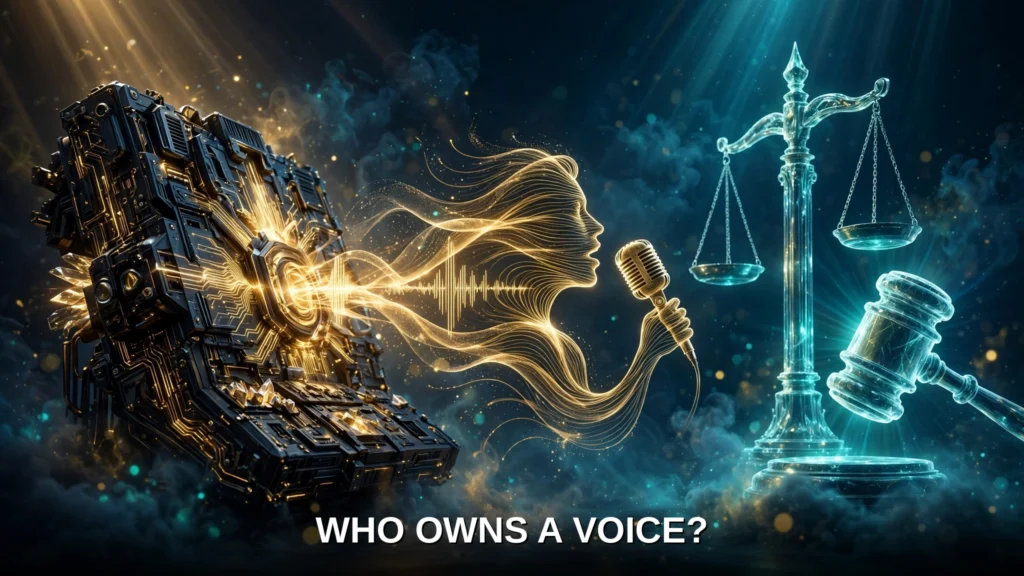
The ELVIS Act and voice cloning

The most novel part of the Presley suit is not the copyright claim but the law it invokes alongside it. The Ensuring Likeness, Voice and Image Security (ELVIS) Act is Tennessee legislation passed in 2024, specifically designed to stop AI companies from cloning singers’ voices. The bill passed the Tennessee House 93 to 0 on 5 March 2024 and the Senate 30 to 0 two days later; Governor Bill Lee signed it on 21 March 2024 as Public Chapter 588, and it took effect on 1 July 2024.
The Act works by treating voice as property. It amended Tennessee’s existing Protection of Personal Rights law to add voice — including simulated voice — to the list of attributes every individual has a property right in. The statute defines voice as:
“Voice” means a sound in a medium that is readily identifiable and attributable to a particular individual, regardless of whether the sound contains the actual voice or a simulation of the voice of the individual.
The test is whether the sound is recognisably someone’s, not whether they recorded it — which is what brings AI voice clones inside the law.
The Act creates three kinds of civil liability. A person is liable for knowingly using someone’s name, photograph, voice or likeness in advertising or fundraising without consent; for publishing, performing, distributing or transmitting a voice or likeness knowing the use was not authorised; and — the provision that matters most for Suno — for distributing or making available an algorithm, software, tool or other technology whose primary purpose or function is producing a particular, identifiable individual’s photograph, voice or likeness without authorisation. Unauthorised voice cloning is also a Class A misdemeanor in Tennessee, carrying up to 11 months and 29 days of incarceration and fines of up to $2,500, on top of civil damages.
That third prong is why the Presley suit is described as one of the first major tests of the law. The ELVIS Act also targets the company that built and distributed the tool that makes the imitation possible. If the claim holds, an AI company cannot answer that its users typed the prompts.
Suno’s legal fight so far
The new suits do not arrive out of nowhere. On 24 June 2024, the Recording Industry Association of America sued Suno and Udio on behalf of Sony Music, Universal Music Group and Warner Records, alleging that both platforms trained their models on copyrighted recordings without licences. The Suno case was filed in the District of Massachusetts, the Udio case in the Southern District of New York, and the Suno complaint’s illustrative sample alone listed 560 copyrighted works. Suno answered by claiming fair use. No federal judge has yet ruled on whether training a music model on copyrighted recordings is fair use.
Since then the industry has started cutting deals instead of finishing the fight. Universal settled with Udio in October 2025 and announced a licensed AI music platform for 2026. Warner settled with Udio in November 2025, and with Suno on 25 November 2025, in a licensing partnership. Sony never settled and is still litigating against both companies; on 18 September 2026, Sony and Universal filed a new complaint against Suno over its earlier training data, on the logic that licensing the future does not settle the past. In the main Suno case, fact discovery was scheduled to close on 30 September 2026 — a date that has now passed — and dispositive motions are not due until 9 April 2027.
The fight is not only American. On 31 July 2026, a German court sided with GEMA, the German music rights organisation, finding infringement involving GEMA’s repertoire and rejecting Suno’s argument that training a model required no licence. And in March 2026, the US Supreme Court declined to hear Thaler v. Perlmutter, leaving in place the rule that a purely machine-generated track is not eligible for copyright protection, because copyright requires a human author.
Suno is also, by now, a large company defending itself with large-company resources. It raised a $250 million Series C at a $2.45 billion valuation in November 2025, and a further $400 million at a reported $5.4 billion valuation in June 2026. Nor are the two new suits its only fresh exposure: it also faces lawsuits from Sony, UMG, Isbell and Reservoir Media, and the same lawyer behind the Presley case sued Anthropic on the Presley owners’ behalf only weeks ago.
What the Suno music lawsuit could mean for AI music
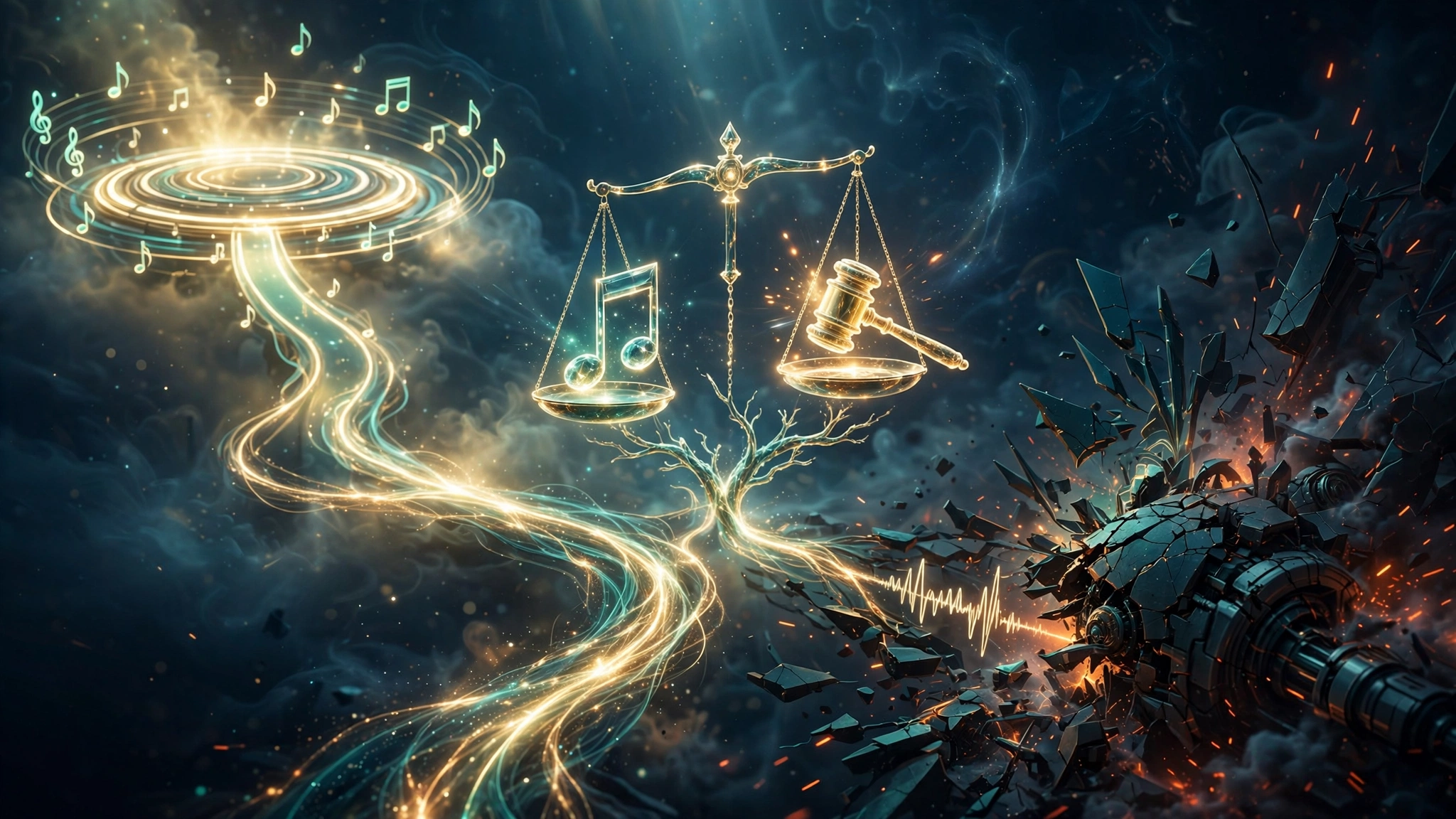
The two suits pull in different directions, and each would change a different part of the AI music business if it succeeded.
A Presley win on the ELVIS Act could establish that a toolmaker, not just the user, can be liable for a voice clone — at least where the tool’s primary purpose or function is producing a particular, identifiable individual’s likeness or voice. That could matter beyond Suno: tools meeting that threshold could face similar exposure, and one possible response would be licensing — paying for the voices a model can imitate — or building guardrails that prevent imitation rather than merely discouraging it in the terms of service. The case is one of the first major tests of whether the Act’s tools provision reaches a general-purpose music generator.
An Eight Mile Style win would show the arithmetic of statutory damages applied to a catalogue. At $150,000 per wilfully infringed work, a publisher with a few hundred songs can credibly ask for tens of millions — as potential maximum exposure, contingent on findings of infringement and willfulness. If the court grants the requested impoundment relief, a win could threaten the model itself, not just the company’s balance sheet.
A Suno win would cut the other way: a ruling that training is fair use, or that the ELVIS Act does not reach a general-purpose music generator, would settle those questions on the facts decided. Even then, the industry’s direction is already visible — Warner and Universal have chosen licensing partnerships over litigation.
For the people who use these tools, the implications are more immediate. Identifiable voice simulations can raise the voice-rights issues described above, and the ELVIS Act can reach qualifying tool providers as well as people making covered unauthorised uses, subject to the respective statutory requirements. Purely AI-generated tracks cannot be copyrighted at all, after the Supreme Court left Thaler in place. Anyone building a business on AI music should treat the legal ground as unsettled until a court, not a settlement, says otherwise.
What happens next
The next step in both cases is Suno’s answer, which has not yet been filed. After that, the questions to watch are concrete: whether the court lets the ELVIS Act claim proceed against a general-purpose music tool rather than a dedicated voice-cloning product; whether Eight Mile Style’s impoundment request survives; whether other artists or rights holders join the fight; and whether the main RIAA case, with its scheduled discovery deadline of 30 September 2026 now passed and motions due in April 2027, produces the first real judicial answer on training and fair use.
Until then, the two suits are allegations, not findings. But they are allegations aimed at two unresolved questions raised by the lawsuits: whether training on other people’s songs without permission is infringement, and whether a company that sells a machine for imitating voices is responsible when the machine does exactly that. The answers could influence other AI music tools with similar training or voice-generation practices, not just Suno’s.