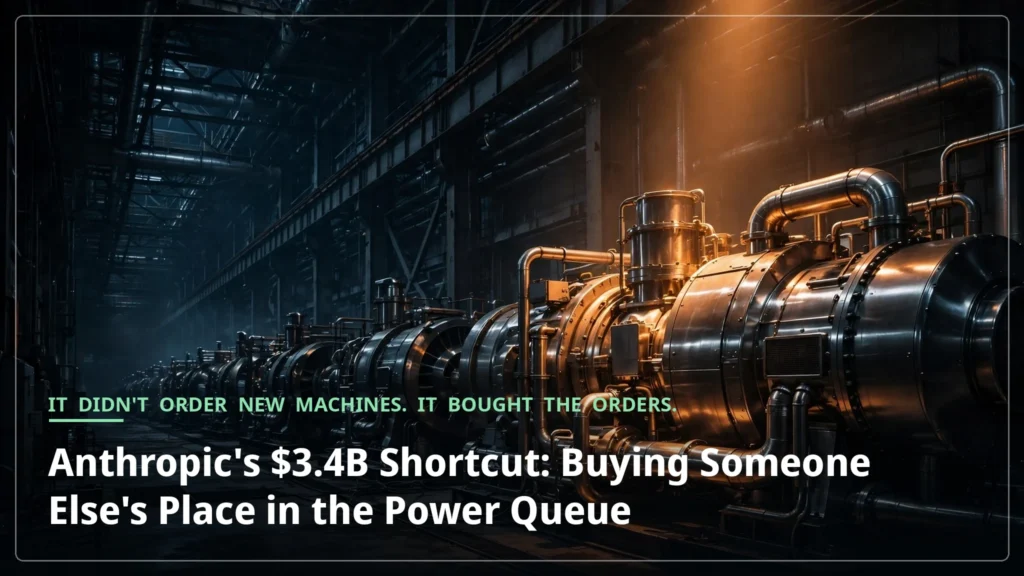



Anthropic has reportedly agreed to pay about $3.4 billion for something it cannot buy off the shelf: time. The Financial Times reported on November 8 that in the Anthropic generator deal, the AI lab took over orders for 1.7 gigawatts of gas-fired generators placed with Caterpillar by OnePWR Solutions, a Texas supplier, about two years ago. The deal, signed in late September, also includes the engineering and construction capacity to install the machines. Anthropic, OnePWR and Caterpillar all declined to comment, and Reuters said it could not independently verify the account — so every figure that follows is reported, not confirmed.
The Anthropic generator deal: the queue is the asset
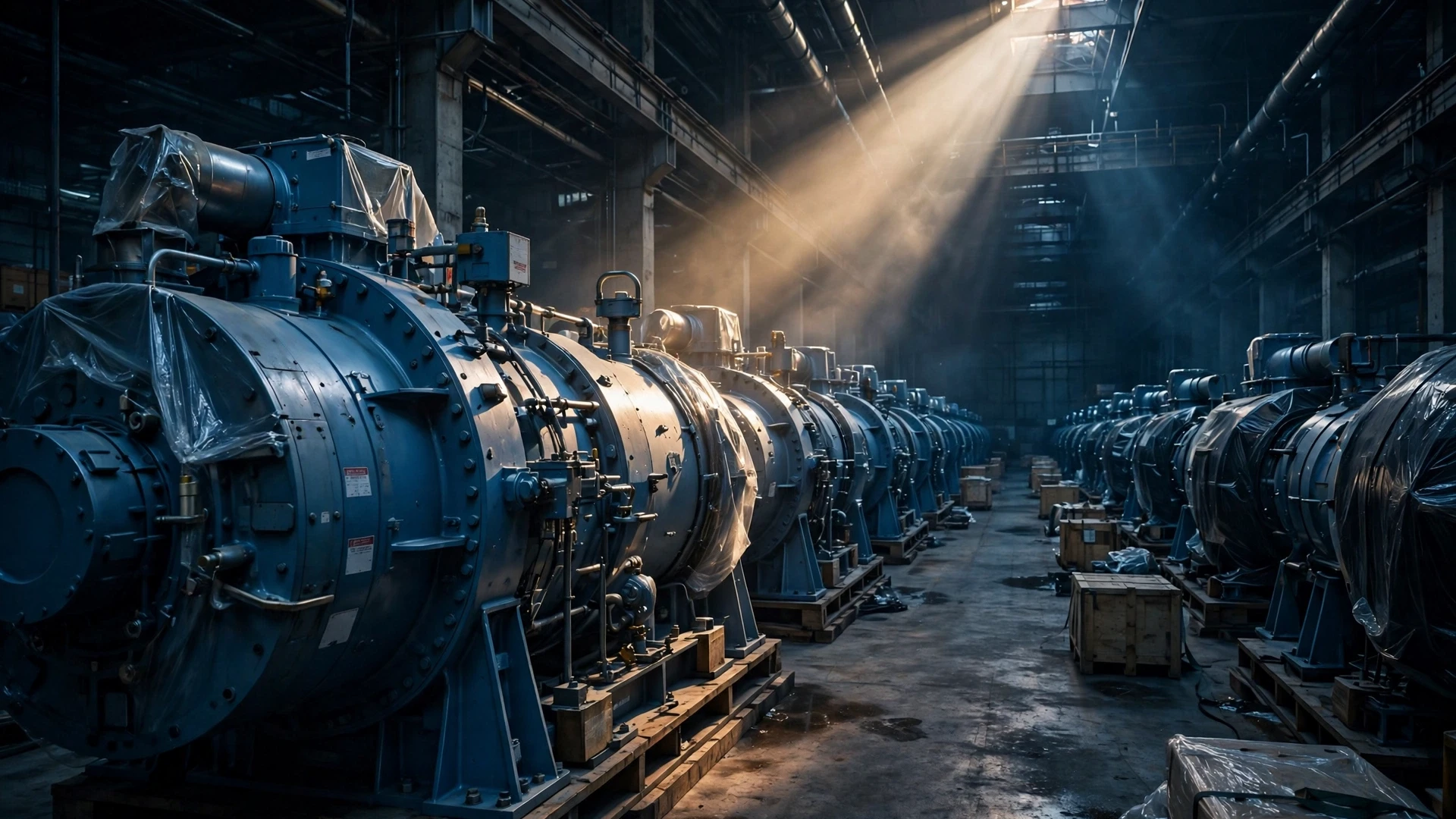
The generators are not new orders. OnePWR placed them with Caterpillar about two years ago and then needed financing to complete the purchase, according to the FT. Anthropic first planned to become a OnePWR customer — to buy electricity from the supplier — and then took over the orders instead. That sequence is the story: the scarce thing was never the generators themselves, but the place in line for them. Orders placed two years ago sit ahead of orders placed today, and lead times for this kind of equipment now run into years.
Anthropic’s own IPO filing says as much. Its Form S-1, filed October 26, warns that generators, turbines, substations and transmission parts “must be ordered years in advance” and have faced extended delivery timelines, price increases, tariffs and rationing as data-center operators compete for them. The filing also says certain planned facilities rely on dedicated on-site natural-gas-fired generation. A separate record points the same way: Piper Sandler lists a $3.4 billion sale of OnePWR’s “power generation platform” to an unnamed frontier AI lab in September 2026. Piper Sandler, which advised OnePWR, does not name the buyer — but the dollar figure and the month match the FT’s account.
The FT called the package the largest known single purchase of power-generation equipment by an AI lab. That is the FT’s characterization, and it rests on the same single-sourced account as the rest of the deal.
A pledge that points the same way
This is not Anthropic’s first move on power. On February 11, the company committed to pay for 100 percent of the grid upgrades needed to connect its data centers, and to bring net-new power generation online to match their electricity needs. “AI companies shouldn’t leave American ratepayers to pick up the tab,” the company said at the time. The February pledge was about who pays for the grid. Whether the reported generator deal is the same promise in hardware form — new capacity arriving with the campus instead of drawing on the grid — is an open question: no site, delivery schedule or commissioning date has been disclosed.
The S-1 makes the exposure plain. Anthropic told investors it bears the fuel cost for the on-site gas generation “on a pass-through basis without cost caps.” The hardware has a price tag; the fuel bill does not have a ceiling. The filing adds that a planned site could be delayed or abandoned if firm gas supply and pipeline transportation cannot be secured, and that it expects more competition for gas wherever on-site generation is allowed.
For scale: the amended S-1 puts Anthropic’s aggregate committed spend at roughly $895.4 billion as of and subsequent to September 30, mostly compute and infrastructure, with about $69.8 billion expected in the following twelve months. Against that, $3.4 billion is a rounding error — which is itself a useful check on the story. This is procurement at scale, not a transformation of the company, and buying generators is what any operator does when the grid is slow. What makes it an editorial story rather than a purchase order is the queue: Anthropic did not order new machines. It bought the orders.
What nobody will say
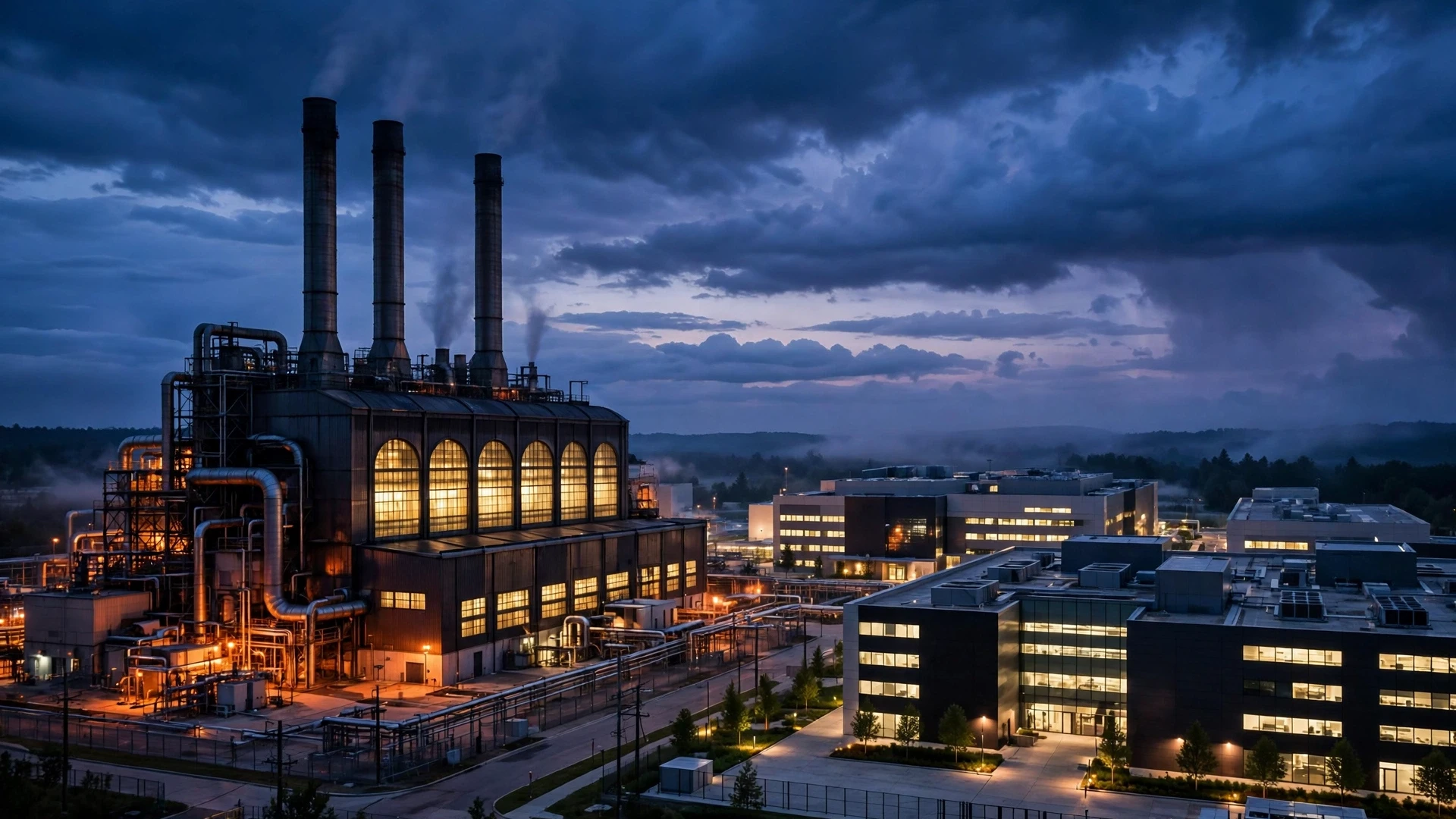
The deal’s shape is reported; its details are not confirmed. No sites have been named, no delivery schedule has been disclosed, and nothing public says who will operate the plants once they are commissioned. The operating question matters: Latitude Media reported in late October on a growing volume of calls from data-center developers who run gas-fired turbines and lack their own operations and maintenance expertise — an anecdotal account that names no firms, but one that fits a field Cleanview estimates has grown from 20 gigawatts of on-site gas projects last summer to 110 gigawatts underway now.
Then there is the permitting. The S-1 says behind-the-meter generation faces a separate set of permitting, air-quality and siting requirements, and that opposition to data-center development has become more organized across jurisdictions. The November 3 elections gave that opposition a number: Latitude Media counted at least 40 local ballot initiatives dealing with reining in data-center development, about half of them in Ohio, with 24 officially approved when the story ran. Texas, where OnePWR is based, accounts for roughly a quarter of planned American data-center development over the next five years. A gas plant adds an air permit to a list that already includes power bills and water.
The questions that stay open
Five questions still have no public answer:
- Where will the generators be installed, and which data centers will they serve?
- What is the delivery schedule, and when does the 1.7 GW come online?
- Who will operate the plants after commissioning?
- What will the fuel bill actually be, given the S-1 says the fuel cost is passed through without caps?
- Does this deal make Anthropic an operator of power generation in its own right, or is it a one-off procurement of equipment and installation capacity?
Until those questions have answers, the deal is best read as exactly what the reporting describes: a reported $3.4 billion for 1.7 gigawatts of generator orders placed two years ago, plus the means to install them. The queue for power hardware is itself what is being bought — and the queue, unlike the generators, is not something you can manufacture.