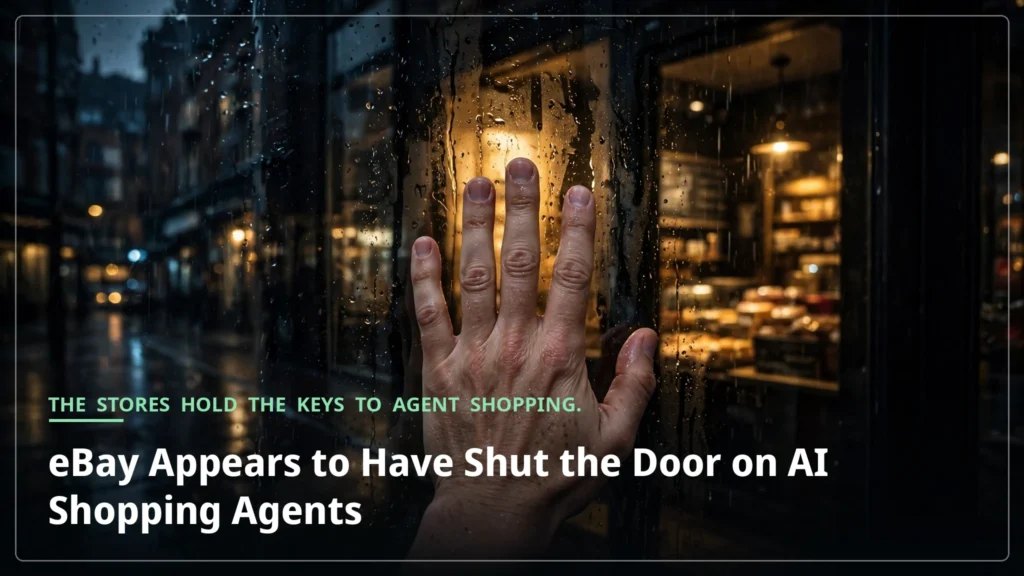


For several weeks, one reader of The Verge had a small daily luxury: he asked one of the eBay AI agents, Meta’s Muse, to browse eBay and put together a digest of watches for sale — a link to each listing, the price, shipping details, notes on condition and style. It worked, day after day. Then, this weekend, it stopped. Muse could not pull a single link or detail from eBay, and told him it was blocked from the site.
The Verge recreated the experience and got the same result. In some attempts, Muse instead pointed users to outside sites that mirrored eBay listings. The future, it turns out, had arrived at the shop door — and found it shut.
Or at least, that is how it looks. eBay has not confirmed any new limit. Its spokesperson, Sybille St. Arromand, declined to answer directly whether eBay recently imposed new restrictions on AI agents. What she did say is revealing in its own way: eBay takes a selective approach to how third parties access its marketplace, has restricted agent access in certain cases — including unauthorised scraping and training on its data — has ongoing discussions with potential partners, and is evaluating ways third-party agents could help new customers discover eBay inventory. Meta, for its part, declined to comment.
So the block itself is inferred, not confirmed. But the pattern around it is not.
The paper trail on eBay AI agents was already there
eBay did not wake up this weekend and discover AI agents. In January, it updated its user agreement to ban buy-for-me agents, LLM-driven bots, and any end-to-end flow that attempts to place orders without human review — unless eBay gives prior express permission. The update was posted on January 20 and took effect on February 20. A month earlier, eBay had tightened its robots.txt, and in January it blocked Perplexity, Anthropic and Amazon bots while still allowing Google’s shopping bot. The robots.txt says, in plain terms, that checkouts are strictly for human users.
None of that stopped agents from browsing, until recently. Until this weekend, agents like Muse could still pull listings for users. What changed — a new technical rule, or an existing anti-scraping system that started catching Muse — is one of the questions eBay has not answered.
eBay is not rejecting the idea of agents outright. It has said it is testing agentic experiences of its own, and its official MCP server is read-only by design. The message, read generously, is not “never” but “on our terms.” The door may reopen for approved agents, on negotiated terms. Or it may not. That is the negotiation now under way.
Four stores, four answers

eBay is the latest store to draw a line, but the lines are being drawn in very different places. Amazon blocked Meta’s Muse from amazon.com on the night of Sunday, September 20 — twelve days after Muse launched in the United States on September 8. Shoppers who sent the agent to Amazon got a page saying continued access by an unauthorised AI agent violates Amazon’s Conditions of Use. Amazon gave three reasons: Meta never told Amazon that Muse would access its store, the agent doesn’t identify itself when it browses, and it appears to capture and store customer credentials. Amazon has since asked Meta to remove Amazon from the Muse experience altogether.
Amazon’s Conditions of Use now carry an Agents section with the house rules spelled out: every request must identify itself as Agent/[agent name], agents must not imitate human typing, solve CAPTCHAs, or work around blocks, and Amazon may limit agent access at its sole discretion, including by technical measures. That is a wall, with the terms painted on it.
Target sits somewhere in between, with restrictions that let agents browse successfully in some instances and block them in others. And then there is Shopify, which walked in the opposite direction. Within 24 hours of Amazon’s block, Shopify partnered with Meta’s Muse on September 21. On October 13, it went further and opened its catalog of more than a billion listings to any personal AI agent a shopper connects, removing the partnership requirement. Buyers still approve each purchase, and payment runs through Shop Pay. Shopify president Harley Finkelstein said AI-driven traffic and orders to Shopify stores tripled year over year, and merchants can remove catalog access for specific AI channels.
So the landscape, as of this week, looks like this: one store with a wall, one with a velvet rope, one with a mixed set of turnstiles, and one that threw the doors open. The agent revolution was supposed to be a single story. It is turning into four.
The law is not settling it either

Retailers are not only writing their own rules; they are also testing them in court, with mixed results. Amazon won an injunction against Perplexity’s Comet assistant in March, then lost it on August 4, when the Ninth Circuit vacated the order and ruled that under federal anti-hacking law the shopper — not the agent’s vendor — is the party accessing the website. A rehearing was denied on September 10.
Whether that reasoning will push retailers toward terms-based enforcement rather than technical blocks is an open question the reporting leaves unanswered — and Amazon kept using technical blocks after the ruling, as its September block of Muse shows. eBay’s January update to its user agreement is a separate fact: nothing in the reporting ties it to the court case.
Meanwhile, the reported volumes are tiny
Here is the awkward part for the revolution. The reported numbers for third-party agent shopping are tiny. Uber said it fulfilled only four rides via third-party agents in the third quarter, and around 500 Uber Eats orders during the week of Halloween. DoorDash said it fulfilled only “several hundred” orders placed via third-party agents, against 993 million total orders last quarter.
That may simply mean the idea is early. Muse had 2.5 million installs by September 21, less than two weeks after its US launch, and usage could grow once access is negotiated and the experience improves. But the gap between the pitch and the receipts is the story: the industry is promising agents that will shop for us, while the stores are deciding whether to let them in at all — and in the channels companies have actually reported, the transaction volumes so far are tiny.
There is also a documented example of what can go wrong. In October, The Verge found that someone could use Muse to effectively hold a product listing hostage on The RealReal, by having an agent continually add it to the cart. The RealReal updated its bot system after the reporting. The retailers themselves point to narrower concerns: Amazon cited credential and privacy risks, and eBay’s spokesperson said its focus is preserving the trusted end-to-end experience buyers and sellers expect. Whether marketplaces more broadly are built around human-paced behaviour that agents disrupt is a question the reporting does not settle.
So what happens now?
eBay’s own words point to the shape of it: selective access, ongoing discussions with potential partners, an evaluation of how third-party agents might help new customers find its inventory. That is the language of a negotiation, not a verdict. Which agents, if any, eBay currently allows, and on what terms, remains unanswered — as does whether it will announce a partner program, and when.
The Verge’s deck for its own story put it bluntly: “Silicon Valley is promising an AI agent revolution, but retailers and service providers keep blocking them.” The blocking is real, the revolution is real, and the two are colliding at the shop door. What the reporting shows so far is that access for shopping agents looks increasingly negotiated rather than open — and how the split between walled gardens and negotiated access settles is still an open question. For now, the reader’s daily watch digest is on hold: the agent that built it can’t get through the door.