
On Tuesday, OpenAI rolled out a set of tools that lets businesses plant a flag inside ChatGPT: a verified profile, an agent that answers customer questions, and a dashboard showing how users find them. The bundle, called Businesses in ChatGPT and managed through a Business Hub, is in beta — and it looks strikingly familiar. The profiles greatly resemble the ones Google and other search engines have offered businesses for years, and the analytics call to mind Google Analytics. That resemblance is the story.
What Business Hub gives businesses

Any eligible business where ChatGPT is available can claim a profile and, once verified, correct its details. The claimed profile carries a blue check. Retailers can also add self-service product feeds with pricing and availability, so the information ChatGPT gives about them stays current.
Eligible companies can also build a Business Agent, which lets ChatGPT users ask questions about the business and its products. Agents are initially limited to eligible ecommerce and online-service businesses in the United States. A customer has to choose to start the conversation from the business’s profile, and OpenAI says that exchange stays separate from ChatGPT’s own answer.
Then there is the dashboard. Business Hub reports aggregated mentions, impressions and website clicks, plus “discovery topics” — the common themes of conversations in which ChatGPT cites the company’s website — covering the past 28 days. What businesses do not get is the conversations themselves: OpenAI says firms see only aggregated figures, not individual chats.
Before any of that, there is verification. Businesses must prove they are authorised to manage the profile through a formal process, and OpenAI requires approved identity verification through Persona before a business can publish changes, view insights or create an agent. OpenAI reviews changes before they go live. What the company has not said is exactly how verification works — at Monday’s press briefing, Benji Shomair, OpenAI’s VP of Monetization, would only say there are “multiple verification methods that we use for different types of business in different markets.”
The checkout that came before it
This is not OpenAI’s first attempt to make money from what people buy through ChatGPT. In September 2025 it launched Instant Checkout alongside the Agentic Commerce Protocol, a standard built with Stripe, letting shoppers buy without leaving the chat. The pitch was a commission on every sale.
It lasted about six months. In March 2026, OpenAI stepped back: the first version of Instant Checkout, it said, “did not offer the level of flexibility that we aspire to provide,” so merchants would use their own checkouts “while we focus our efforts on product discovery.” The transaction went back to the merchant’s site. What stayed in ChatGPT was the discovery — the browsing and comparing that happens before anyone pays. That failure, though, does not prove the transaction model itself is exhausted — it may have been a matter of timing or execution, and a later commerce attempt in a different form remains possible.
That history matters, because the Business Hub is built on the half of the transaction OpenAI kept.
The conversation is the product now

Listen to how OpenAI describes the launch: “As people turn to AI to discover products, compare options and make decisions, ChatGPT has become the platform for people and businesses to connect through AI. Today’s announcement is an early step in bringing businesses more deeply into ChatGPT.”
Note the words. Not buy. Discover, compare, decide. The person making the case to journalists on Monday was Shomair, the VP of Monetization — which suggests, without proving, that this is a revenue strategy as much as a product feature.
Read that way, the Business Hub looks like a change of plan: rather than taking a cut when a ChatGPT user buys, OpenAI is giving businesses the tools to be found and questioned in the conversation where the buying decision gets made. The sale happens elsewhere. The decision — the moment a shopper asks which one, why this one, what it costs — happens in ChatGPT, and now the business gets a verified voice in it, plus a count of how often it comes up.
That is the mechanism. It is also, for now, only a mechanism — not a business model.
What is still missing
Start with the money. The new tools are free for now, and OpenAI has said nothing about what businesses will eventually pay for — the profiles, the agent, the analytics, or placement in answers. OpenAI did introduce Sponsored Agents in September, letting people who click an ad in ChatGPT start a conversation with the business behind it, so paid business conversations already exist in the product. But the Business Hub itself arrives without a price tag.
Then there is the question of influence. Claiming a profile does not guarantee higher placement or more sales, OpenAI says, and ChatGPT keeps making its own independent recommendations. That is a promise, not a mechanism — and the verification process that decides who gets a blue check remains largely undisclosed.
And there is the simplest objection of all: this may be feature parity, not a strategy. Any platform that lists businesses offers profiles and analytics, and Google’s version works because Google is where search happens. ChatGPT’s discovery volume is unproven — OpenAI says the service reaches 1.2 billion people a week (figure as of September 29, 2026), but that is a headcount, not a count of shoppers. Whether people actually discover products in ChatGPT in numbers that make these profiles valuable is the open question the whole bet rests on.
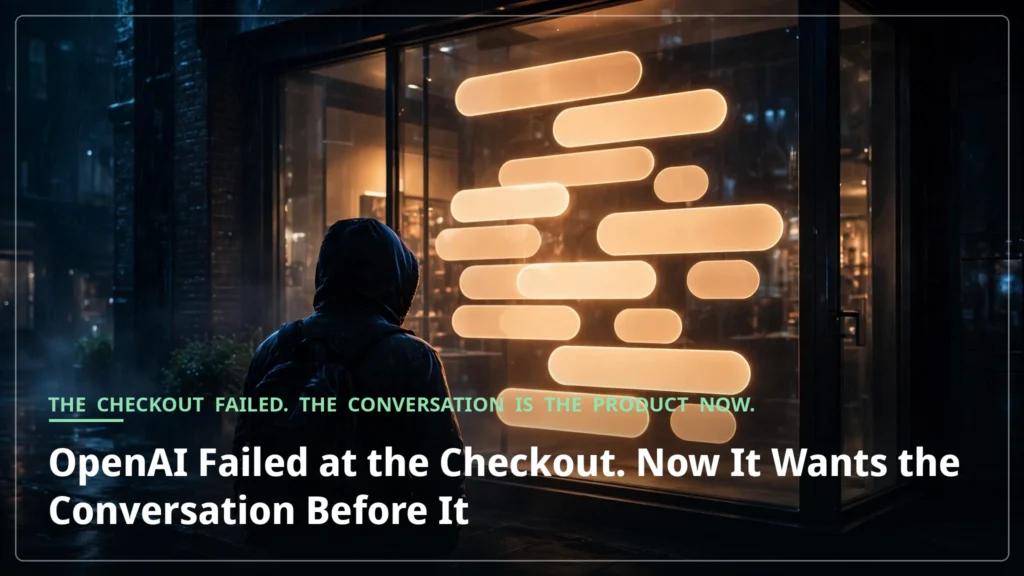
So the shape of the thing is clear, and the value of it is not. OpenAI tried to own the sale inside ChatGPT and that failed; what it is building now is a stake in the conversation that happens before the sale. Whether that stake becomes revenue — and on what terms — is still unanswered. The checkout, in its first form, is gone. The conversation is the product now. What it is worth is the next thing to find out.