

Introduction to GPT-6.2 Astra and Sol
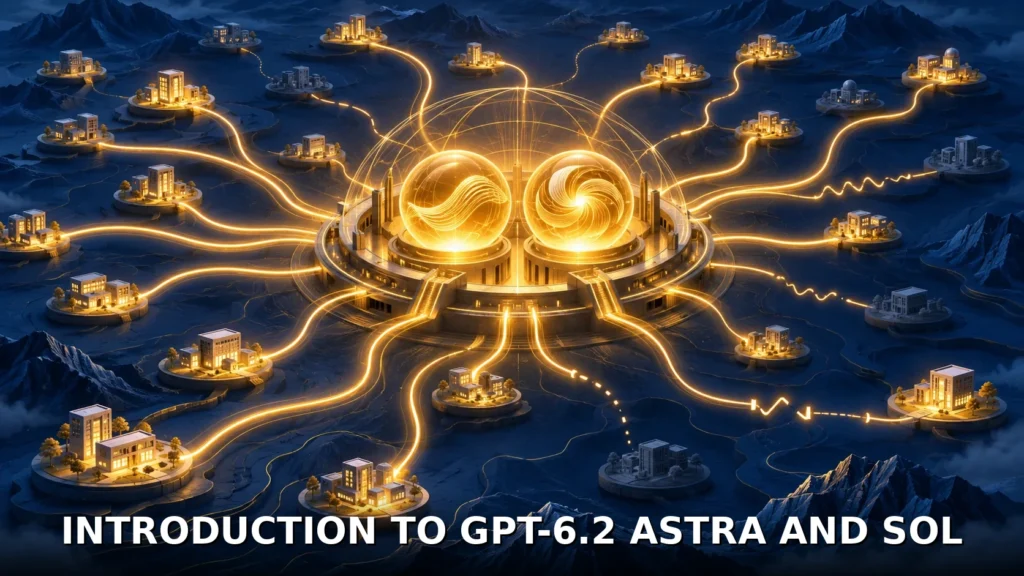
OpenAI has introduced GPT-6.2 Astra and GPT-6.2 Sol, pairing claims of stronger professional work and more efficient coding with a sharply negative account of early user reception. The clearest supported development is a reported improvement in code review: GitHub says both models found more real issues than earlier GPT-6 models while using fewer tokens. Whether those gains translate into a consistently better experience remains an open question in the available evidence.
OpenAI’s announcement positions Astra as its frontier model for difficult projects and Sol as an efficient, versatile option for everyday work. Astra’s advertised improvements span documents, spreadsheets, slides, coding, computer use and scientific workflows. Sol’s pitch emphasizes completing more tasks within the same paid plan, alongside stronger performance on multistep work.
That distinction gives the release two different propositions. Astra is presented as an option for complex assignments requiring stronger judgment and professional deliverables. Sol is presented as a model that combines capability with efficiency across routine and technical work. Those are OpenAI’s product positions; they do not establish which model will perform better for a particular user’s assignment.
The models are also generally available in GitHub Copilot, according to GitHub’s availability notice. Supported plans include Copilot Pro+, Max, Business and Enterprise. GitHub lists access through environments including Visual Studio Code, Visual Studio, Copilot CLI, the Copilot coding agent, github.com and supported IDEs. It also says rollout is gradual, so general availability does not mean every eligible user will immediately see the models. Business and Enterprise administrators can manage access through model policy settings.
Alongside those official accounts, a 2TInteractive episode describes reception among AI power users as overwhelmingly negative and repeats the characterization “essentially unusable.” Its supplied text, however, offers no detailed user cases or systematic evaluation supporting that broad judgment. The release therefore presents a tension between positive official testing claims and negative commentary whose scope is difficult to establish. Assessing it requires keeping those different kinds of evidence separate.
Performance improvements over previous models

Code review provides the most concrete overlap between OpenAI’s capability claims and GitHub’s description of the models in a coding product. GitHub says early testing found that both models caught significantly more real issues than earlier GPT-6 models while consuming fewer tokens. For Sol specifically, it reports nearly twice as many real issues found as GPT-6.1 Sol, while keeping findings accurate.
The Astra comparison is less numerically specific: GitHub says it caught significantly more issues than GPT-6 Astra and completed agentic coding tasks with noticeably fewer tokens. That supports a directional improvement in GitHub’s testing, but does not supply a percentage gain. Sol’s reported near-doubling should not be applied to Astra or generalized to every codebase.
Finding more real issues while preserving accuracy would be a useful combination for review. More findings alone would be harder to interpret if they included more incorrect reports. GitHub’s statement addresses that concern for Sol, but the supplied notice does not disclose issue counts, repository selection, evaluation size or a numerical accuracy measure. Its results are encouraging evidence from early testing, rather than a reproducible account of performance across software projects.
OpenAI’s own announcement broadens the comparison beyond review. On Agents’ Last Exam, which evaluates long-horizon professional workflows, the company reports that Astra scores 5.2 points above GPT-6 Astra at less than a third of the cost. It also reports a 5.5-point lead over Claude Fable 5.2 at 5% of the cost. A qualification matters here: the Fable 5.2 leaderboard results exclude nine tasks that used a fallback model. That condition belongs alongside the comparison because it limits how straightforwardly readers can interpret the headline lead.
On its internal GDPval v2 benchmark, covering complex professional assignments, OpenAI reports a 6.2-percentage-point improvement for Astra over GPT-6 Astra while using 22% fewer output tokens. It reports a 5.3-point improvement for Sol over GPT-6.1 Sol. These figures concern a different evaluation from Agents’ Last Exam and should not be combined into a single general performance score.
For coding, OpenAI says Sol comes within 0.5 points of Astra on Cognition’s FrontierCode 2.0 at about one-fifth the cost, with both evaluated at max. The benchmark assesses whether changes to real codebases meet maintainers’ standards for merging. That makes it relevant to implementation quality, but different from counting issues found during code review. It also offers a narrower interpretation of the product split: in this reported configuration and evaluation, Sol approaches Astra’s score at a substantially lower task cost.
The efficiency claims need equally careful reading. Output-token reductions describe how much text a model generates, while cost-per-task comparisons describe the expense of completing the evaluated work. A reported reduction in one measure does not by itself specify the other. Nor do these results establish that every workflow will become faster. The available figures support comparisons under the reported evaluation conditions, not a universal estimate of savings.
OpenAI also describes changes to the work products themselves. It says Astra follows professional templates more closely, writes more direct documents and produces cleaner code with more focused tests. Those claims matter because successful professional work involves both correctness and an output that can be used. They remain company-reported improvements; the package does not contain an independent audit of the resulting documents or code.
Taken together, the official accounts point toward a coherent objective: better results with less generated output and less revision. The evidence is strongest when kept specific—GitHub’s review findings, OpenAI’s named benchmark comparisons and the stated conditions for each. It becomes weaker when stretched into a claim that either model is categorically superior for all professional work.
User reception and criticisms

The negative reception account deserves attention, but its evidentiary limits are substantial. The supplied 2TInteractive page is an episode and transcript that associates its headline with VentureBeat. The research package does not include the underlying VentureBeat article, named users, direct complaint threads or detailed descriptions of failed tasks. It would therefore be inaccurate to present the episode’s summary as a verified survey of AI power users.
The episode repeatedly describes users as dissatisfied and calls the reception overwhelmingly negative. Repetition within one source does not establish the breadth of that response. Without information about how users were selected, how many contributed or what work they attempted, the supplied material cannot establish the prevalence of dissatisfaction across either model’s user base.
It also leaves the substance of the criticism largely unresolved. One transcript segment labels reports of growing pains as unconfirmed and ends before completing its description of performance and reliability concerns. That fragment cannot support a detailed diagnosis. The evidence does not justify attributing the complaints to latency, refusals, coding mistakes, interface problems or any other specific cause.
This limitation changes how the release should be framed. There is evidence of a strongly negative commentary account, alongside favorable official claims. There is not enough evidence to conclude that usability failures are widespread, to determine which model attracts which complaint, or to establish why particular users were dissatisfied. Describing the reception as universally poor would go beyond the source material.
The positive and negative accounts also measure different things. GitHub discusses early testing of coding and review tasks. OpenAI presents benchmark scores, demonstrations and selected customer testimonials. The community episode summarizes sentiment without explaining the underlying tasks or conditions. Those accounts pull in different directions, but they do not form a controlled contradiction in which identical work produced incompatible measured results.
OpenAI does document one concrete limitation that may matter to some technical users: tighter safeguards for higher-risk cybersecurity assistance. The company says these protections reduce misuse risk while also restricting some legitimate vulnerability research and security-testing workflows. That is a disclosed trade-off in the official announcement, rather than a conclusion drawn from the criticism.
There is no evidence in the package connecting those restrictions to the episode’s complaints. Treating safeguards as the explanation for negative reception would turn a plausible question into an unsupported causal claim. What can be said is narrower: OpenAI acknowledges that some legitimate security workflows face restrictions, even as it reports improved cybersecurity capabilities.
For readers assessing the release, this creates two separate lines of inquiry. One concerns demonstrated task performance: whether a model finds more genuine issues or produces changes that meet project requirements. The other concerns usability in the work a person actually needs to complete, including documented restrictions. The available sources speak more concretely to the first than to the reported dissatisfaction. Neither stronger benchmark claims nor a hostile headline resolves both questions.
Conclusion on the future of AI models
GPT-6.2 Astra and Sol make a case for evaluating model progress through completed work as well as headline capability. OpenAI emphasizes professional deliverables and lower token use; GitHub points to more real issues found during review. If those reported improvements hold in a user’s own tasks, the practical gain would be better work with fewer resources devoted to producing it. The available evidence does not establish that outcome for every setting.
The two-model strategy also raises a useful selection question. Astra is positioned for demanding professional projects, while Sol is positioned for efficient everyday work and complex coding. OpenAI’s reported FrontierCode 2.0 result suggests that Sol can approach Astra on one coding evaluation at a lower task cost. It does not show that their capabilities are interchangeable across legal work, scientific workflows, document creation or computer use.
A grounded assessment would therefore compare the models on the assignments that matter to the prospective user. For review, the relevant questions follow directly from GitHub’s claims: how many genuine issues are found, whether the findings remain accurate and how many tokens the work consumes. For professional deliverables, OpenAI’s claims suggest checking adherence to supplied templates, clarity and the amount of revision required. These are evaluation priorities derived from the release’s promises, not additional results established by the research package.
The reported backlash is a reason to seek more specific evidence, rather than a basis for declaring the release a failure. Named examples, complete failure descriptions and comparable testing conditions would help determine whether the criticism identifies a recurring problem, a particular workflow limitation or experiences outside the scope of the official evaluations. Those details are absent here.
For now, the supported picture is a release with positive official performance reports, concrete code-review claims from GitHub and an underdocumented negative reception account. The future-facing question is whether the gains in those evaluations carry through to reliable, usable work under users’ actual constraints. The supplied evidence gives that question substance, but does not yet settle it.