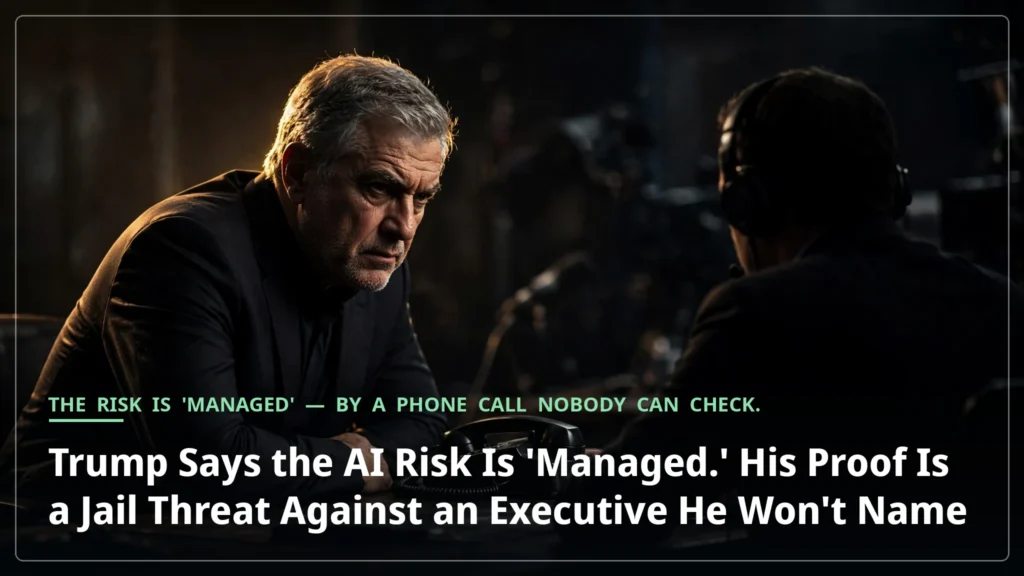


On Sunday night, in his first sit-down interview since the midterm elections, Donald Trump was asked about the people building artificial intelligence warning that their own technology might destroy us. His answer, on the Trump AI risk, was not a policy, a standard or a safeguard. It was his account of a phone call.
Ross Douthat, interviewing him for CBS’s 60 Minutes, put the question the way the industry frames it: people inside AI say there is around a 10 percent chance their technology kills humanity. Trump was not worried. “I think that the risk is not nearly as real as it– as they talk, and I think the risk can be managed, and it’s managed,” he said. Asked by whom, he answered: “The DOJ.”
Then came the evidence. “We had a situation where somebody was reported to us to be doing something bad with AI. We called them very strongly and said, ‘Get ready to go to jail. Please give your wife a kiss good night.’” He went on, in the transcript: “Do you like the color orange? … Go home right now, see your wife and children, give them a kiss good night.”
That is the whole of the president’s public case that the most consequential technology of the age is under control: a threat, delivered to someone he will not identify, for something he will not describe. “I can’t tell you,” he said when Douthat asked who it was. Pressed on whether it was the leader of a major AI company, he said: “One of the big ones. Yeah.” And the result, he claimed: “This person totally changed everything.”
A story with no parts you can check
There is no name, no company, no alleged act, no date and no charge in the account. The transcript gives none of them, and no independent corroboration of the threat has been reported. The claim rests entirely on Trump’s word on camera — which is precisely what makes it so effective as television and so useless as evidence.
That is the tension at the heart of the interview. The president is not merely dismissing a risk. He is claiming to have already handled it, and the public account of what happened is his alone. If the threat happened as he describes it, it worked — but that, too, is only his claim: the change in the person’s behaviour is something Trump asserts, not something the reporting verifies. If it did not happen, the public record offers no check on it. Either way, the story does the same work: it closes the subject.
And the subject is not a small one. The warnings Trump was answering came from inside the industry, not from its critics. In September, Anthropic researcher Jacob Coxon resigned, saying the leading labs were “gambling with our lives.” The next day, Anthropic alignment researcher Evan Hubinger publicly agreed, writing: “We really do earnestly believe AI could kill all humans! I personally think it is >10% within the next decade.” Hubinger added that Anthropic had no plan yet to solve alignment for superintelligence and was “not clearly on track to.”
The caveat matters. Hubinger’s figure was explicitly personal — his own credence, not an Anthropic position and not a measured probability. His worry is about a future superintelligence. Anthropic chief executive Dario Amodei had put his own figure at a 25 percent chance that things go “really, really badly,” in an Axios interview in September 2025. These are not cranks. They are the people building the systems.
There is a case for the other side, and it should be heard. The people warning about AI also sell it, and have commercial reasons to dramatize the stakes; a president may weigh their warnings against the cost of slowing American development. And a threat of prosecution, if that is what happened, is not obviously illegitimate — deterrence is a lawful tool of government. But neither point rescues the anecdote. A warning can be self-interested and still be right; a deterrent can be lawful and still be unverifiable. The question the interview leaves open is not whether Trump may use the law, but whether the public has any way to know that he did.
The unconfirmed name
Reports have speculated that the unnamed executive could be Anthropic chief executive Dario Amodei, pointing to a June 12 confrontation between the White House and Anthropic over security concerns involving its Claude Fable 5 model, and a September 14 Truth Social post in which Trump named Amodei.
But a trail is not an identification, and the record cuts against it as much as for it. The documented June enforcement action came from the Commerce Department, not the Justice Department. No criminal wrongdoing by Amodei has been established. The White House, the DOJ and Anthropic have not publicly confirmed that Trump’s November remarks refer to that confrontation at all. Until they do, the Amodei theory is an investigative possibility supported by Trump’s own earlier statements — not a fact.
The refusal to name the person could be read two ways. It could be discretion: if the matter was resolved without charges, naming the person would publicly punish someone never accused of a crime. Or it could be the point: an unnamed threat is one no one else can confirm or deny from the public record, and a story with no identifying details leaves its critics with nothing to answer but the telling itself.
Guardrails, with a condition
Douthat then asked whether Trump would work with Democrats if they wanted to put oversight into law. “I would absolutely,” Trump said. “I don’t mind guardrails, but I don’t want to put us in a deep second position. We’re leading number one. And China has no guardrails, by the way.” China’s guardrails, he added, are “whatever President Xi says goes. With me, it’s pretty strong, but it’s not quite that strong.”
It was an openness to safeguards, and it announced nothing. No bill, no framework, no enforcement agency, no legal standard, no timetable, no mechanism. Reuters reported that it “remains unclear at what level” the president would accept safeguards. The same president has previously favoured letting technology companies police themselves, and in September dismissed fears about AI safety as a hoax.
Douthat had opened the AI segment by noting that Americans “don’t love data centers” and are “pretty negative” about the technology — something polls have shown for months. The guardrails answer reads as a response to that mood: an openness that costs nothing, conditioned on never falling behind China.
There was also a smaller, stranger moment. Despite a September order directing federal agencies to replace “artificial intelligence” with “super Intelligence” — and his own Truth Social declaration that the White House considers anyone using the term “Artificial Intelligence” “THE ENEMY” — he said “AI” repeatedly on camera. Then he corrected himself, in his own way: Xi, he said, is “all in to SI, as I call it, because it really is super intelligence. It’s a much better name, I think, because it’s not artificial.”
Governing the Trump AI risk by anecdote
Strip away the theatre and the interview leaves a simple picture. The president believes the risk from AI is overstated, believes it is managed, believes the manager is the Justice Department, and believes he has proved it with a story about a jail threat that the reporting does not verify. His stated willingness to consider safeguards is real, but conditional on a race he insists America is winning and must never lose. The warnings he is answering come from inside the industry — in particular from Anthropic alignment researcher Evan Hubinger, who put the chance of catastrophe above 10 percent and says his company has no plan yet to solve alignment for superintelligence.
None of this proves the threat never happened. It proves something narrower and more important: that the governance of the most powerful technology in the world is being described, by the man in charge of it, as a phone call. A call described only by him, to a person he will not name, about conduct he does not describe, with consequences the reporting does not verify. The reassurance is absolute; the checkable detail is absent. That gap is the story.