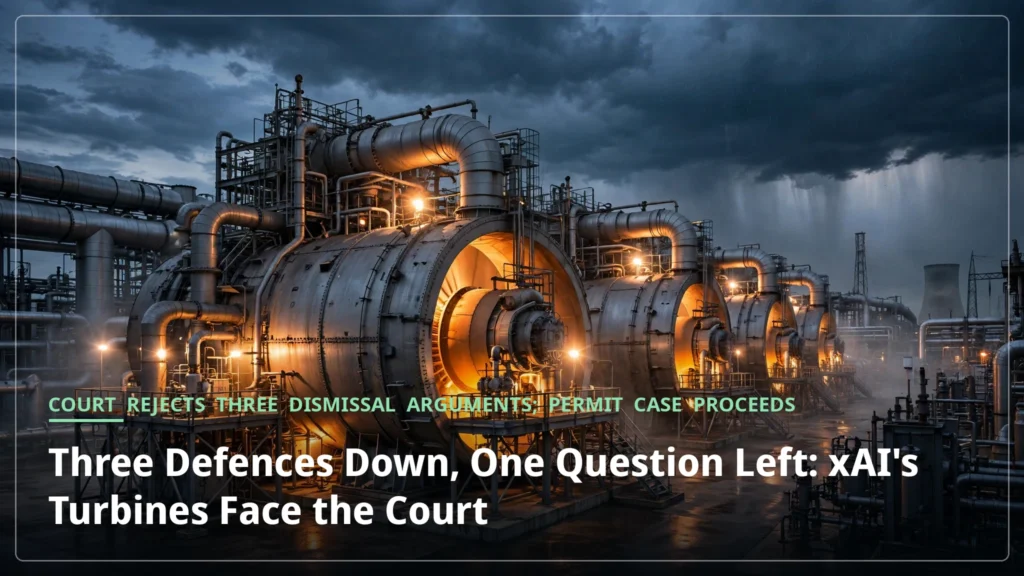



On October 30, 2026, a federal judge in Mississippi did something that sounds procedural and turns out to be anything but. Judge Debra M. Brown, of the United States District Court for the Northern District of Mississippi, denied a motion by X.AI Corp. and MZX Tech LLC to dismiss the xAI gas turbines lawsuit brought by the NAACP and the Mississippi State Conference of the NAACP under the Clean Air Act. The case will proceed.
That single word — proceed — is the whole story for now. It does not mean the companies broke the law. It means the court refused to throw the case out before the central question could be heard: whether a gas-fired power plant built to feed an artificial intelligence data center operated without the air permits the law requires.
The plant sits in Southaven, in DeSoto County, Mississippi, and, according to the court’s opinion, supplies power to the Colossus 2 data center in Whitehaven, Memphis, Tennessee. The plaintiffs filed their complaint on April 14, 2026, alleging that the companies constructed and operated the plant, which they call the Colossus Gas Plant, without a permit, in violation of the Clean Air Act and Mississippi’s State Implementation Plan.
The ruling, in plain terms
Judge Brown’s reasoning is stated in a single, compact sentence: “Because the plaintiffs have statutory standing under the Clean Air Act, because the combustion turbines are not ‘mobile sources’ under Mississippi’s State Implementation Plan, and because the citizen suit provision does not violate Article II of the Constitution or the private nondelegation doctrine, the plaintiffs’ claims will proceed.” Each clause answers one of the three dismissal arguments — a defence built from three separate doors, each of which the court closed.
Three doors, all closed in the xAI gas turbines lawsuit

The first door was the mobile-source exemption. The companies argued that the turbines were exempt from permitting because they are mobile. The history, as recounted in the opinion: in July 2025, an X.AI vice president of operations told the Mississippi Department of Environmental Quality of the plan to build energy resources at the site using combustion turbines. The department responded on July 29 that the turbines would be “mobile” because each would remain affixed to a portable unit — a flatbed trailer — and “temporary” because each was intended to remain on site for less than twelve months, and, contingent on those criteria remaining valid, acknowledged them as exempt. The court did not accept that the turbines qualify as mobile sources under Mississippi’s plan, removing the exemption on which the plant’s permitting position rested.
The second door was standing. The companies argued that the plaintiffs lacked statutory standing under the Clean Air Act. The court held that the plaintiffs have statutory standing.
The third door was the most sweeping: that the Clean Air Act’s citizen suit provision itself is unconstitutional, violating Article II and the private nondelegation doctrine. The judge’s reasoning here has consequences beyond this one plant. As quoted in the decision, “Because citizen suit plaintiffs sue on their own behalf, in their own name, and seek penalties that redress harm to themselves, they are not exercising the federal government’s executive power.” A private party suing for harm to itself is not seizing the government’s job — and that preserves the citizen suit as a tool for the next community that tries to use it.
What the ruling does not decide
It is worth being precise about what has not happened. A motion to dismiss under Rule 12(b)(6) tests whether a complaint states a claim on which relief can be granted. Denying the motion is therefore a threshold ruling, not a finding that X.AI or MZX Tech violated the Clean Air Act. The turbines’ permit status remains unproven, the companies may still prevail on the merits, and the case could still end in settlement or further procedural rulings before any trial.
That distinction matters because the plaintiffs’ allegations are serious and still, at this stage, allegations. The complaint alleges that the companies constructed and operated the plant without the required air permits. Those are claims in a complaint, not findings of a court, and they should stay labeled as such until a court says otherwise.
The numbers, and a gap in them
The exact turbine count depends on which document and which date you use. The complaint, as summarized in the opinion, states that as of April 7, 2026, there were at least twenty-seven gas-fired combustion turbines on site, with a combined capacity of at least 495 megawatts and potential annual emissions of approximately 1,700 tons of nitrogen oxides, 19 tons of formaldehyde, 580 tons of carbon monoxide, and 180 tons of fine particulate matter.
The Southern Environmental Law Center, which represents the plaintiffs, has more recently alleged at least thirty-five combustion turbines, and its October 20, 2026 press release states the plant is able to emit over 5,000 tons of nitrogen oxides, more than 400 tons of fine particulate matter, and more than 47 tons of formaldehyde each year. The sources do not reconcile the two sets of figures; they may reflect different dates, different counting bases, or an expanded plant — a question the case itself may eventually answer, not one to paper over.
What the plaintiffs seek gives a sense of the stakes: a declaration of violation, an injunction against operating the plant except in accordance with the Act, best available control technology, steps to remedy, mitigate, and offset harm, a civil penalty of up to $124,426 per day per violation, and costs and attorneys’ fees.
A second dismissal attempt also failed
The companies’ motion was not the only attempt to end the case early. The United States Department of Justice also sought dismissal, and the same court denied that attempt, in an order reported by the Southern Environmental Law Center on October 20, 2026. The court wrote, as quoted by the center, that there is no “fairly possible” interpretation of the Clean Air Act that would give the United States the right to unilaterally dismiss a citizen suit. The Fifth Circuit had also denied the department’s motion for a stay.
The NAACP’s director of environmental and climate justice, Abre’ Connor, called the latest ruling “another important victory in our effort to hold xAI accountable” and said: “Our position has been clear: xAI cannot operate gas turbines without the required permits.” That is advocacy, and it should be read as advocacy — but it is also an accurate summary of what the plaintiffs must now prove.
What happens next
The case now turns, as the ruling positions it, on the permit question itself. Did the turbines need permits that were never obtained, or does an exemption or a different classification apply? Will the plant keep operating while the case continues? What remedy, if any, would follow a plaintiffs’ victory? And what will X.AI say in substance? TechCrunch reported that it reached out to SpaceX for comment, and no comment was reported in its article.
For now, the cleanest way to describe what happened is also the most dramatic: three arguments that would have ended the case were rejected, one by one, and the question that remains is the one the case was filed to ask. A data center’s power plant, built at great scale, will have to answer in court for whether it followed the permitting law. The answer is not yet known. That it must be given at all is the news.