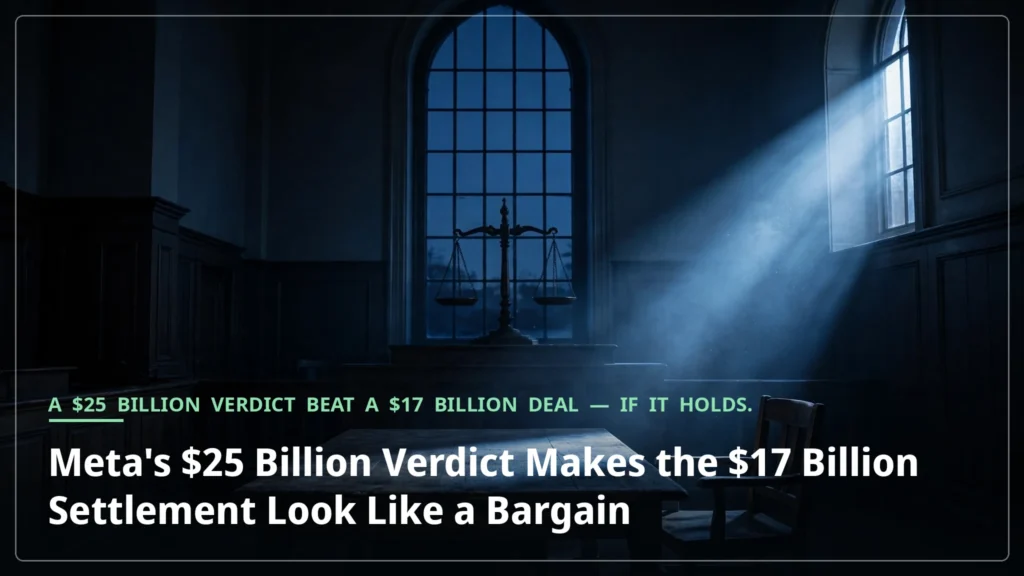


Last week, a judge in New Mexico ordered Meta to pay $25 billion. The Meta $25 billion verdict was, by any measure, an extraordinary number — and it immediately made another number look small: the $17 billion that attorneys general from across the United States accepted this summer to settle similar claims against the company.
The gap between the two figures is now the most uncomfortable question in American consumer-protection law: did the states that settled sell too cheap?
A jury, a judge, and a $219 billion starting point
In September 2026, a New Mexico jury ruled that Meta had misled consumers over how it protected their data and how it prevented misinformation and hate speech on its platforms. The case traced back to a 2021 complaint, filed after revelations that Cambridge Analytica had harvested data from millions of Facebook accounts to target political messages to voters ahead of Donald Trump’s first election.
The penalty phase is where the numbers turned vertiginous. The penalty order covers more than 43 million violations of New Mexico’s unfair practices law. At $5,000 per violation — the highest penalty the law allows — the initial calculation produced total civil penalties exceeding $219 billion, before the judge reduced the figure to $25 billion. The judge cited the extraordinary number of willful violations, the duration and repetition of the conduct, the breadth of subjects on which violations occurred, and the involvement of senior Facebook leadership as justifying the highest penalty.
That is the arithmetic of a verdict: a per-violation price at the maximum the law allows, multiplied by a staggering count — producing a total above $219 billion that the judge then reduced to $25 billion.
The Meta $25 billion verdict and the deal everyone else took
This summer, attorneys general from across the country announced a $17 billion settlement with Meta, described at the time as unprecedented. Similar claims — that Meta misled users around the 2018 Cambridge Analytica scandal and related incidents — were resolved by that settlement with most other states.
New Mexico’s claims were not resolved by that settlement. They went to a jury instead, and the jury’s answer, plus the judge’s penalty order, produced a figure $8 billion larger than the settlement that covered most of the country.
What exactly the settling states gave up in exchange is one of the questions the verdict has reopened. The settlement was described as unprecedented when it was announced, but which claims the attorneys general waived — and whether anything they did not waive is still available to them — remains an open question in the reporting behind this story. Keller’s expectation is that they will now go looking for what is left; whether they find anything is unanswered.
That is the comparison now hanging over every attorney general who signed the summer deal. Daphne Keller, director of platform regulation at the Stanford Program in Law, Science & Technology, put it plainly: the settling attorneys general, she said, are “going to look at this and maybe experience some regret for all the claims that they waived” — and start looking for whatever they did not waive.
The comparison has limits — and Meta knows it
The comparison is not as clean as the two numbers make it look. The $25 billion prices more than 43 million violations of New Mexico’s own unfair practices law. The $17 billion settlement covered other states’ claims, under other states’ laws, with different violations and different leverage. A verdict is also not a settlement: the settling states took guaranteed money, while New Mexico’s payout is still uncertain and will have to survive years of appeals.
Meta, for its part, is confident it will not have to pay anything like $25 billion. Chief legal officer C.J. Mahoney said the company is “confident we will prevail on appeal” and called New Mexico’s lawsuit an attempt to impose “a tax on speech”. He also said the penalty “makes it all but impossible to do business in the state of New Mexico”.
The judge has already cut the figure once — from more than $219 billion to $25 billion. An appeals court could cut it again, or erase it. The settling states, whatever their regrets, banked a negotiated sum. New Mexico is still waiting on its.
That uncertainty is worth keeping in view. The verdict’s cash value is unproven until the appeal is decided, and the history of this case so far is a history of very large numbers getting smaller. What the record does show, whatever the appeal decides, is that a jury found Meta misled consumers — and that the judge cited willful violations when calculating penalties at the maximum $5,000 per violation, before reducing the total from more than $219 billion to $25 billion.
Blood in the water

What the verdict does to other cases is still an open question. Keller’s other observation was about the parties still in the fight: the verdict, she said, is “very encouraging and will make them hopeful that continuing to litigate aggressively will lead to a big payout”. Individuals, school districts and tribes with outstanding claims against Meta may now see reason to hold out for trial rather than take a deal — but whether they actually do, and at what price, is unanswered.
That is the possible aftershock of the New Mexico verdict. The $17 billion settlement was set by negotiation; the $25 billion figure was set by a jury and a judge. The two amounts now sit side by side, and the second may shape what future negotiations with Meta start from — if it survives appeal.
Whether that figure survives appeal is an open question. Whether the settling states waived claims they now wish they had kept is an open question. What the record does show is the tradeoff at the heart of it: the settling states took certainty at $17 billion, while New Mexico holds a larger number — $25 billion — that is still unresolved.