
On October 23, an X user who goes by @log4j posted about an OpenAI account ban: OpenAI had deactivated his account over local reverse-engineering work. He says he never used OpenAI to exploit systems or find vulnerabilities — only local reverse engineering, which he says tripped “daybreak”. He put the cost at $500 and a stack of banked resets, and wrote that it motivated him to get three more machines and finish a cluster.
He also posted a screenshot of an email from OpenAI. It begins with the news that his account has been deactivated because recent activity violated the company’s Terms and Usage Policies — and then the reason is cut off, mid-sentence, in the image. The post has drawn 12,200 likes and 360 replies. OpenAI has not commented on the case, and nothing beyond @log4j’s account establishes why the account was closed.
That gap — between a public claim and a silent company — is where the story lives.
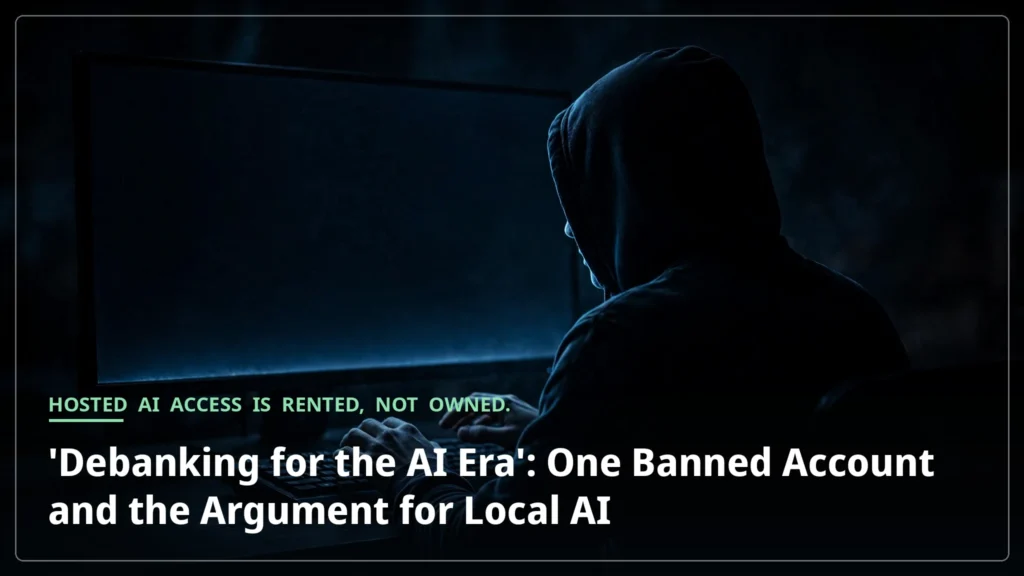
“Debanking for the AI era”

The response that followed did not come from @log4j himself, but from the people who read his post and answered it in public.
@bayeslord, quote-posting the ban on October 24, called it “debanking for the AI era”. “They can lobotomize you without due process,” he wrote, while acknowledging that the safety concerns are legitimate and calling the current system broken.
@beffjezos argued that open-source and local AI are a counterbalance: “The importance of open source and local AI as a counter balance is dawning on people.”
By the time Digg aggregated the conversation, it counted 14 sources, 86,600 combined views and 1,300 likes, with 81.3% of the sentiment-bearing replies running negative toward OpenAI.
What we actually know — and what we don’t
The first thing to say plainly is that the cause of the ban is unconfirmed. Digg’s own report stresses it: the restriction and its cause remain @log4j’s account, not an explanation from OpenAI. Runtime Wire, which covered the claim on October 23, is equally careful, noting that both the closure and its stated reason rest on the user’s account alone.
Some of the details circulating with the story are not in @log4j’s post at all. Commenters have characterised the reason as “Cyber Abuse” — an unconfirmed characterisation, not a stated deactivation reason — and the email screenshot cuts off before the reason. And the version of the story in which @log4j was reverse-engineering his Samsung TV to investigate targeted ads comes from other accounts, not from @log4j’s post: Digg explicitly notes that his post did not identify a TV. A newsletter retelling (dunlap.today) describes a 2025 Samsung TV teardown that found always-on microphone features and content recognition, with the ban following two days later — but that telling is secondary, and the TV detail’s origin in @log4j’s own words is unresolved.
None of this means the ban didn’t happen, or that @log4j is wrong about why. It means the public record contains a claim, a screenshot with the key line cut off, and silence from the company that could settle it.
What “daybreak” is

The one word in @log4j’s post that does have a public definition is “daybreak”. Project Daybreak — also called Trusted Access for Cyber — is OpenAI’s program for approved defensive cybersecurity work. It gives approved users access under two tiers, Blue and Red, for verified defensive work. The program’s rules limit that work to systems the user owns or operates, or has explicit permission to test or analyse.
That context cuts both ways. It means there is a sanctioned path for the kind of work @log4j says he was doing. It also means the program’s blocking classifiers are tuned to catch misuse — and OpenAI has said it is tuning them to mitigate potential misuse. Runtime Wire adds a wrinkle that matters: the user believes a Daybreak warning may have preceded the closure, and OpenAI’s published guidance says a safety-check notice alone does not establish a policy violation.
In other words, it is possible to trip a warning without violating a policy — and it is also possible that the warning and the ban are two separate events that look connected. The public record does not say which it was.
Is there anything to appeal?
Here the story gets more uncomfortable, because OpenAI does describe an appeal route. Its help centre says that if you believe your account was deactivated in error, you can appeal through the link in the email notification you received, or through an intake form if you cannot access that email. It also says subscriptions billed directly by OpenAI stop renewing when an account is banned, and the ban prevents you from using the account.
That is a real process. Whether @log4j used it, and what answer he got, is not in the public record. The sharper version of the complaint — made by @AnandNSharma in a reply — is not that no appeal exists, but that a ban with no stated rule leaves nothing to appeal: “If the ban comes with no stated rule, there’s nothing to appeal, and the lab can’t tell afterwards whether the classifier was right either.”
The distinction matters. If that is right, an appeal against an unstated reason is an appeal against a blank page.
Why the OpenAI account ban landed so hard
Part of the answer is who @log4j is to the people reading: a tinkerer and a reverse engineer. @BSumariuk argued that bans for local reverse engineering push the people who would find a platform’s bugs toward local models. Whether that is what happens here — whether the people most likely to stress-test a system take their work somewhere the platform cannot reach them — is an open question the case does not answer.
Part of it is the money. Five hundred dollars is not a fortune, but it is real — and the banked resets, the subscription that stops renewing, the account that cannot be used, are the shape of a real loss.
And part of it is that the local-AI argument was already loaded and waiting. The ban did not create the open-models movement; it handed it a parable. Is the story’s power that it confirms what its audience already believed? If so, that is also the reason to be careful with it.
The steelmanned case for OpenAI is straightforward. The company has a legitimate interest in enforcing its terms: if a classifier flagged activity that looked like cyber abuse, the ban may have been correct, and @log4j’s own framing is self-serving — the deactivation email cites Terms and Usage Policies violations, and no one outside OpenAI has seen the full record. One user’s account is not a systemic story, and a single deactivation, even a harsh one, does not prove a pattern of “debanking”. The local-AI chorus is a pre-existing movement seizing a convenient anecdote, not necessarily a response caused by this ban.
All of that may be true. It does not answer the question the thread is actually asking: when the account goes, what recourse does the person behind it have — and who decides whether the classifier was right?
Hosted AI access is rented, not owned. One deactivation cost @log4j the $500 and banked resets he says he lost, with no public explanation from OpenAI. The open question is not whether OpenAI may enforce its terms — it may — but whether the people building on rented intelligence will keep accepting access that can be switched off with no public explanation from the company. Until OpenAI says what happened here, the argument will keep making itself — one local model at a time.