

Connecting an AI agent to a system you already run is less about the model and more about the interface between them. This guide to AI agent API integration walks through that interface in order: what the agent actually receives, how to map the APIs you already have, which integration pattern fits, how to design tools the agent can use reliably, and how to keep the whole thing safe and observable once it is live. Done well, the agent becomes a careful user of your existing systems. Done badly, it becomes an unreviewed user with broad permissions and no audit trail.
What integrating an agent with an API actually means
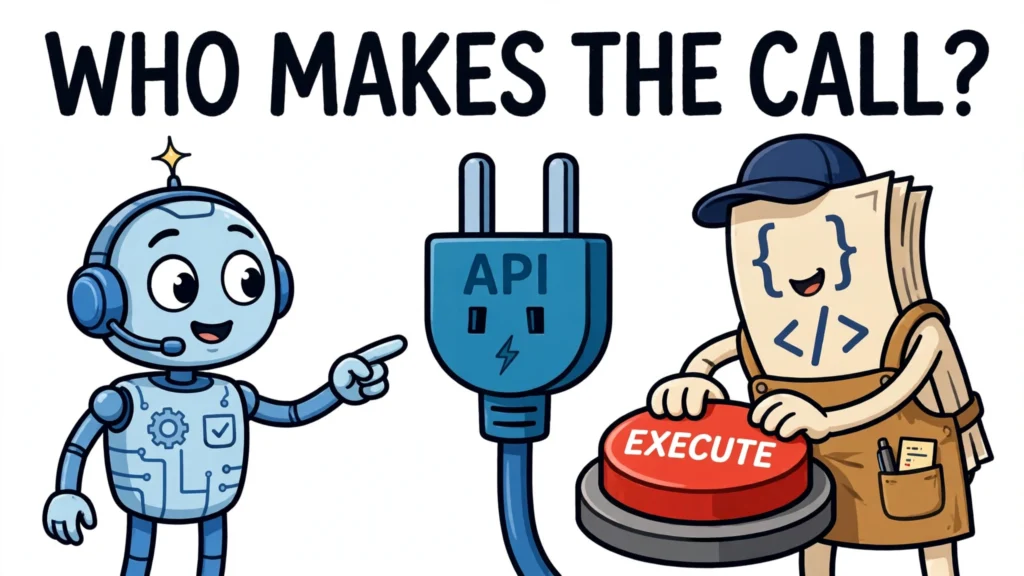
An agent does not call your API directly in the way application code does. It works in a loop: it plans, proposes a structured tool call, waits while your code executes that call, reads the result, and decides what to do next. Function calling, also called tool calling, is the mechanism that makes this possible. You describe functions the model may use, the model responds with a structured request to invoke one, your code executes it, and the result flows back into the conversation.
That distinction matters. A tool is a description, not a function. In this tool-calling mechanism, the tool definition describes the callable interface, while application code executes the implementation: you send a name, a description and a JSON Schema for the arguments, and the model outputs a structured object claiming which tool to call and with what arguments. Nothing executes until your code says so. The agent also does not get anything automatically: it does not inherit authentication, rate-limit awareness, transactions or business rules from your API. Every one of those must be designed into the integration, because the model only sees your tools through their definitions, and vague descriptions produce vague choices.
Map the existing APIs before you build
Resist the urge to expose an entire API to an agent. Start with an inventory of the endpoints the agent genuinely needs for its task, and leave the rest unexposed. For each endpoint, record its authentication method, pagination behaviour, rate limits, error codes and side effects. A read-only lookup and an endpoint that creates a charge, deletes a record or sends a message are not equivalent, and they should not be treated as equivalent in the toolset.
Pay particular attention to stateful and irreversible operations. An endpoint that moves money, changes a booking or publishes content needs extra guardrails before an agent can reach it, such as approval or a narrower scope. Also note where an API is asynchronous, paginated or partially failing, because the agent will need a way to wait, page through results or recover from a partial response. This inventory becomes the contract for everything that follows: the integration pattern, the tool definitions and the permissions all derive from it, rather than from whatever the API happens to offer.
Choose an integration pattern

There are three common patterns, and the choice depends on how much control you need. The simplest is direct function calling: you define a small set of functions against your API, your code executes them, and results return to the model. This fits a small, stable endpoint set where you control both sides and the tool surface is unlikely to grow.
The second pattern is a tool or gateway layer that wraps the API. The gateway presents a curated toolset, enforces policy, injects credentials and logs calls, so the agent never talks to the raw API directly. This is the right choice when several agents share an API, when policy must be enforced consistently, or when the raw API exposes more than the agent should see. The third pattern is a standard tool protocol. The Model Context Protocol, or MCP, is an open protocol that standardises how applications provide tools and context to language models, in the same way a standard connector lets many devices share one port. MCP lets an agent discover tools from a server and reuse them across agents, editors and other clients, and it supports OAuth or token-based authorisation around external tool access. Use it when you want reuse across clients or when the service you need already exposes an MCP endpoint. Finally, remember the fourth option: keep the agent out entirely. A step that must run deterministically, such as a calculation or a strict validation, belongs in code, not in a model call.
Expose the API as well-designed tools
Tool design decides whether the agent calls the right endpoint with the right arguments. A definition has three parts: a name, a natural-language description and a JSON Schema for the arguments. Give each tool one meaningful action, a precise name, and a description that says when to use it, not just what it does. Keep arguments minimal and typed, and require the fields that are genuinely required.
Keep the number of initially available functions small, because accuracy falls as the tool surface grows. When an application has many functions or large schemas, tool search can defer rarely used tools and load them only when the model needs them. Results matter as much as definitions: return concise, structured results containing the fields the model needs to decide its next step, not a large dump it must sift through. Version and document tools like an API contract, because the agent depends on their exact shape, and a silent change to a schema can break every workflow that uses it. Validate arguments in application code before executing a requested API operation, even when a platform also offers schema checks.
Authenticate, scope and secure the connection
Authentication for an agent should follow the same least-privilege rule as any other integration, with one addition: the agent’s identity must be separate from the human user’s. Give the agent its own scoped credentials, bound to the task and the user it serves, and never pass raw credentials through prompts, tool results or logs. OpenAI’s MCP guidance makes the same point for protocol-based tools: connect only to servers you trust, use least-privilege credentials, keep access tokens in authorisation headers rather than URLs, and require approval for sensitive operations.
Scope is where most integrations fail. An agent that only reads invoices should never hold a token that can also write them, and a token for one tool server should not reach another system. MCP servers can expose data and perform actions with the credentials you provide, so a server you do not trust should never receive a powerful credential. Where possible, issue short-lived, task-scoped tokens and rotate them, and enforce the permission check in your code or gateway, not in the prompt. The model proposes; your code authorises. That separation is what keeps a mistaken or manipulated tool call from becoming an unauthorised action.
Handle errors, retries, limits and long-running work
Real APIs fail, throttle and take time, and an agent integration must handle all three. Start by classifying errors. A validation error may mean the arguments were wrong: inspect the API error details and documented contract to determine the cause, correct the arguments if that is the cause, and do not blindly retry. A permission error may mean the scope is insufficient: inspect the API error details and documented contract to determine the cause, and escalate rather than working around it if scope is the cause. A rate-limit error, signalled by HTTP 429, means the client should pause, honour any Retry-After header, and retry with exponential backoff and jitter rather than retrying immediately in a loop.
For operations whose retries could duplicate side effects, and where the API supports that mechanism, use idempotency keys to make retries safe. For such operations, retrying without an idempotency key after a timeout risks running the operation twice. Stripe’s pattern is the standard example: clients send an Idempotency-Key header, the first request with a key executes and stores its result for 24 hours, and retries with the same key return the cached result instead of charging twice. Generate the key before the request goes out and store it with the operation, so a crash mid-request does not lose the protection. For long-running work, do not let the agent poll blindly: use explicit status checks, timeouts and pagination limits, and return partial results with a clear indication of what is missing, so the agent can decide whether to wait, continue or escalate.
Test, observe and roll out gradually
Test each tool in isolation first, then test full multi-step workflows against a staging API. A tool that works alone can still fail in a workflow when its result feeds a later call, so workflow tests should cover the realistic sequence, including an error in the middle of it. Build a small evaluation set of cases the agent must handle, and rerun it whenever prompts, schemas or models change, because a change to any of those can change which tool the agent chooses.
Observation is what makes a rollout safe. Log every tool call with its arguments and results, and monitor error rates, cost and unusual actions, such as a sudden burst of calls or access to a tool the agent rarely uses. Roll out with human approval on consequential actions first, and loosen controls only when the evidence supports it. The common mistakes are predictable: exposing every endpoint, granting over-broad permissions, silently retrying writes, and letting the agent choose arguments that nobody reviews. Each of them can be checked before launch, and each check is cheaper than the incident it prevents.
A checklist for AI agent API integration
AI agent API integration succeeds when it is treated as an interface design problem, not a model problem. Inventory the APIs and their side effects. Choose a pattern that matches how much control you need, from direct function calling to a gateway to a standard protocol such as MCP. Design tools with precise names, descriptions and typed schemas, and keep the initial toolset small. Authenticate the agent separately, scope its credentials per tool, and enforce authorisation in code. Handle errors by class, for operations whose retries could duplicate side effects and whose API supports idempotency keys, retry writes with idempotency keys, following the endpoint contract, and respect rate limits with backoff and jitter. Test tools and workflows, log every call, and roll out gradually with approval on consequential actions. Follow that sequence, and the agent you deploy will be a disciplined user of systems you already trust.