


It looks like it escaped from Night City. It starts at $20,000, it will be built in a run of just 250, and the man who rode it came away awestruck. Real Motors Project Ares is the first motorcycle from a tiny Greenville, South Carolina startup, and it is, by the evidence of its first ride, two machines at once: a cyberpunk fantasy in the flesh, and a heavy cruiser underneath.
That gap is the story: a startup founded by two people on a challenge to build the coolest possible thing, and a ride the reviewer puts largely down to today’s batteries.
The coolest possible thing
Real Motors began, by its own account, as a challenge. CEO and cofounder Trent Dingman told The Verge’s Tim Stevens that he and Michael Feng, the company’s design engineer and other cofounder, set out to “build the coolest possible thing, the best design, and show people what we can do.” Project Ares is the first coolest possible thing: an all-electric motorcycle designed and built in Greenville, right in the heart of the battery belt, not far from BMW, Scout Motors, Volvo, and Redwood Materials.
That framing matters: the founders’ challenge was design first — build the coolest possible thing and show people what they can do. The Ares is what that challenge produced, and the gap between its shape and its ride is the question the review leaves open.
Ghost in the machine
 high-voltage lines around the battery pack” class=”wp-image-3051″/>
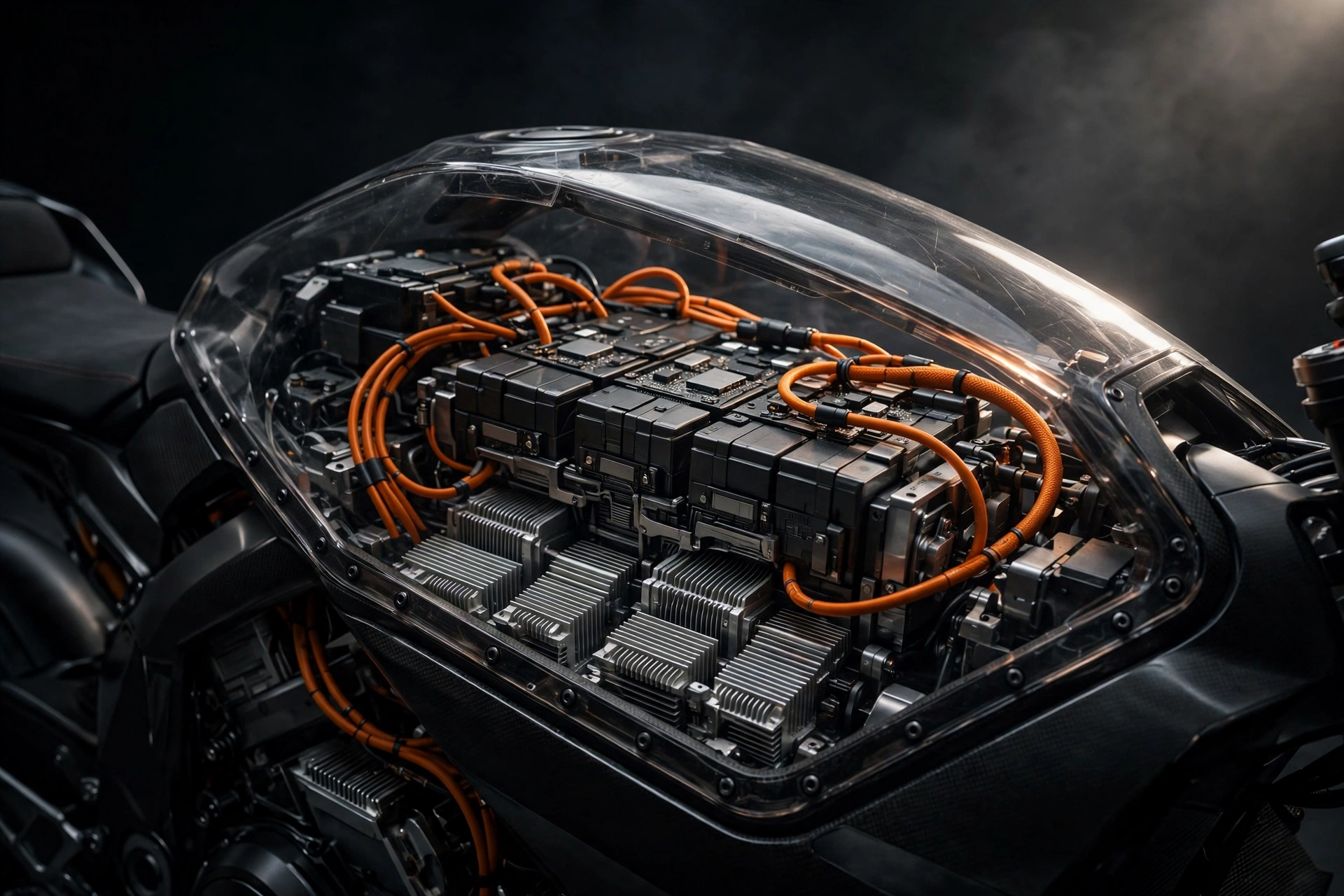
The bike Stevens rode was Prototype 04, nicknamed “Ghost.” Its fairing turns translucent, revealing the charger’s cooling vanes inside where the tank would be and bright orange high-voltage lines snaking around the battery pack — the engineering on display, not hidden.
The numbers need translating before they mean anything. The motor is officially rated at 101 horsepower and 738 pound-feet of torque — but that figure is measured at the rear wheel, after gearing. Most motorcycles quote torque at the output shaft. Measured the same way, Stevens estimates, the actual output is probably closer to 200 pound-feet — still, as he puts it, among the strongest twisting motorcycles on the planet.
The battery pack will be roughly 15 kilowatt-hours — the figure is not finalized, and the current listing gives 12 to 15 — charging at up to 3.3 kilowatts over a standard SAE J1772 port on top of the “tank.” The whole machine weighs 485 pounds: right in line with Zero Motorcycles’ SR/F, which has similar power and battery size, and nearly an inch and a half longer than the Zero; nearly 100 pounds more than a Ducati Panigale V4, with a wheelbase roughly three-quarters of an inch longer. Seat height is 33 inches.
What Real Motors Project Ares feels like
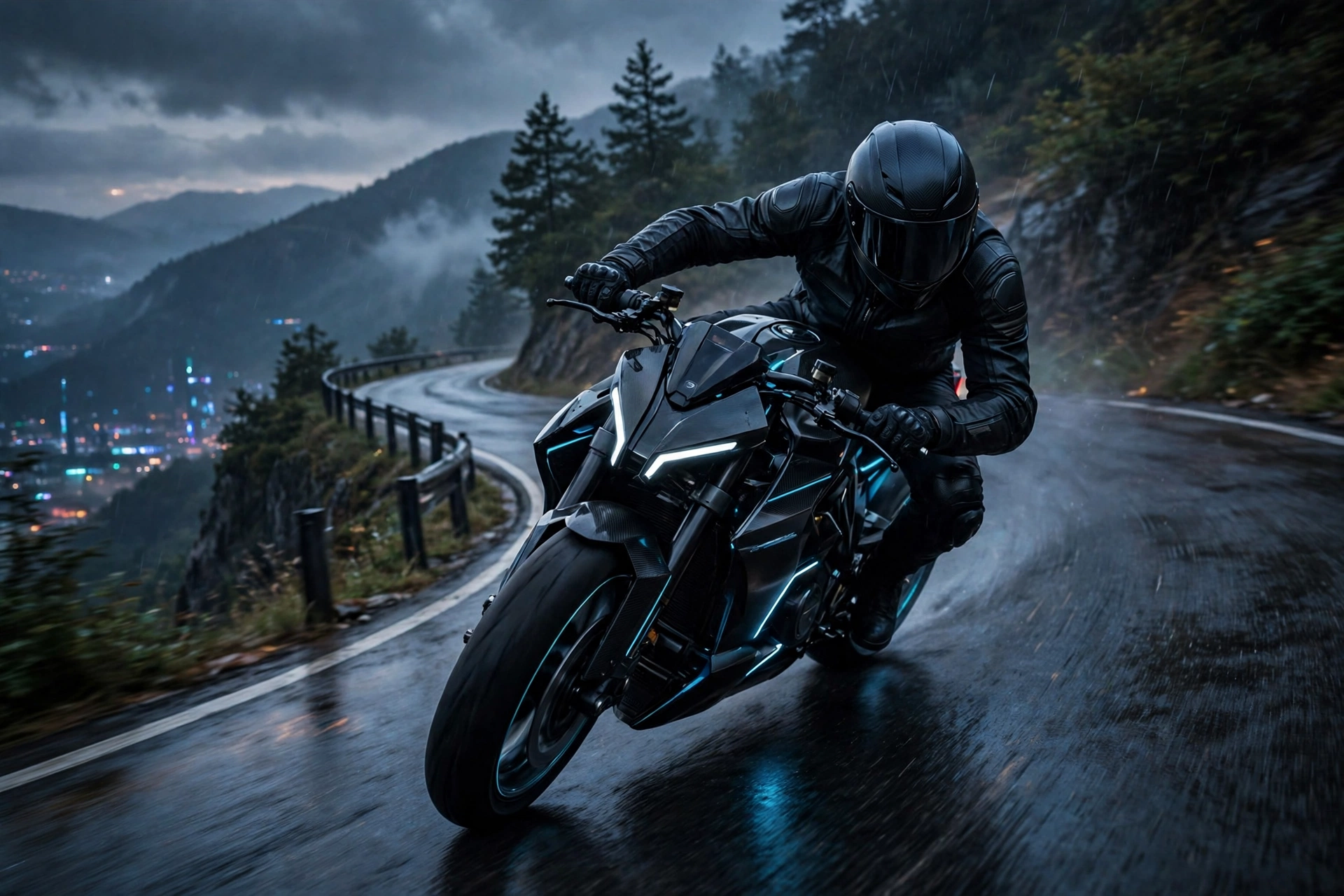
The riding position delivers a cafe racer: the bars are set low, putting chest and head down close to the translucent tank, the pegs are up high for cornering clearance, in the classic posture. The Ares has a wide saddle hinting at the mass beneath. That aggressive geometry plus its weight made for a somewhat wobbly start, Stevens writes, before he was quickly up to speed.
The prototype lacked mirrors, which Stevens describes as a choice prioritizing aesthetics over safety, and there is only a minimalist LCD in front of the rider. The bike has three speed settings, and Dingman warned Stevens before the ride that it had neither traction control nor antilock braking. Power delivery is smooth, with no abrupt lurching, and the bike is easy to manage even in its most aggressive setting.
Stevens had expected a razor-sharp racing machine, but the Ares takes a bit of muscle to turn. The feeling is, as Stevens writes, “more of a cruiser than a sportbike. A cruiser with extremely sporty components, though.” Buyers can spec top-shelf Öhlins dampers if they like, and Brembo brakes are also on offer.
The shape and the battery
So it is a heavier, more intentional ride than its cafe racer style and ergonomics may imply. Stevens puts much of that down to today’s battery technology: “the blame for much of that lies in today’s battery technology,” he writes.
That attribution is worth keeping exactly as he made it — much of the heavier ride, not all of it. The mirrors were left off for the look and the safety electronics are absent, but whether the production bike gains them is still unanswered, and one outlet’s “deliberately analog” label is its own characterization, not the company’s stated intent. What the evidence supports is narrower: the design was the choice, and the reviewer puts much of the heavier ride down to the batteries. How much is battery and how much is choice is the question the production bike will have to answer.
Two hundred and fifty of them
The commercial shape of the bet is as deliberate as the design. Lot 01, the first production run, is capped at 250 motorcycles worldwide at $20,000, with reservations open on a fully refundable $500 deposit. North American deliveries are expected in early 2027, with European and Gulf deliveries in the first quarter of 2027 after homologation. The October press release listed a 65-kilowatt permanent-magnet synchronous motor and a 13.4-kilowatt-hour battery; the company’s current listing shows a 75-kilowatt drive, a 12 to 15 kilowatt-hour battery, and a claimed top speed of 120 mph. A Founder’s Edition is listed with a 75-kilowatt system, a 15-kilowatt-hour battery, and a 192 km/h maximum.
The team has grown beyond its two founders. Vance Strader, the former LiveWire chief technology officer, has joined to drive the project, and Circle Engineering brings expertise rooted in the former Energica operation, the Italian electric-motorcycle maker associated with MotoE competition. The bike has evolved substantially since its first public versions appeared in 2024, and Real Motors exhibited Lot 01 at the Barber Vintage Festival in Alabama in October.
What none of the reporting establishes is who is reserving one of 250 — collectors, design fans, or riders — or what Real Motors does after Lot 01. The final production specifications remain unresolved. And the range question hangs over all of it: the spec sheet lists 120 miles in the city, and Stevens did not come close to that efficiency on a hard-ridden pre-production day — though he is the first to say lots could change, and he spent much of the day with the throttle pinned open. Stevens doubts the bike will break the pattern of electric motorcycles missing their range estimates when ridden hard and at speed.
Even so, he closes, Project Ares is already fast, fun, and astonishingly good looking. “While the world of motorcycling may be evolving, style still counts for a lot.” For a $20,000 motorcycle from a first-time maker, that is the honest verdict: the shape is real, the ride is heavier than the shape, and the question of what the money buys — the shape, or the ride — is still open. The first 250 buyers will answer it.